Food Chemistry Unit, Department of Chemistry and Pharmacy, Emil Fischer Center, Friedrich-Alexander Universität Erlangen-Nürnberg Erlangen, Germany.
Institute of Experimental and Clinical Pharmacology and Toxicology, Emil Fischer Center, Friedrich-Alexander Universität Erlangen-Nürnberg Erlangen, Germany.
Front Psychol. 2014 Mar 31;5:250. doi: 10.3389/fpsyg.2014.00250. eCollection 2014.
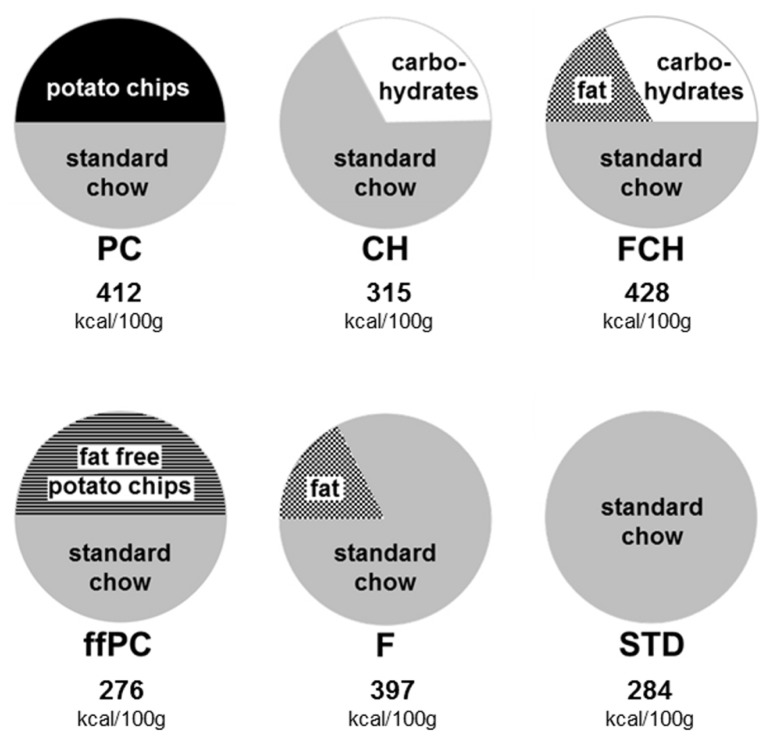
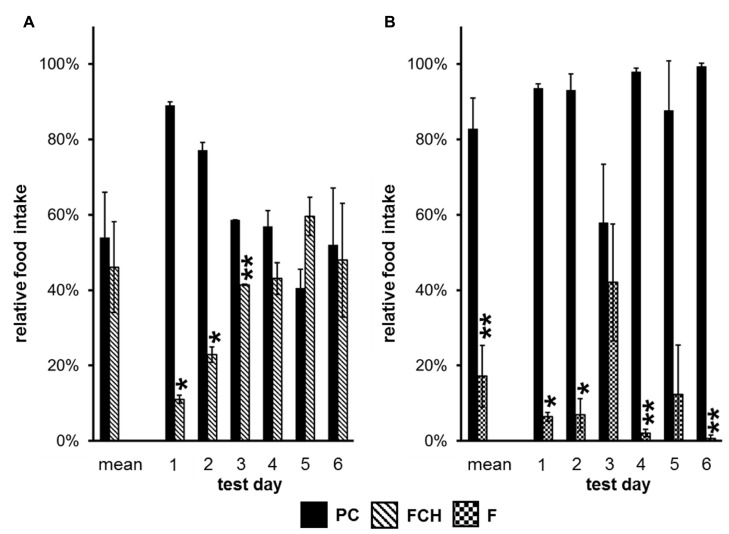
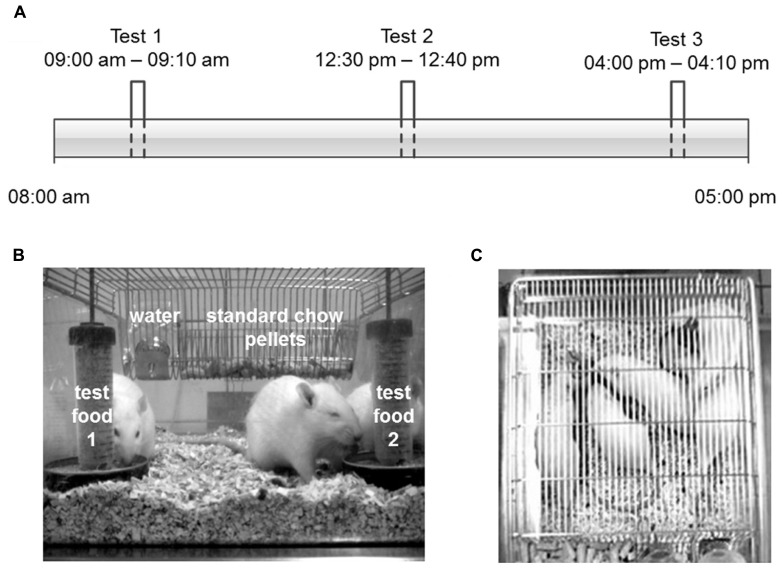
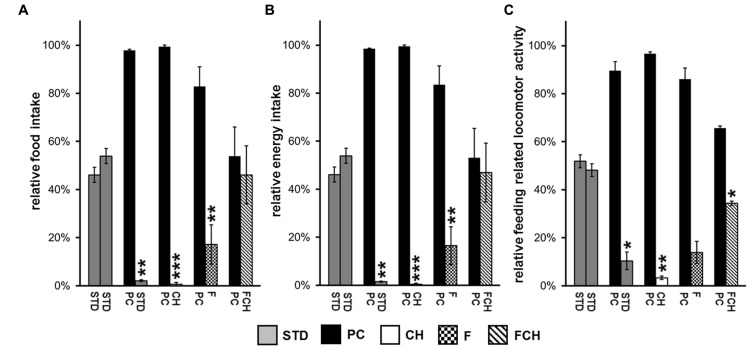
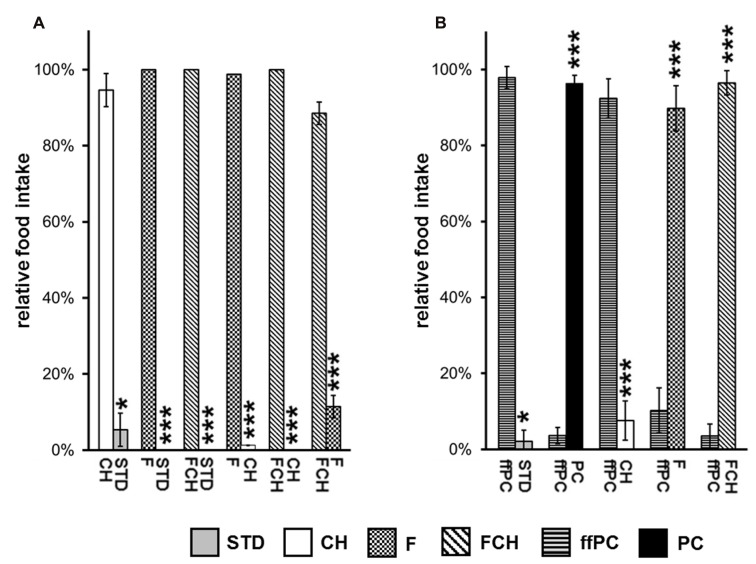
Snack food like potato chips substantially contributes to energy intake in humans. In contrast to basic food, snacks are consumed additionally to other meals and may thereby lead to non-homeostatic energy intake. Snack food is also frequently associated with hedonic hyperphagia, a food intake independent from hunger. Analysis of brain activity patterns by manganese-enhanced MRI has previously revealed that the intake of potato chips in ad libitum fed rats strongly activates the reward system of the rat brain, which may lead to hedonic hyperphagia. The purpose of the present study was to develop a two-choice preference test to identify molecular determinants of snack food triggering extra food intake in ad libitum fed rats. Different kinds of test food were presented three times a day for 10 min each time. To minimize the influence of organoleptic properties, each test food was applied in a homogenous mixture with standard chow. Food intake as well as food intake-related locomotor activity were analyzed to evaluate the effects induced by the test foods in the two-choice preference test. In summary, fat (F), carbohydrates (CH), and a mixture of fat and carbohydrates (FCH) led to a higher food intake compared to standard chow. Notably, potato chip test food (PC) was highly significantly preferred over standard chow (STD) and also over their single main macronutrients F and CH. Only FCH induced an intake comparable to PC. Despite its low energy density, fat-free potato chip test food (ffPC) was also significantly preferred over STD and CH, but not over F, FCH, and PC. Thus, it can be concluded that the combination of fat and carbohydrates is a major molecular determinant of potato chips triggering hedonic hyperphagia. The applied two-choice preference test will facilitate future studies on stimulating and suppressive effects of other food components on non-homeostatic food intake.
零食,如薯片,在人类的能量摄入中占有相当大的比重。与基本食物不同,零食是在其他餐食之外额外摄入的,可能导致非稳态能量摄入。零食还常常与享乐性多食症有关,即一种与饥饿无关的食物摄入。通过锰增强磁共振成像对大脑活动模式的分析表明,在自由进食的大鼠中摄入薯片强烈激活了大鼠大脑的奖励系统,这可能导致享乐性多食症。本研究的目的是开发一种二选一偏好测试,以确定引发自由进食大鼠额外食物摄入的零食的分子决定因素。不同种类的测试食物每天呈现三次,每次持续 10 分钟。为了最小化感官特性的影响,每种测试食物都与标准饲料均匀混合使用。分析食物摄入量以及与食物摄入相关的运动活动,以评估测试食物在二选一偏好测试中引起的影响。总的来说,脂肪(F)、碳水化合物(CH)和脂肪与碳水化合物的混合物(FCH)的食物摄入量明显高于标准饲料。值得注意的是,薯片测试食物(PC)明显优先于标准饲料(STD),也优先于它们的主要单一宏量营养素 F 和 CH。只有 FCH 诱导的摄入量与 PC 相当。尽管其能量密度低,但无脂薯片测试食物(ffPC)也明显优先于 STD 和 CH,但不优先于 F、FCH 和 PC。因此,可以得出结论,脂肪和碳水化合物的组合是薯片引发享乐性多食症的主要分子决定因素。所应用的二选一偏好测试将有助于未来研究其他食物成分对非稳态食物摄入的刺激和抑制作用。