Institute of Clinical Pharmacology, Goethe - University, Frankfurt am Main, Germany.
Institute of Clinical Pharmacology, Goethe - University, Frankfurt am Main, Germany; Fraunhofer Institute of Molecular Biology and Applied Ecology - Project Group Translational Medcine and Pharmacology (IME-TMP), Frankfurt am Main, Germany.
PLoS One. 2014 Apr 21;9(4):e95592. doi: 10.1371/journal.pone.0095592. eCollection 2014.
TRPA1 ion channels are involved in nociception and are also excited by pungent odorous substances. Based on reported associations of TRPA1 genetics with increased sensitivity to thermal pain stimuli, we therefore hypothesized that this association also exists for increased olfactory sensitivity.
Olfactory function and nociception was compared between carriers (n = 38) and non-carriers (n = 43) of TRPA1 variant rs11988795 G>A, a variant known to enhance cold pain perception. Olfactory function was quantified by assessing the odor threshold, odor discrimination and odor identification, and by applying 200-ms pulses of H2S intranasal. Nociception was assessed by measuring pain thresholds to experimental nociceptive stimuli (blunt pressure, electrical stimuli, cold and heat stimuli, and 200-ms intranasal pulses of CO2).
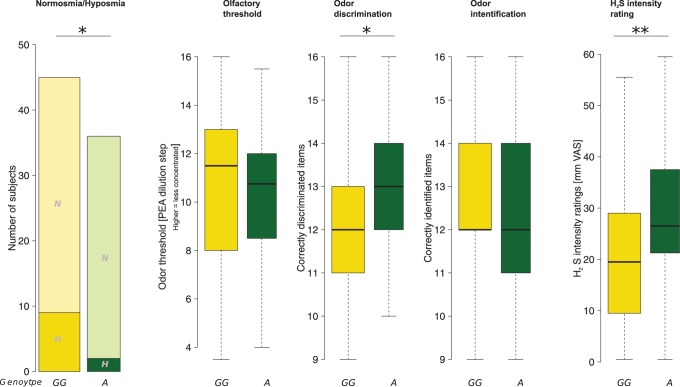
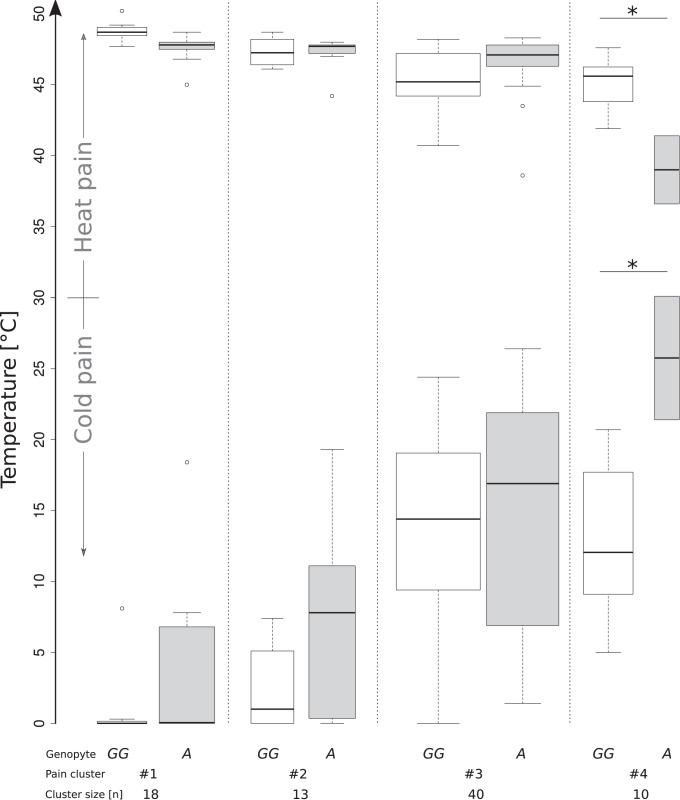
Among the 11 subjects with moderate hyposmia, carriers of the minor A allele (n = 2) were underrepresented (34 carriers among the 70 normosmic subjects; p = 0.049). Moreover, carriers of the A allele discriminated odors significantly better than non-carriers (13.1±1.5 versus 12.3±1.6 correct discriminations) and indicated a higher intensity of the H2S stimuli (29.2±13.2 versus 21±12.8 mm VAS, p = 0.006), which, however, could not be excluded to have involved a trigeminal component during stimulation. Finally, the increased sensitivity to thermal pain could be reproduced.
The findings are in line with a previous association of a human TRPA1 variant with nociceptive parameters and extend the association to the perception of odorants. However, this addresses mainly those stimulants that involve a trigeminal component whereas a pure olfactory effect may remain disputable. Nevertheless, findings suggest that future TRPA1 modulating drugs may modify the perception of odorants.
TRPA1 离子通道参与痛觉感受,也可被刺鼻气味物质激活。基于 TRPA1 基因与热痛觉刺激敏感性增加的相关报道,我们假设这种关联也存在于嗅觉敏感性增加的情况中。
我们比较了携带 TRPA1 变体 rs11988795 G>A(已知可增强冷觉痛觉感知的变体)的携带者(n=38)和非携带者(n=43)的嗅觉功能和痛觉感受。通过评估气味阈值、气味辨别和气味识别,以及应用 200ms 的 H2S 鼻内脉冲来量化嗅觉功能。通过测量实验性痛觉刺激(钝压、电刺激、冷和热刺激,以及 200ms 的 CO2 鼻内脉冲)的疼痛阈值来评估痛觉感受。
在 11 名嗅觉中度减退的受试者中,携带 minor A 等位基因的个体(n=2)数量较少(70 名嗅觉正常的受试者中有 34 名携带者;p=0.049)。此外,与非携带者相比,A 等位基因携带者对气味的辨别能力显著提高(13.1±1.5 与 12.3±1.6 次正确辨别),并对 H2S 刺激的强度有更高的感知(29.2±13.2 与 21±12.8mm VAS,p=0.006),然而,在刺激过程中,这种差异可能涉及三叉神经成分。最后,我们重现了对热痛觉的敏感性增加。
这些发现与之前人类 TRPA1 变体与痛觉参数的关联一致,并将这种关联扩展到对气味的感知。然而,这主要涉及到那些涉及三叉神经成分的刺激物,而纯嗅觉效应可能仍有争议。尽管如此,这些发现表明,未来的 TRPA1 调节药物可能会改变对气味的感知。