Institute of Clinical Pharmacology, Goethe-University, Frankfurt am Main, Germany.
Fraunhofer Institute for Molecular Biology and Applied Ecology IME, Project Group Translational Medicine and Pharmacology TMP, Frankfurt am Main, Germany.
Pain. 2018 Jul;159(7):1366-1381. doi: 10.1097/j.pain.0000000000001222.
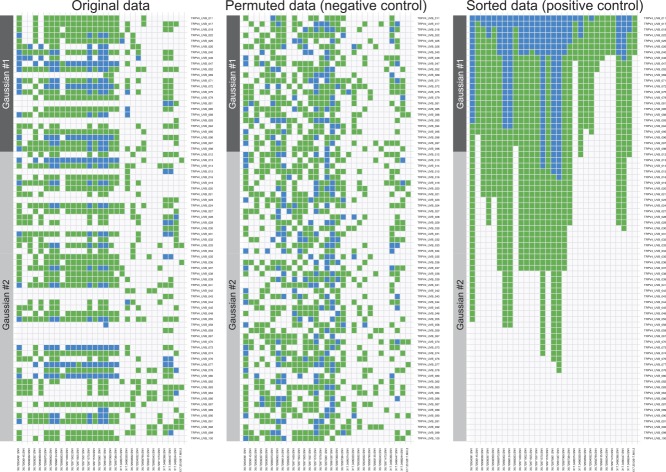
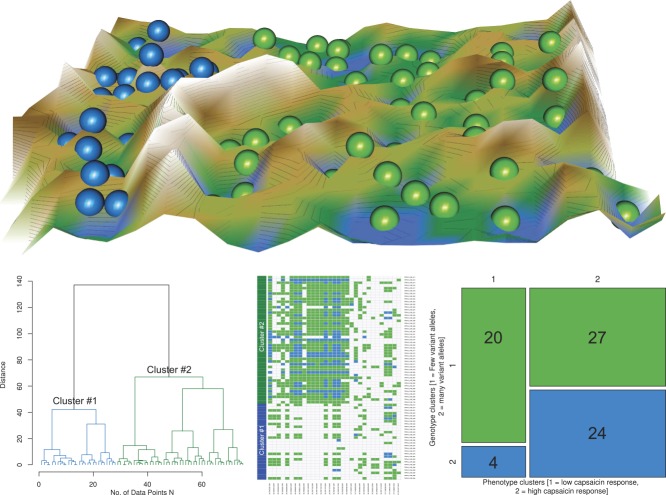
Heat pain and its modulation by capsaicin varies among subjects in experimental and clinical settings. A plausible cause is a genetic component, of which TRPV1 ion channels, by their response to both heat and capsaicin, are primary candidates. However, TRPA1 channels can heterodimerize with TRPV1 channels and carry genetic variants reported to modulate heat pain sensitivity. To address the role of these candidate genes in capsaicin-induced hypersensitization to heat, pain thresholds acquired before and after topical application of capsaicin and TRPA1/TRPV1 exomic sequences derived by next-generation sequencing were assessed in n = 75 healthy volunteers and the genetic information comprised 278 loci. Gaussian mixture modeling indicated 2 phenotype groups with high or low capsaicin-induced hypersensitization to heat. Unsupervised machine learning implemented as swarm-based clustering hinted at differences in the genetic pattern between these phenotype groups. Several methods of supervised machine learning implemented as random forests, adaptive boosting, k-nearest neighbors, naive Bayes, support vector machines, and for comparison, binary logistic regression predicted the phenotype group association consistently better when based on the observed genotypes than when using a random permutation of the exomic sequences. Of note, TRPA1 variants were more important for correct phenotype group association than TRPV1 variants. This indicates a role of the TRPA1 and TRPV1 next-generation sequencing-based genetic pattern in the modulation of the individual response to heat-related pain phenotypes. When considering earlier evidence that topical capsaicin can induce neuropathy-like quantitative sensory testing patterns in healthy subjects, implications for future analgesic treatments with transient receptor potential inhibitors arise.
在实验和临床环境中,热痛及其对辣椒素的调制在不同个体中存在差异。一个合理的原因是遗传因素,其中 TRPV1 离子通道因其对热和辣椒素的反应,是主要的候选者。然而,TRPA1 通道可以与 TRPV1 通道异二聚化,并携带被报道调节热痛敏感性的遗传变异体。为了研究这些候选基因在辣椒素诱导的热敏感化中的作用,在 75 名健康志愿者中评估了辣椒素和 TRPA1/TRPV1 外显子组序列经下一代测序获得的热痛阈值,并包含了 278 个基因座。高斯混合模型表明,有 2 个表型组存在对热的辣椒素诱导超敏反应高或低。未监督机器学习实现的基于群集的聚类暗示了这些表型组之间遗传模式的差异。几种监督机器学习方法,包括随机森林、自适应增强、k-最近邻、朴素贝叶斯、支持向量机和比较方法,二进制逻辑回归,当基于观察到的基因型而不是使用外显子序列的随机置换时,一致更好地预测表型组关联。值得注意的是,TRPA1 变体对于正确的表型组关联比 TRPV1 变体更为重要。这表明 TRPA1 和 TRPV1 基于下一代测序的遗传模式在调节个体对热相关疼痛表型的反应中起作用。当考虑到早期的证据表明局部辣椒素可以在健康受试者中诱导神经病变样定量感觉测试模式时,这对使用瞬时受体电位抑制剂的未来镇痛治疗产生了影响。