Yumoto Kenji, Eber Matthew R, Berry Janice E, Taichman Russell S, Shiozawa Yusuke
Authors' Affiliation: Department of Periodontics and Oral Medicine, University of Michigan School of Dentistry, Ann Arbor, Michigan.
Authors' Affiliation: Department of Periodontics and Oral Medicine, University of Michigan School of Dentistry, Ann Arbor, Michigan
Clin Cancer Res. 2014 Jul 1;20(13):3384-9. doi: 10.1158/1078-0432.CCR-13-0897. Epub 2014 Apr 22.
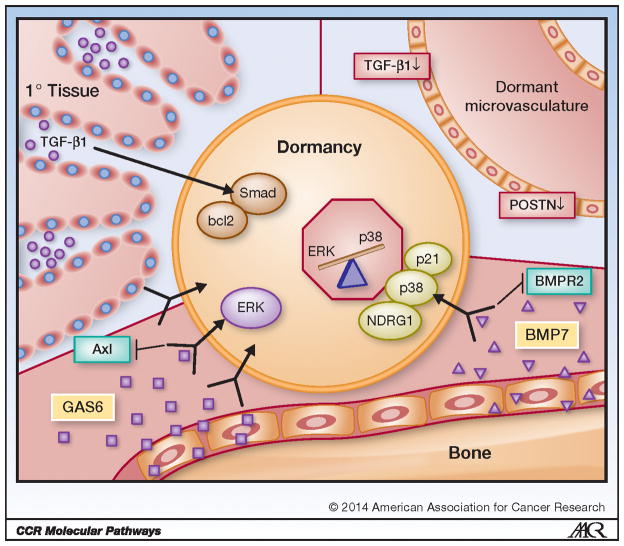
Despite the best available treatments for primary tumors, cancer can return, even after a long disease-free interval. During this period, cancer cells are believed to lie dormant in either primary sites, metastatic sites, or independent sites like bone marrow, effectively escaping adjuvant cytotoxic treatments. To date, little is known about how these cells transition to dormancy, or how they are reactivated if cancer recurs. Recent studies have revealed the effects of tumor microenvironment or niche on the regulation of tumor dormancy via the signaling pathways of growth arrest-specific 6, bone morphogenetic protein 7, and TGFβ1, and that the balance between activation of p38 MAPK and ERK MAPK plays a pivotal role in tumor dormancy. In this review, we discuss tumor dormancy from the perspective of the niche and consider potential therapeutic targets. Greater understanding of the mechanisms involved will help guide innovation in the care of patients with advanced cancer.
尽管针对原发性肿瘤有现有的最佳治疗方法,但癌症仍可能复发,即使在长时间无病期之后。在此期间,癌细胞被认为潜伏在原发部位、转移部位或骨髓等独立部位,有效地逃避了辅助性细胞毒性治疗。迄今为止,对于这些细胞如何进入休眠状态,或者如果癌症复发它们如何被重新激活,人们知之甚少。最近的研究揭示了肿瘤微环境或生态位通过生长停滞特异性6、骨形态发生蛋白7和转化生长因子β1的信号通路对肿瘤休眠调节的影响,并且p38丝裂原活化蛋白激酶(MAPK)和细胞外信号调节激酶(ERK)MAPK激活之间的平衡在肿瘤休眠中起关键作用。在这篇综述中,我们从生态位的角度讨论肿瘤休眠,并考虑潜在的治疗靶点。对所涉及机制的更深入理解将有助于指导晚期癌症患者护理方面的创新。