Gollo Leonardo L, Mirasso Claudio, Sporns Olaf, Breakspear Michael
Systems Neuroscience Group, QIMR Berghofer Medical Research Institute, Brisbane, Queensland, Australia.
IFISC, Instituto de Fsica Interdisciplinar y Sistemas Complejos (CSIC-UIB), Campus Universitat de les Illes Balears, Palma de Mallorca, Spain.
PLoS Comput Biol. 2014 Apr 24;10(4):e1003548. doi: 10.1371/journal.pcbi.1003548. eCollection 2014 Apr.
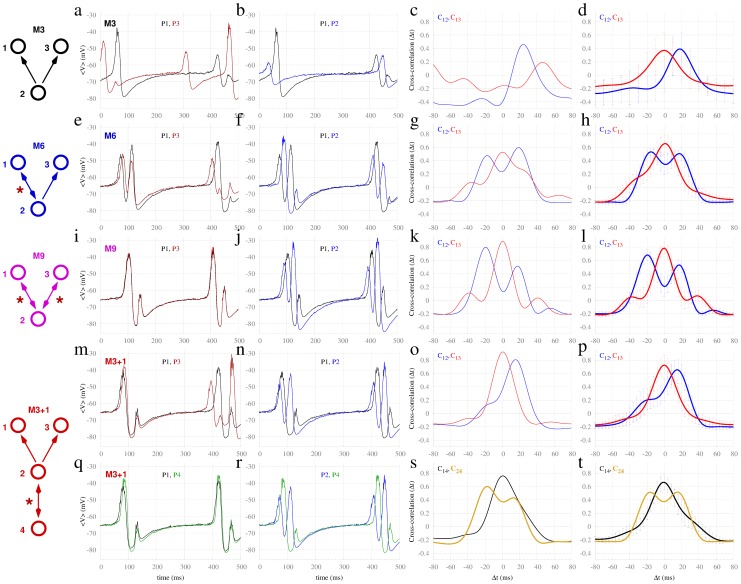
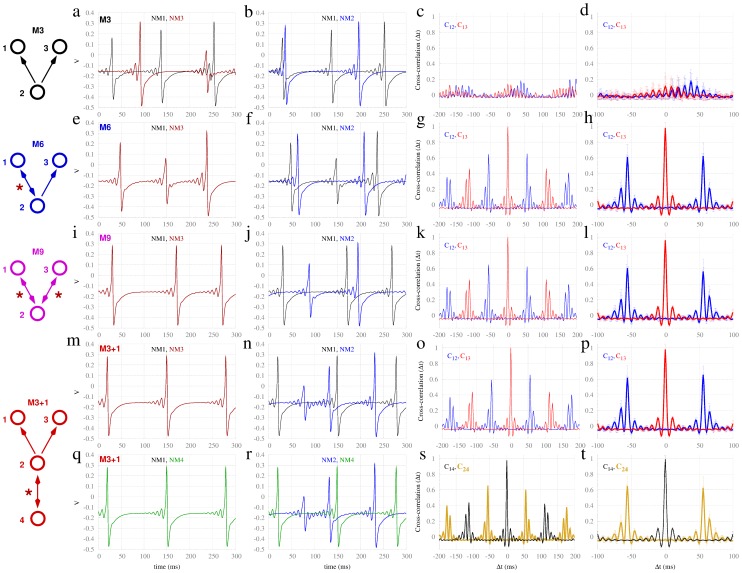
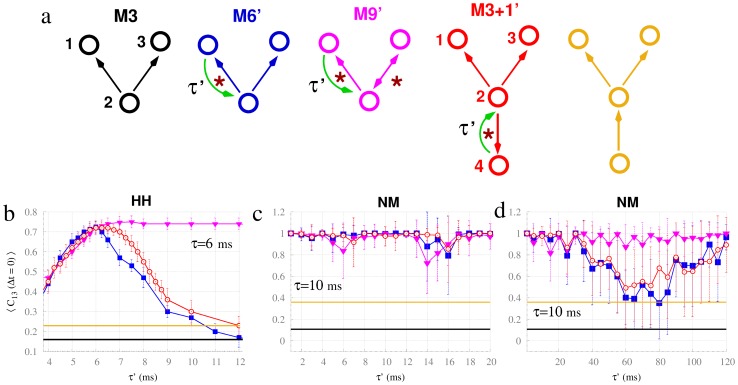
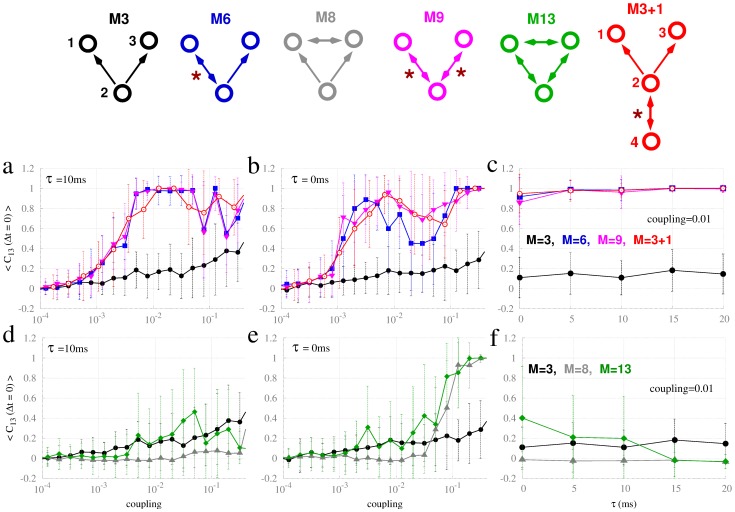
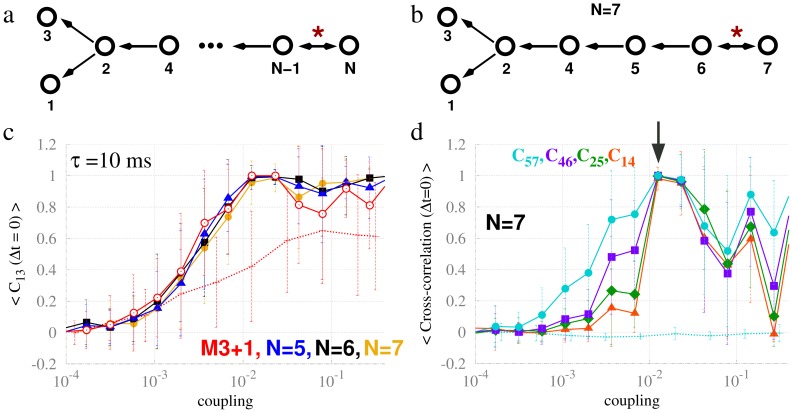
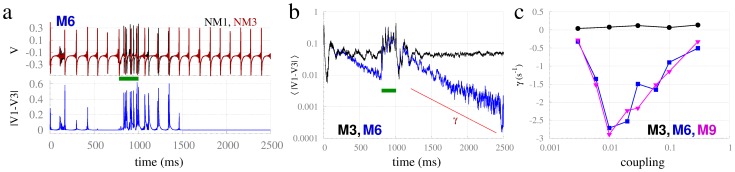
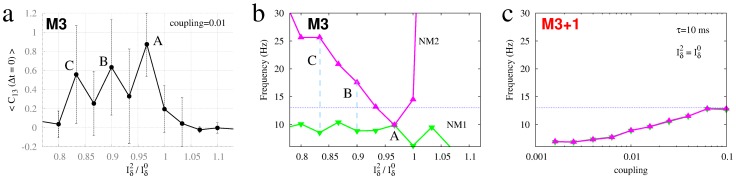
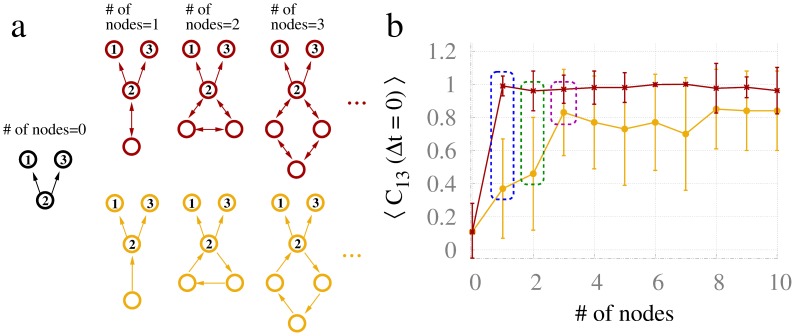
Zero-lag synchronization between distant cortical areas has been observed in a diversity of experimental data sets and between many different regions of the brain. Several computational mechanisms have been proposed to account for such isochronous synchronization in the presence of long conduction delays: Of these, the phenomenon of "dynamical relaying"--a mechanism that relies on a specific network motif--has proven to be the most robust with respect to parameter mismatch and system noise. Surprisingly, despite a contrary belief in the community, the common driving motif is an unreliable means of establishing zero-lag synchrony. Although dynamical relaying has been validated in empirical and computational studies, the deeper dynamical mechanisms and comparison to dynamics on other motifs is lacking. By systematically comparing synchronization on a variety of small motifs, we establish that the presence of a single reciprocally connected pair--a "resonance pair"--plays a crucial role in disambiguating those motifs that foster zero-lag synchrony in the presence of conduction delays (such as dynamical relaying) from those that do not (such as the common driving triad). Remarkably, minor structural changes to the common driving motif that incorporate a reciprocal pair recover robust zero-lag synchrony. The findings are observed in computational models of spiking neurons, populations of spiking neurons and neural mass models, and arise whether the oscillatory systems are periodic, chaotic, noise-free or driven by stochastic inputs. The influence of the resonance pair is also robust to parameter mismatch and asymmetrical time delays amongst the elements of the motif. We call this manner of facilitating zero-lag synchrony resonance-induced synchronization, outline the conditions for its occurrence, and propose that it may be a general mechanism to promote zero-lag synchrony in the brain.
在各种实验数据集以及大脑的许多不同区域之间,都观察到了远距离皮质区域之间的零延迟同步。已经提出了几种计算机制来解释在存在长传导延迟的情况下的这种等时同步:其中,“动态中继”现象——一种依赖于特定网络基序的机制——已被证明在参数失配和系统噪声方面最为稳健。令人惊讶的是,尽管该领域存在相反的观点,但共同驱动基序是建立零延迟同步的不可靠手段。尽管动态中继已在实证和计算研究中得到验证,但仍缺乏更深层次的动力学机制以及与其他基序动力学的比较。通过系统地比较各种小基序上的同步,我们确定单个相互连接的对——“共振对”——的存在在区分那些在存在传导延迟时促进零延迟同步的基序(如动态中继)和那些不促进的基序(如共同驱动三元组)方面起着关键作用。值得注意的是,对包含相互对的共同驱动基序进行微小的结构改变可恢复稳健的零延迟同步。这些发现出现在脉冲神经元的计算模型、脉冲神经元群体和神经质量模型中,并且无论振荡系统是周期性的、混沌的、无噪声的还是由随机输入驱动的,都会出现。共振对的影响对基序元素之间的参数失配和不对称时间延迟也很稳健。我们将这种促进零延迟同步的方式称为共振诱导同步,概述其发生的条件,并提出它可能是大脑中促进零延迟同步的一种普遍机制。