Lavigueur A, Maltby V, Mock D, Rossant J, Pawson T, Bernstein A
Division of Molecular and Developmental Biology, Mount Sinai Hospital Research Institute, Toronto, Ontario, Canada.
Mol Cell Biol. 1989 Sep;9(9):3982-91. doi: 10.1128/mcb.9.9.3982-3991.1989.
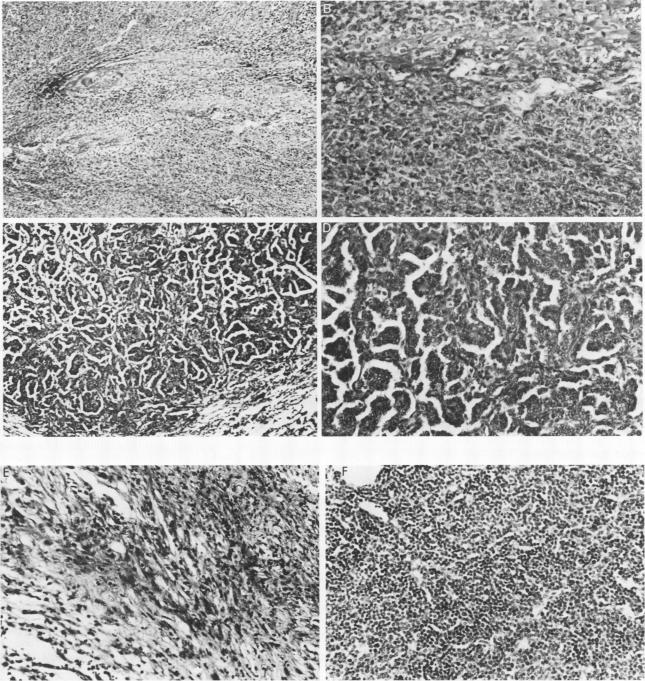
We have investigated the role of the p53 gene in oncogenesis in vivo by generating transgenic mice carrying murine p53 genomic fragments isolated from a mouse Friend erythroleukemia cell line or BALB/c mouse liver DNA. Elevated levels of p53 mRNA were detected in several tissues of two transgenic lines tested. Increased levels of p53 protein were also detected in most of the tissues analyzed by Western blotting (immunoblotting). Because both transgenes encoded p53 proteins that were antigenically distinct from wild-type p53, it was possible to demonstrate that overexpression of the p53 protein was mostly, if not entirely, due to the expression of the transgenes. Neoplasms developed in 20% of the transgenic mice, with a high incidence of lung adenocarcinomas, osteosarcomas, and lymphomas. Tissues such as ovaries that expressed the transgene at high levels were not at higher risk of malignant transformation than tissues expressing p53 protein at much lower levels. The long latent period and low penetrance suggest that overexpression of p53 alone is not sufficient to induce malignancies and that additional events are required. These observations provide direct evidence that mutant alleles of the p53 oncogene have oncogenic potential in vivo and that different cell types show intrinsic differences in susceptibility to malignant transformation by p53. Since recent data suggest that p53 may be a recessive oncogene, it is possible that the elevated tumor incidence results from functional inactivation of endogenous p53 by overexpression of the mutant transgene. The high incidence of lung and bone tumors suggests that p53 transgenic mice may provide a useful model to investigate the molecular events that underlie these malignancies in humans.
我们通过构建携带从小鼠Friend红白血病细胞系或BALB/c小鼠肝脏DNA中分离出的鼠源p53基因组片段的转基因小鼠,研究了p53基因在体内肿瘤发生中的作用。在检测的两个转基因品系的多个组织中检测到p53 mRNA水平升高。通过蛋白质免疫印迹法(免疫印迹)分析,在大多数组织中也检测到p53蛋白水平升高。由于两个转基因编码的p53蛋白在抗原性上与野生型p53不同,因此有可能证明p53蛋白的过表达大部分(如果不是全部)是由于转基因的表达。20%的转基因小鼠发生了肿瘤,其中肺腺癌、骨肉瘤和淋巴瘤的发生率较高。与低水平表达p53蛋白的组织相比,高水平表达转基因的组织如卵巢发生恶性转化的风险并未增加。较长的潜伏期和低外显率表明,单独的p53过表达不足以诱导恶性肿瘤,还需要其他事件。这些观察结果提供了直接证据,表明p53癌基因的突变等位基因在体内具有致癌潜力,并且不同细胞类型对p53介导的恶性转化的易感性存在内在差异。由于最近的数据表明p53可能是一种隐性癌基因,肿瘤发生率升高可能是由于突变转基因的过表达导致内源性p53功能失活所致。肺和骨肿瘤的高发生率表明,p53转基因小鼠可能为研究人类这些恶性肿瘤的分子机制提供一个有用的模型。