Meric Murat, Soylu Korhan, Avci Bahattin, Yuksel Serkan, Gulel Okan, Yenercag Mustafa, Coksevim Metin, Uzun Adem
Department of Cardiology, Ondokuz Mayis University, Faculty of Medicine, Samsun, Turkey.
Department of Biochemistry, Ondokuz Mayis University, Faculty of Medicine, Samsun, Turkey.
Med Sci Monit. 2014 Apr 28;20:698-705. doi: 10.12659/MSM.890784.
Chemerin is a novel adipokine that plays a role in inflammation and atherosclerosis. Although there are several correlations between hypertension and the inflammatory system, there is still insufficient information about the relationship between blood pressure variability and inflammatory markers. In this study, we aimed to determine whether chemerin levels are elevated in non-dipper patients compared with dippers and healthy controls.
This study was composed of a group of 90 patients: 60 hypertensive patients and 30 healthy control subjects (12 males, mean age 53.2 ± 15.4 years). Ambulatory blood pressure monitoring devices (ABPM) were connected to all patients. Using data from the ABPM, hypertensive patients were divided into 2 groups: 30 dipper patients (12 males, mean age 52.5 ± 15.1 years) and 30 non-dipper patients (11 males, mean age 54.6 ± 13.0 years). Complete blood count and biochemistry were measured by standard methods and plasma chemerin concentrations were quantified by ELISA.
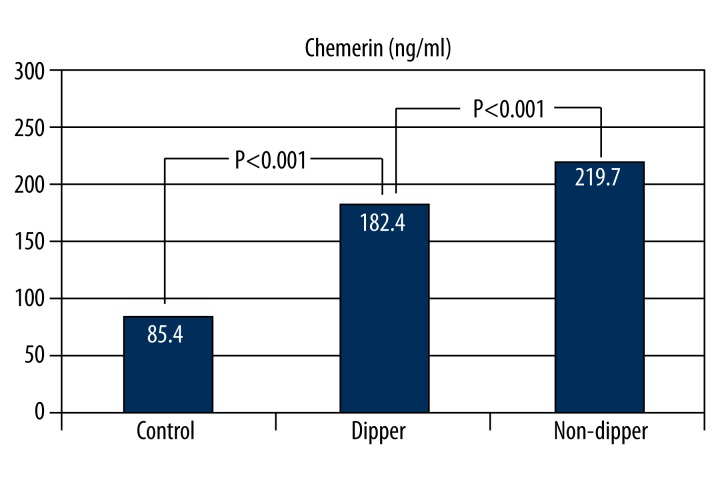
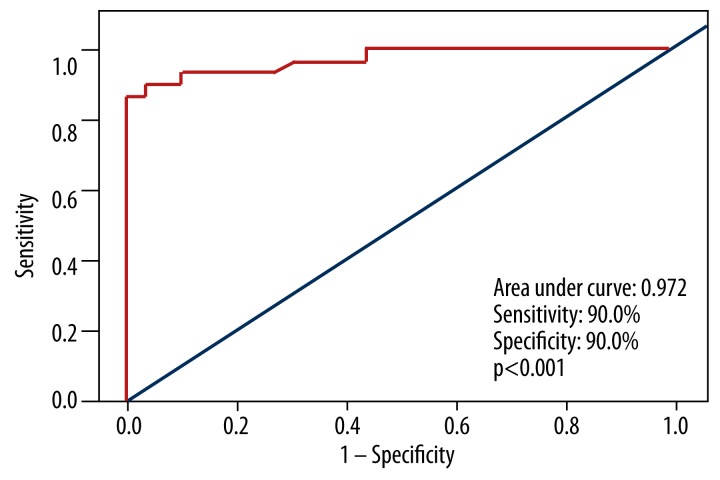
Non-dipper patients demonstrated higher chemerin levels compared to dippers and normotensives (219.7 ± 16.3 vs. 182.4 ± 21.4 ng/ml; 219.7 ± 16.3 vs. 85.4 ± 38.1 ng/ml, respectively, p<0.001 for both comparisons). A receiver operating characteristic curve analysis revealed that the optimal cut-off value for chemerin to predict a non-dipping pattern was 201.4, with 90% sensitivity and 90% specificity. There was a positive correlation between chemerin levels and all ambulatory blood pressure values in all hypertensive patients.
Chemerin, which plays a role in inflammation and atherosclerosis, was higher in non-dippers compared to dippers and normotensives. Additionally, chemerin shows positive correlations with blood pressure.
chemerin是一种新型脂肪因子,在炎症和动脉粥样硬化中起作用。尽管高血压与炎症系统之间存在多种关联,但关于血压变异性与炎症标志物之间的关系仍信息不足。在本研究中,我们旨在确定与勺型血压患者及健康对照相比,非勺型血压患者的chemerin水平是否升高。
本研究纳入90名患者:60名高血压患者和30名健康对照者(12名男性,平均年龄53.2±15.4岁)。所有患者均连接动态血压监测设备(ABPM)。利用ABPM数据,将高血压患者分为两组:30名勺型血压患者(12名男性,平均年龄52.5±15.1岁)和30名非勺型血压患者(11名男性,平均年龄54.6±13.0岁)。采用标准方法进行全血细胞计数和生化检测,并用酶联免疫吸附测定法(ELISA)定量血浆chemerin浓度。
与勺型血压患者和血压正常者相比,非勺型血压患者的chemerin水平更高(分别为219.7±16.3 vs. 182.4±21.4 ng/ml;219.7±16.3 vs. 85.4±38.1 ng/ml,两组比较p均<0.001)。受试者工作特征曲线分析显示,chemerin预测非勺型血压模式的最佳截断值为201.4,敏感性为90%,特异性为90%。在所有高血压患者中,chemerin水平与所有动态血压值之间存在正相关。
在炎症和动脉粥样硬化中起作用的chemerin,在非勺型血压患者中高于勺型血压患者和血压正常者。此外,chemerin与血压呈正相关。