Institute of Clinical Physiology, Consiglio Nazionale delle Ricerche Pisa, Italy.
Institute of Clinical Physiology, Consiglio Nazionale delle Ricerche Pisa, Italy ; Department of Clinical and Experimental Medicine, University of Pisa Pisa, Italy.
Front Genet. 2014 Apr 7;5:70. doi: 10.3389/fgene.2014.00070. eCollection 2014.
The multifactorial pathogenesis of coronary atherosclerotic lesion formation has been investigated in a swine model of high cholesterol diet induced atherogenesis and data processed by a systems approach.
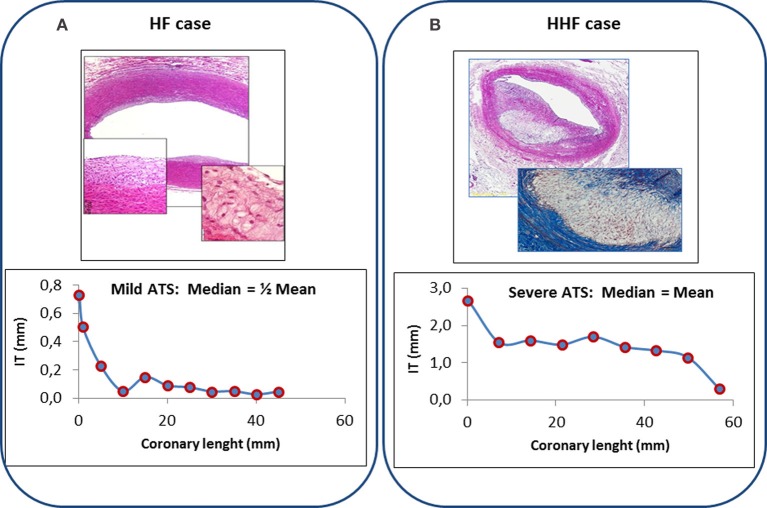
Farm pigs were fed on standard or high cholesterol diet of 8 and 16 weeks duration. Plasma assessment of total cholesterol, HDL, LDL, and ELISA of some cytokines and ICAM-1 were performed on baseline and end-diet samples. Segments of the right coronary artery were incubated for 24 h in serum-free medium to collect secreted proteins and their expression analyzed by mass spectrometry. Data of plasma and tissue factors were processed by a statistical systems inference approach: both histologic parameters of coronary intimal thickness (IT) and of lesion area (LA) were chosen as dependent variables (coronary atherosclerotic burden).
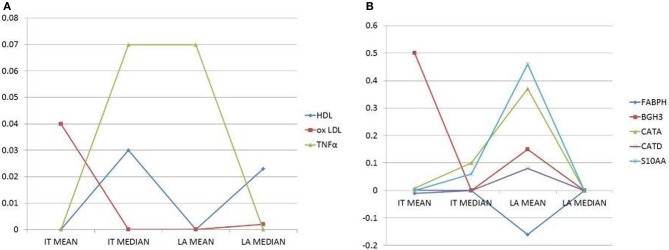
Relations among plasma adhesion molecules, cytokines, lipoproteins, tissue proteins and histology indexes were integrated in a model regression scheme. Bayesian model averaging (BMA) variable selection was chosen as a method to identify relevant factors associated to atherosclerotic burden: TNFα was identified as an associated plasma marker, oxLDL and HDL as relevant lipoproteins; macrophage function related antioxidant Catalase enzyme, lysosome associated Cathepsin D, S100-A10, and Transforming growth factor-beta-induced protein ig-h3 were identified and selected as associated to atherogenesis outcome.
The results of this systems approach are consistent with the hypothesis that, in high cholesterol diet-induced experimental atherogenesis, the interaction between plasma cytokines, lipoproteins and artery-specific proteins, influences lesion initiation and growth. In particular, some macrophage function related proteins are found significantly and positively associated to atherosclerotic burden, suggesting a novel molecular framework into the atherogenesis-inflammatory disorder.
通过系统方法研究高胆固醇饮食诱导动脉粥样硬化形成的猪模型中的多因素发病机制,并对数据进行处理。
将农场猪用 8 周和 16 周的标准或高胆固醇饮食喂养。在基线和结束饮食时,对血浆总胆固醇、HDL、LDL 进行评估,并进行一些细胞因子和 ICAM-1 的 ELISA。在无血清培养基中孵育右冠状动脉节段 24 小时,收集分泌蛋白,并通过质谱分析其表达。通过统计系统推断方法处理血浆和组织因子的数据:将冠状动脉内膜厚度 (IT) 和病变面积 (LA) 的组织学参数均选为依赖变量(冠状动脉粥样硬化负担)。
将血浆黏附分子、细胞因子、脂蛋白、组织蛋白和组织学指标之间的关系整合到回归模型中。贝叶斯模型平均(BMA)变量选择被选为识别与动脉粥样硬化负担相关的相关因素的方法:TNFα 被鉴定为相关的血浆标志物,oxLDL 和 HDL 为相关脂蛋白;巨噬细胞功能相关抗氧化酶 Catalase、溶酶体相关 Cathepsin D、S100-A10 和转化生长因子-β诱导蛋白 ig-h3 被鉴定并选择为与动脉粥样硬化发生相关的因子。
该系统方法的结果与以下假设一致,即在高胆固醇饮食诱导的实验性动脉粥样硬化中,血浆细胞因子、脂蛋白和动脉特异性蛋白之间的相互作用影响病变的起始和生长。特别是,一些与巨噬细胞功能相关的蛋白与动脉粥样硬化负担呈显著正相关,提示了一种新的分子框架进入动脉粥样硬化炎症失调。