Okada Naoyuki, Toda Takashi, Yamamoto Masayuki, Sato Masamitsu
Department of Biophysics and Biochemistry, Graduate School of Science, University of Tokyo, Tokyo 113-0033, Japan.
Laboratory of Cell Regulation, Cancer Research UK London Research Institute, London WC2A 3LY, United Kingdom.
Mol Biol Cell. 2014 Jul 1;25(13):1969-82. doi: 10.1091/mbc.E13-11-0679. Epub 2014 Apr 30.
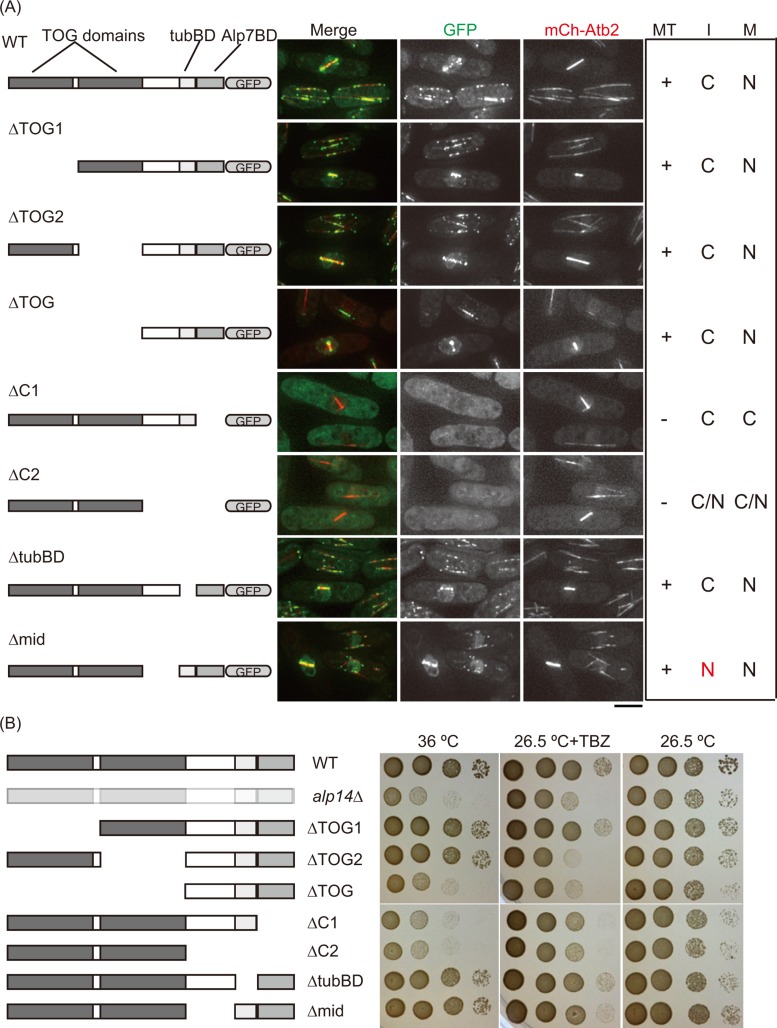
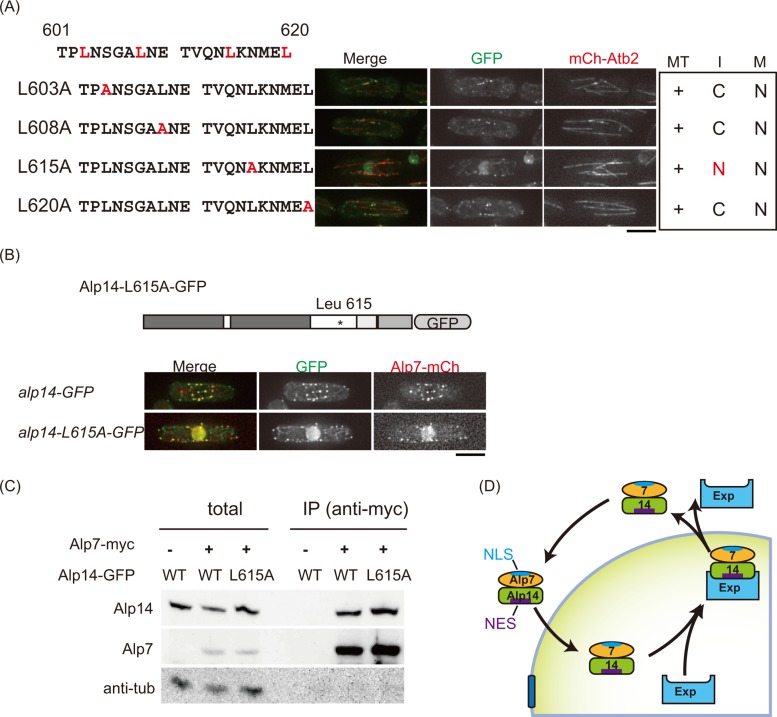
As cells transition from interphase to mitosis, the microtubule cytoskeleton is reorganized to form the mitotic spindle. In the closed mitosis of fission yeast, a microtubule-associated protein complex, Alp7-Alp14 (transforming acidic coiled-coil-tumor overexpressed gene), enters the nucleus upon mitotic entry and promotes spindle formation. However, how the complex is controlled to accumulate in the nucleus only during mitosis remains elusive. Here we demonstrate that Alp7-Alp14 is excluded from the nucleus during interphase using the nuclear export signal in Alp14 but is accumulated in the nucleus during mitosis through phosphorylation of Alp7 by the cyclin-dependent kinase (CDK). Five phosphorylation sites reside around the nuclear localization signal of Alp7, and the phosphodeficient alp7-5A mutant fails to accumulate in the nucleus during mitosis and exhibits partial spindle defects. Thus our results reveal one way that CDK regulates spindle assembly at mitotic entry: CDK phosphorylates the Alp7-Alp14 complex to localize it to the nucleus.
当细胞从间期过渡到有丝分裂期时,微管细胞骨架会重新组织以形成有丝分裂纺锤体。在裂殖酵母的封闭有丝分裂中,一种微管相关蛋白复合体Alp7-Alp14(转化酸性卷曲螺旋-肿瘤过表达基因)在有丝分裂开始时进入细胞核并促进纺锤体形成。然而,该复合体如何被控制仅在有丝分裂期间在细胞核中积累仍不清楚。在这里,我们证明Alp7-Alp14在间期通过Alp14中的核输出信号被排除在细胞核外,但在有丝分裂期间通过细胞周期蛋白依赖性激酶(CDK)对Alp7的磷酸化作用而积累在细胞核中。五个磷酸化位点位于Alp7的核定位信号周围,磷酸化缺陷型alp7-5A突变体在有丝分裂期间无法在细胞核中积累,并表现出部分纺锤体缺陷。因此,我们的结果揭示了CDK在有丝分裂开始时调节纺锤体组装的一种方式:CDK使Alp7-Alp14复合体磷酸化,使其定位于细胞核。