Li Blaise, Lopes João S, Foster Peter G, Embley T Martin, Cox Cymon J
Centro de Ciências do Mar, Universidade do Algarve, Faro, Portugal.
Instituto Gulbenkian de Ciência, Oeiras, Portugal.
Mol Biol Evol. 2014 Jul;31(7):1697-709. doi: 10.1093/molbev/msu105. Epub 2014 May 2.
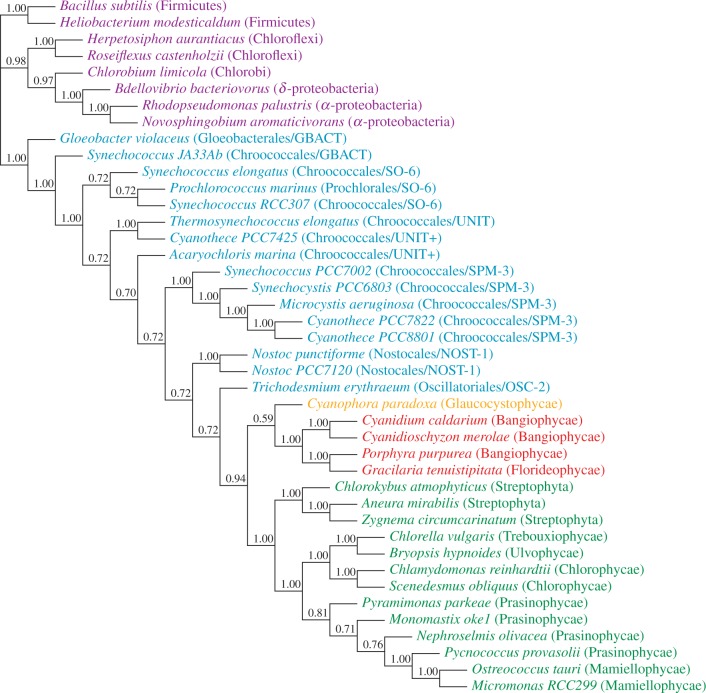
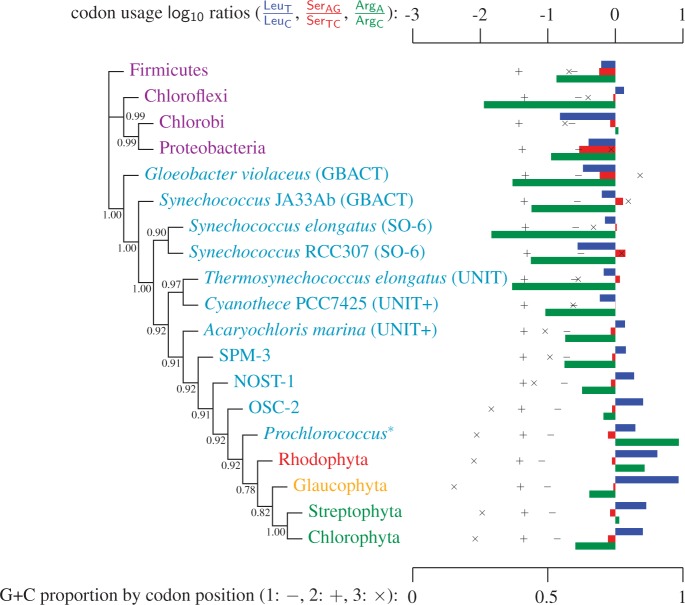
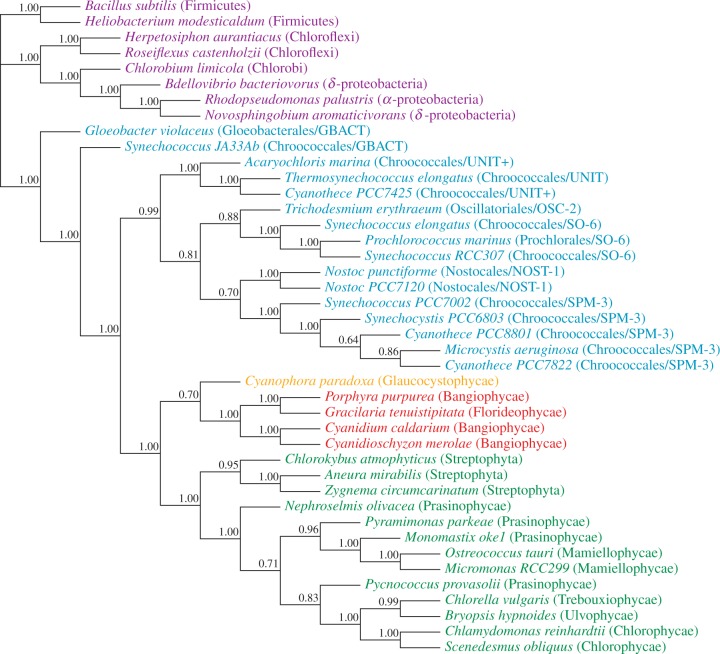
Archaeplastida (=Kingdom Plantae) are primary plastid-bearing organisms that evolved via the endosymbiotic association of a heterotrophic eukaryote host cell and a cyanobacterial endosymbiont approximately 1,400 Ma. Here, we present analyses of cyanobacterial and plastid genomes that show strongly conflicting phylogenies based on 75 plastid (or nuclear plastid-targeted) protein-coding genes and their direct translations to proteins. The conflict between genes and proteins is largely robust to the use of sophisticated data- and tree-heterogeneous composition models. However, by using nucleotide ambiguity codes to eliminate synonymous substitutions due to codon-degeneracy, we identify a composition bias, and dependent codon-usage bias, resulting from synonymous substitutions at all third codon positions and first codon positions of leucine and arginine, as the main cause for the conflicting phylogenetic signals. We argue that the protein-coding gene data analyses are likely misleading due to artifacts induced by convergent composition biases at first codon positions of leucine and arginine and at all third codon positions. Our analyses corroborate previous studies based on gene sequence analysis that suggest Cyanobacteria evolved by the early paraphyletic splitting of Gloeobacter and a specific Synechococcus strain (JA33Ab), with all other remaining cyanobacterial groups, including both unicellular and filamentous species, forming the sister-group to the Archaeplastida lineage. In addition, our analyses using better-fitting models suggest (but without statistically strong support) an early divergence of Glaucophyta within Archaeplastida, with the Rhodophyta (red algae), and Viridiplantae (green algae and land plants) forming a separate lineage.
古质体生物(=植物界)是主要的含质体生物,它们大约在14亿年前通过异养真核宿主细胞与蓝藻内共生体的内共生结合而进化。在这里,我们展示了对蓝藻和质体基因组的分析,这些分析基于75个质体(或靶向核质体)蛋白质编码基因及其直接翻译成的蛋白质,显示出强烈冲突的系统发育关系。基因和蛋白质之间的冲突在很大程度上不受复杂的数据和树异质组成模型使用的影响。然而,通过使用核苷酸歧义编码来消除由于密码子简并导致的同义替换,我们确定了一种组成偏差以及相关的密码子使用偏差,这是由亮氨酸和精氨酸的所有第三密码子位置以及第一密码子位置的同义替换引起的,是冲突的系统发育信号的主要原因。我们认为,由于亮氨酸和精氨酸的第一密码子位置以及所有第三密码子位置的趋同组成偏差引起的假象,蛋白质编码基因数据分析可能会产生误导。我们的分析证实了先前基于基因序列分析的研究,这些研究表明蓝藻是通过蓝细菌和特定的聚球藻菌株(JA33Ab)的早期并系分裂而进化的,所有其他剩余的蓝藻群体,包括单细胞和丝状物种,形成了古质体生物谱系的姐妹群。此外,我们使用更合适模型的分析表明(但没有统计学上的有力支持),蓝藻植物在古质体生物中早期分化,红藻和绿藻植物(绿藻和陆地植物)形成一个单独的谱系。