Pai S A, Gagangras S A, Kulkarni S S, Majumdar A S
Department of Pharmacology, Bombay College of Pharmacy, Kalina, Mumbai-400 098, India.
Indian J Pharm Sci. 2014 Jan;76(1):87-92.
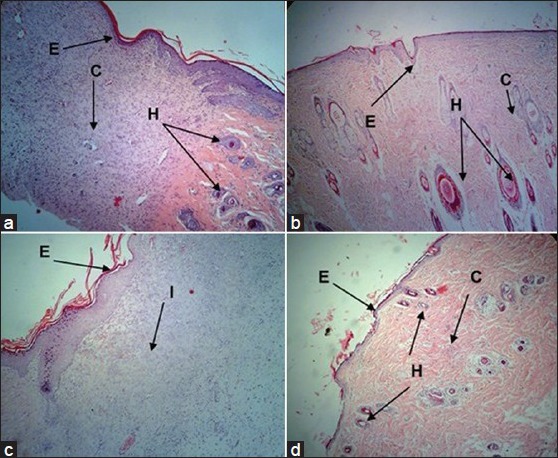
The hypothesis that ozonated oil has wound healing property was investigated in an excision wound model using Sprague Dawley rats. The animals were divided into four groups, which were treated with sesame oil (vehicle), framycetin (standard), or two doses of ozonated sesame oil (peroxide values 500 and 700 mEq/1000 g, respectively). The formulations were topically applied on the excision wounds once daily for 11 consecutive days and the animals were euthanized on the 12(th) day. Wound healing was assessed by measuring the wound contracture, tensile strength, collagen content and superoxide dismutase activity of skin of the excised wound area. On the terminal day, areas of the wounds of the group receiving high dose ozonated oil were significantly smaller than those of the group treated with vehicle. Ozonated oil treated wounds had significantly higher tensile strength, collagen content and superoxide dismutase activity than that of the vehicle treated wounds. Histopathological analysis of skin of the excised wound area treated with ozonated oil revealed better healing activity vis-à-vis vehicle-treated wounds. Thus, it can be concluded that ozonated oil can be of potential therapeutic use for healing wounds.
在使用斯普拉格-道利大鼠的切除伤口模型中,对臭氧油具有伤口愈合特性这一假说进行了研究。将动物分为四组,分别用芝麻油(赋形剂)、硫酸新霉素(标准品)或两剂臭氧油(过氧化值分别为500和700 mEq/1000 g)进行治疗。连续11天每天一次将制剂局部应用于切除伤口,在第12天对动物实施安乐死。通过测量切除伤口区域皮肤的伤口挛缩、抗张强度、胶原蛋白含量和超氧化物歧化酶活性来评估伤口愈合情况。在实验末期,接受高剂量臭氧油组的伤口面积明显小于用赋形剂治疗组。臭氧油处理的伤口比赋形剂处理的伤口具有明显更高的抗张强度、胶原蛋白含量和超氧化物歧化酶活性。对用臭氧油处理的切除伤口区域皮肤进行组织病理学分析显示,与赋形剂处理的伤口相比,其愈合活性更好。因此,可以得出结论,臭氧油在伤口愈合方面具有潜在的治疗用途。