Rodríguez Estefanía, Barbeitos Marcos S, Brugler Mercer R, Crowley Louise M, Grajales Alejandro, Gusmão Luciana, Häussermann Verena, Reft Abigail, Daly Marymegan
Division of Invertebrate Zoology, American Museum of Natural History, New York City, New York, United States of America.
Sackler Institute for Comparative Genomics, American Museum of Natural History, New York City, New York, United States of America; Departamento de Zoologia, Universidade Federal do Paraná, Curitiba, Brazil.
PLoS One. 2014 May 7;9(5):e96998. doi: 10.1371/journal.pone.0096998. eCollection 2014.
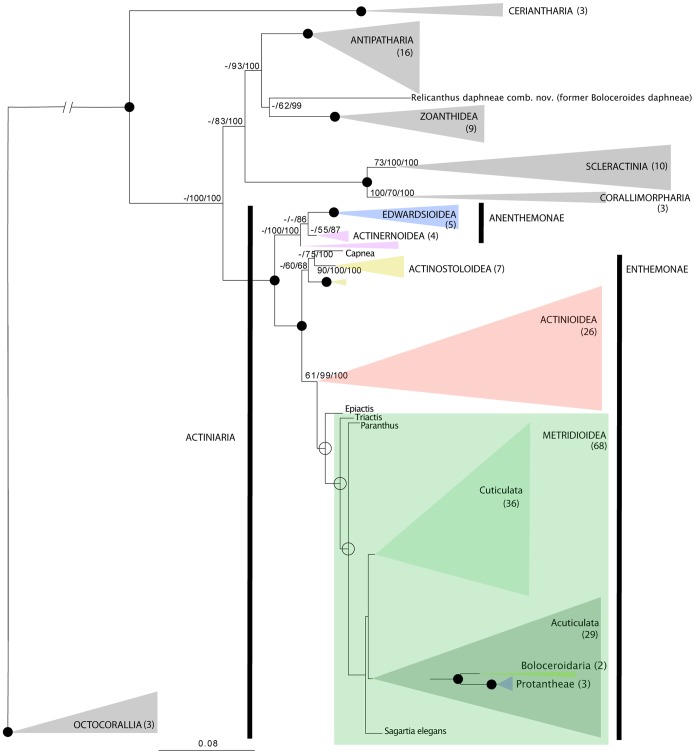
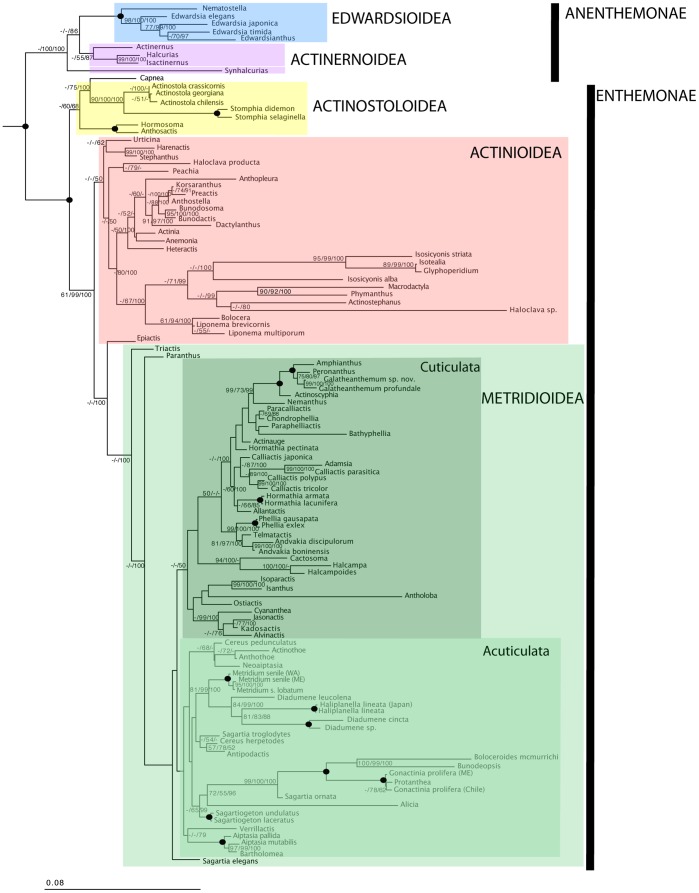
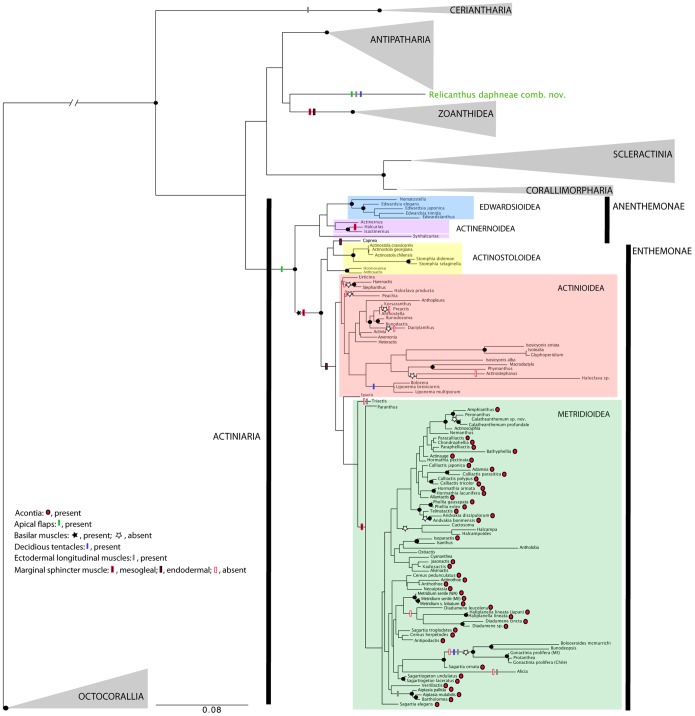
Sea anemones (order Actiniaria) are among the most diverse and successful members of the anthozoan subclass Hexacorallia, occupying benthic marine habitats across all depths and latitudes. Actiniaria comprises approximately 1,200 species of solitary and skeleton-less polyps and lacks any anatomical synapomorphy. Although monophyly is anticipated based on higher-level molecular phylogenies of Cnidaria, to date, monophyly has not been explicitly tested and at least some hypotheses on the diversification of Hexacorallia have suggested that actiniarians are para- or poly-phyletic. Published phylogenies have demonstrated the inadequacy of existing morphological-based classifications within Actiniaria. Superfamilial groups and most families and genera that have been rigorously studied are not monophyletic, indicating conflict with the current hierarchical classification. We test the monophyly of Actiniaria using two nuclear and three mitochondrial genes with multiple analytical methods. These analyses are the first to include representatives of all three currently-recognized suborders within Actiniaria. We do not recover Actiniaria as a monophyletic clade: the deep-sea anemone Boloceroides daphneae, previously included within the infraorder Boloceroidaria, is resolved outside of Actiniaria in several of the analyses. We erect a new genus and family for B. daphneae, and rank this taxon incerti ordinis. Based on our comprehensive phylogeny, we propose a new formal higher-level classification for Actiniaria composed of only two suborders, Anenthemonae and Enthemonae. Suborder Anenthemonae includes actiniarians with a unique arrangement of mesenteries (members of Edwardsiidae and former suborder Endocoelantheae). Suborder Enthemonae includes actiniarians with the typical arrangement of mesenteries for actiniarians (members of former suborders Protantheae, Ptychodacteae, and Nynantheae and subgroups therein). We also erect subgroups within these two newly-erected suborders. Although some relationships among these newly-defined groups are still ambiguous, morphological and molecular results are consistent enough to proceed with a new higher-level classification and to discuss the putative functional and evolutionary significance of several morphological attributes within Actiniaria.
海葵(海葵目)是珊瑚虫纲六放珊瑚亚纲中最多样化且最成功的成员之一,占据着所有深度和纬度的底栖海洋栖息地。海葵目包括约1200种单独生活且无骨骼的珊瑚虫,并且缺乏任何解剖学上的共衍征。尽管基于刺胞动物门的高级分子系统发育预计海葵目是单系类群,但迄今为止,单系性尚未得到明确检验,并且关于六放珊瑚亚纲多样化的至少一些假说表明海葵目是并系或多系的。已发表的系统发育研究表明,海葵目内现有的基于形态学的分类并不充分。经过严格研究的超科级类群以及大多数科和属都不是单系的,这表明与当前的层级分类存在冲突。我们使用两个核基因和三个线粒体基因,通过多种分析方法来检验海葵目的单系性。这些分析首次纳入了海葵目内目前所有三个已被认可的亚目的代表。我们并未将海葵目恢复为一个单系类群:深海海葵达芙妮氏柱星螅,之前被归入柱星螅亚目,在一些分析中被解析为处于海葵目之外。我们为达芙妮氏柱星螅建立了一个新属和新科,并将这个分类单元的目级地位列为待定。基于我们全面的系统发育研究,我们为海葵目提出了一个新的正式高级分类,仅由两个亚目组成,即无隔膜海葵亚目和有隔膜海葵亚目。无隔膜海葵亚目包括具有独特隔膜排列的海葵(艾氏海葵科成员以及前内胚层海葵亚目成员)。有隔膜海葵亚目包括具有海葵典型隔膜排列的海葵(前原海葵亚目、栉口海葵亚目和新海葵亚目成员及其亚群)。我们还在这两个新建立的亚目内设立了亚群。尽管这些新定义类群之间的一些关系仍然不明确,但形态学和分子学结果足够一致,从而可以进行新的高级分类,并讨论海葵目内几种形态特征的假定功能和进化意义。