Gayek A Sophia, Ohi Ryoma
Department of Cell and Developmental Biology, Vanderbilt University Medical Center, Nashville, TN 37232.
Department of Cell and Developmental Biology, Vanderbilt University Medical Center, Nashville, TN 37232
Mol Biol Cell. 2014 Jul 1;25(13):2051-60. doi: 10.1091/mbc.E14-03-0785. Epub 2014 May 7.
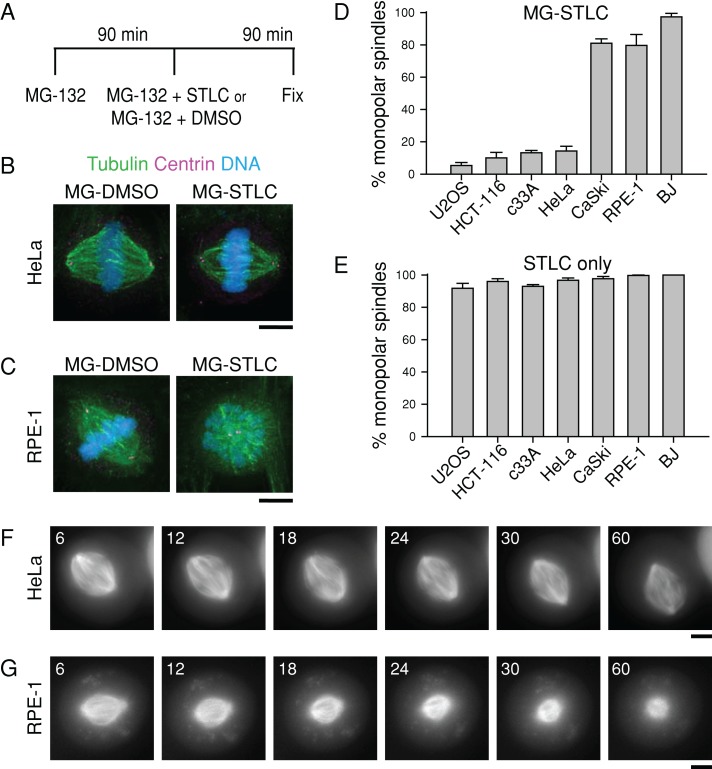
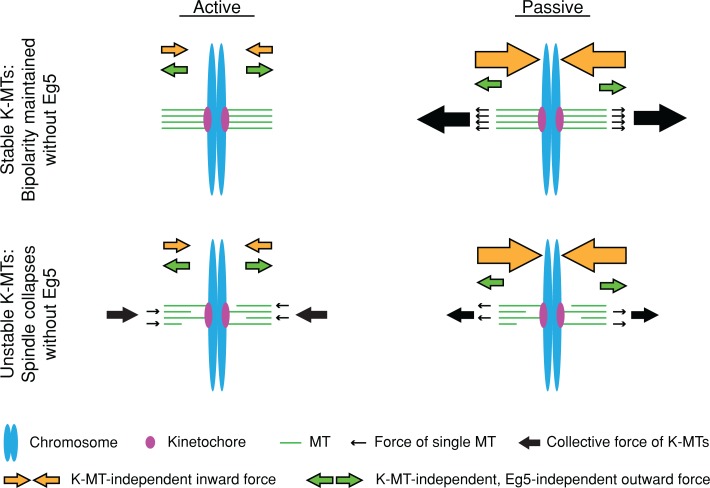
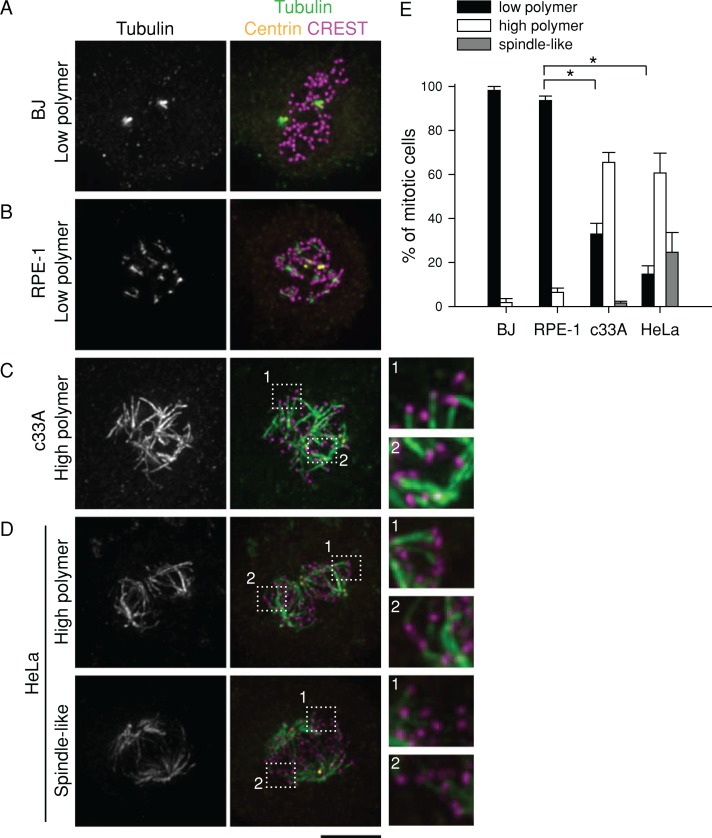
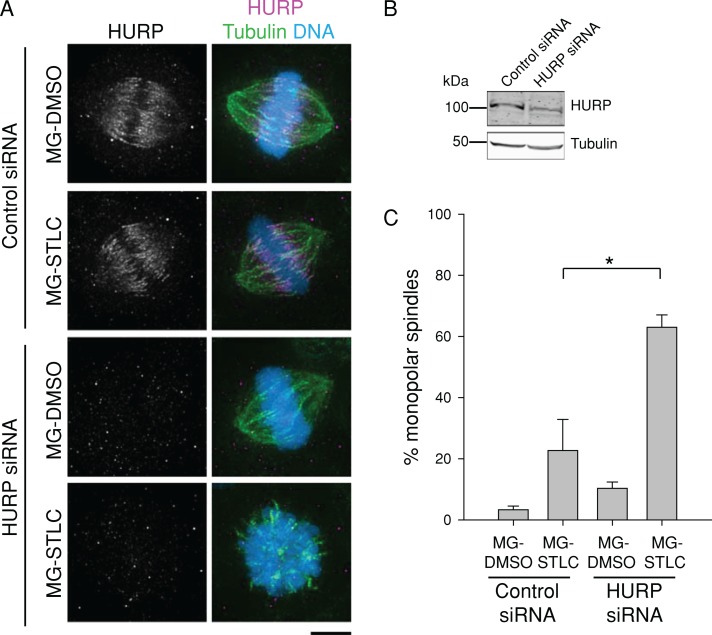
The mitotic spindle is a bipolar, microtubule (MT)-based cellular machine that segregates the duplicated genome into two daughter cells. The kinesin-5 Eg5 establishes the bipolar geometry of the mitotic spindle, but previous work in mammalian cells suggested that this motor is unimportant for the maintenance of spindle bipolarity. Although it is known that Kif15, a second mitotic kinesin, enforces spindle bipolarity in the absence of Eg5, how Kif15 functions in this capacity and/or whether other biochemical or physical properties of the spindle promote its bipolarity have been poorly studied. Here we report that not all human cell lines can efficiently maintain bipolarity without Eg5, despite their expressing Kif15. We show that the stability of chromosome-attached kinetochore-MTs (K-MTs) is important for bipolar spindle maintenance without Eg5. Cells that efficiently maintain bipolar spindles without Eg5 have more stable K-MTs than those that collapse without Eg5. Consistent with this observation, artificial destabilization of K-MTs promotes spindle collapse without Eg5, whereas stabilizing K-MTs improves bipolar spindle maintenance without Eg5. Our findings suggest that either rapid K-MT turnover pulls poles inward or slow K-MT turnover allows for greater resistance to inward-directed forces.
有丝分裂纺锤体是一种基于微管(MT)的双极细胞机器,它将复制后的基因组分离到两个子细胞中。驱动蛋白-5 Eg5建立了有丝分裂纺锤体的双极结构,但此前在哺乳动物细胞中的研究表明,这种马达蛋白对于维持纺锤体双极性并不重要。虽然已知第二种有丝分裂驱动蛋白Kif15在没有Eg5的情况下能维持纺锤体双极性,但Kif15如何发挥这种作用和/或纺锤体的其他生化或物理特性是否促进其双极性,此前研究甚少。在此我们报告,并非所有人类细胞系在没有Eg5的情况下都能有效维持双极性,尽管它们表达Kif15。我们表明,与染色体相连的动粒微管(K-MT)的稳定性对于在没有Eg5的情况下维持双极纺锤体很重要。在没有Eg5的情况下能有效维持双极纺锤体的细胞,其K-MT比那些在没有Eg5时崩溃的细胞更稳定。与这一观察结果一致,人为破坏K-MT会促进在没有Eg5时纺锤体崩溃,而稳定K-MT则会改善在没有Eg5时双极纺锤体的维持。我们的研究结果表明,要么快速的K-MT周转将纺锤体两极向内拉,要么缓慢的K-MT周转能对向内的力产生更大的抵抗力。