Parsons J Kellogg, Pierce John P, Mohler James, Paskett Electra, Jung Sin-Ho, Humphrey Peter, Taylor John R, Newman Vicky A, Barbier Leslie, Rock Cheryl L, Marshall James
Division of Urologic Oncology, UC San Diego Moores Cancer Center, La Jolla, CA, United States; Department of Urology, UC San Diego Health System, La Jolla, CA, United States; VA San Diego Healthcare System, La Jolla, CA, United States.
Department of Family and Preventive Medicine, University of California, San Diego School of Medicine, La Jolla, CA, United States.
Contemp Clin Trials. 2014 Jul;38(2):198-203. doi: 10.1016/j.cct.2014.05.002. Epub 2014 May 13.
Diet may substantially alter prostate cancer initiation and progression. However, large-scale clinical trials of diet modification have yet to be performed for prostate cancer. The Men's Eating and Living (MEAL) Study (CALGB 70807 [Alliance]) is investigating the effect of increased vegetable consumption on clinical progression in men with localized prostate cancer.
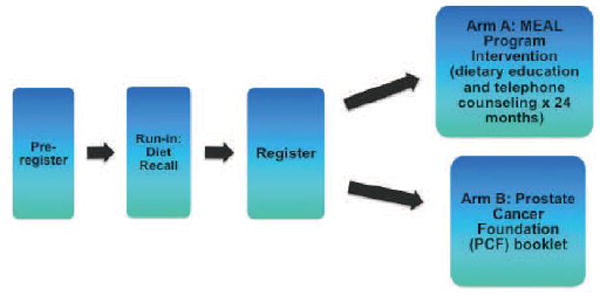
MEAL is a randomized, phase III clinical trial designed to test whether an intervention that increases vegetable intake will decrease the incidence of clinical progression in men with clinically localized prostate cancer on active surveillance. We are randomizing 464 patients to either a validated telephone-based diet counseling intervention or a control condition in which patients receive a published diet guideline. The intervention will continue for two years. The primary outcome variable is clinical progression defined by serum prostate-specific antigen (PSA) and pathological findings on follow-up prostate biopsy. Secondary outcome variables include incidence of surgical and non-surgical treatments for prostate cancer, prostate-cancer related patient anxiety and health-related quality of life.
The MEAL Study is assessing the effectiveness of a high-vegetable diet intervention for preventing clinical progression in men with localized prostate cancer on active surveillance.
饮食可能会显著改变前列腺癌的发生和发展。然而,针对前列腺癌的饮食调整大规模临床试验尚未开展。男性饮食与生活(MEAL)研究(癌症和白血病B组70807研究[联盟研究])正在调查增加蔬菜摄入量对局限性前列腺癌男性临床进展的影响。
MEAL是一项随机III期临床试验,旨在测试增加蔬菜摄入量的干预措施是否会降低接受主动监测的临床局限性前列腺癌男性的临床进展发生率。我们将464名患者随机分为基于电话的有效饮食咨询干预组或对照组,对照组患者接受已发表的饮食指南。干预将持续两年。主要结局变量是由血清前列腺特异性抗原(PSA)和随访前列腺活检的病理结果定义的临床进展。次要结局变量包括前列腺癌手术和非手术治疗的发生率、前列腺癌相关患者焦虑以及健康相关生活质量。
MEAL研究正在评估高蔬菜饮食干预对预防接受主动监测的局限性前列腺癌男性临床进展的有效性。