Department of Social Psychology, Institute of Psychology, Goethe University Frankfurt Frankfurt, Germany.
Department of Cross-Cultural Psychology, Tilburg University Tilburg, Netherlands.
Front Psychol. 2014 May 8;5:392. doi: 10.3389/fpsyg.2014.00392. eCollection 2014.
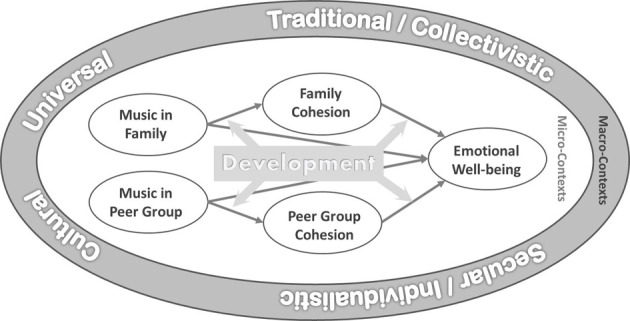
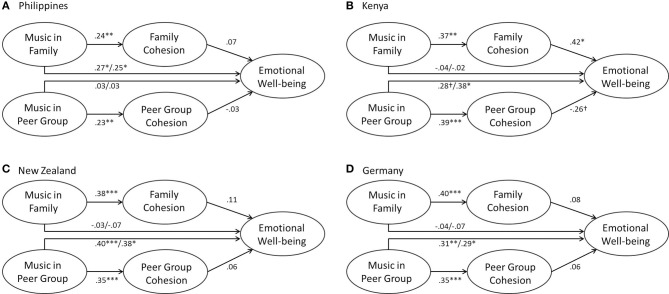
Families are central to the social and emotional development of youth, and most families engage in musical activities together, such as listening to music or talking about their favorite songs. However, empirical evidence of the positive effects of musical family rituals on social cohesion and emotional well-being is scarce. Furthermore, the role of culture in the shaping of musical family rituals and their psychological benefits has been neglected entirely. This paper investigates musical rituals in families and in peer groups (as an important secondary socialization context) in two traditional/collectivistic and two secular/individualistic cultures, and across two developmental stages (adolescence vs. young adulthood). Based on cross-sectional data from 760 young people in Kenya, the Philippines, New Zealand, and Germany, our study revealed that across cultures music listening in families and in peer groups contributes to family and peer cohesion, respectively. Furthermore, the direct contribution of music in peer groups on well-being appears across cultural contexts, whereas musical family rituals affect emotional well-being in more traditional/collectivistic contexts. Developmental analyses show that musical family rituals are consistently and strongly related to family cohesion across developmental stages, whereas musical rituals in peer groups appear more dependent on the developmental stage (in interaction with culture). Contributing to developmental as well as cross-cultural psychology, this research elucidated musical rituals and their positive effects on the emotional and social development of young people across cultures. The implications for future research and family interventions are discussed.
家庭是青少年社会和情感发展的核心,大多数家庭都会一起参与音乐活动,例如听音乐或谈论他们最喜欢的歌曲。然而,关于音乐家庭仪式对社会凝聚力和情感幸福感的积极影响的实证证据却很少。此外,文化在塑造音乐家庭仪式及其心理益处方面的作用完全被忽视了。本文在两个传统/集体主义文化和两个世俗/个人主义文化中,以及在两个发展阶段(青少年和成年早期),研究了家庭和同龄群体(作为一个重要的二级社会化环境)中的音乐仪式。基于肯尼亚、菲律宾、新西兰和德国的 760 名年轻人的横断面数据,我们的研究表明,在不同的文化中,家庭和同龄群体中的音乐聆听分别有助于家庭和同伴的凝聚力。此外,音乐在同龄群体中对幸福感的直接贡献在不同的文化背景下都是存在的,而音乐家庭仪式在更传统/集体主义的背景下对情感幸福感有影响。发展分析表明,音乐家庭仪式在整个发展阶段都与家庭凝聚力密切相关,而同龄群体中的音乐仪式则更多地依赖于发展阶段(与文化相互作用)。本研究为发展心理学和跨文化心理学做出了贡献,阐明了音乐仪式及其对不同文化背景下年轻人情感和社会发展的积极影响。讨论了对未来研究和家庭干预的启示。