Chuang Y-F, Tanaka T, Beason-Held L L, An Y, Terracciano A, Sutin A R, Kraut M, Singleton A B, Resnick S M, Thambisetty M
Clinical and Translational Neuroscience Unit, Laboratory of Behavioral Neuroscience, National Institute on Aging, Baltimore, MD, USA.
Translational Gerontology Branch, National Institute on Aging, Baltimore, MD, USA.
Mol Psychiatry. 2015 Feb;20(1):133-39. doi: 10.1038/mp.2014.49. Epub 2014 May 27.
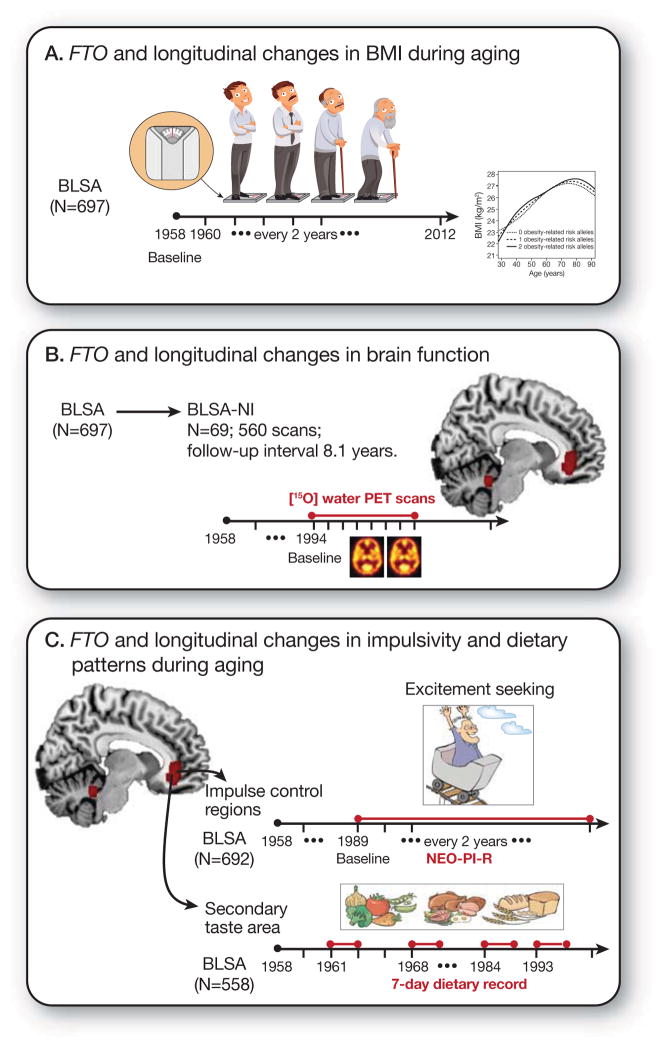
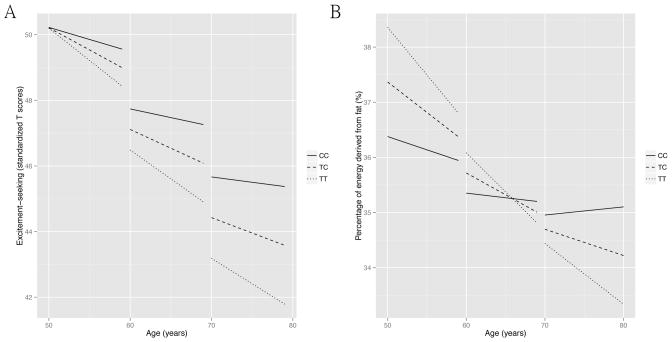
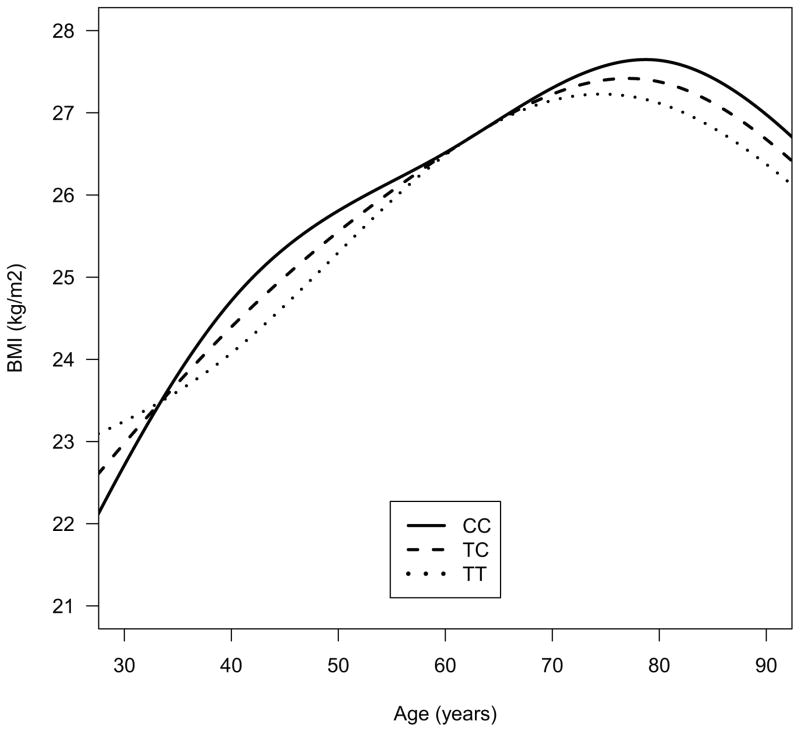
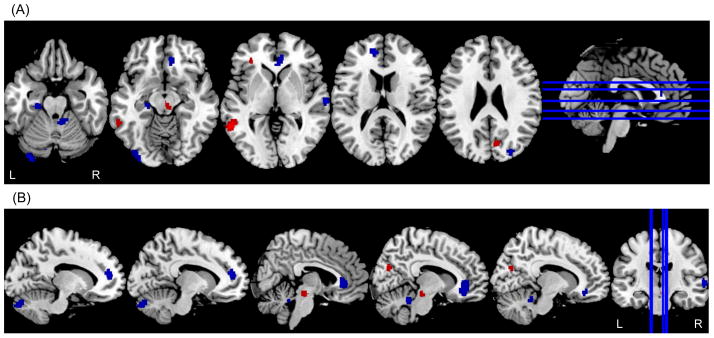
Although overweight and obesity are associated with poor health outcomes in the elderly, the biological bases of obesity-related behaviors during aging are poorly understood. Common variants in the FTO gene are associated with adiposity in children and younger adults as well as with adverse mental health in older individuals. However, it is unclear whether FTO influences longitudinal trajectories of adiposity and other intermediate phenotypes relevant to mental health during aging. We examined whether a commonly carried obesity-risk variant in the FTO gene (rs1421085 single-nucleotide polymorphism) influences adiposity and is associated with changes in brain function in participants within the Baltimore Longitudinal Study of Aging, one of the longest-running longitudinal aging studies in the United States. Our results show that obesity-related risk allele carriers of FTO gene show dose-dependent increments in body mass index during aging. Moreover, the obesity-related risk allele is associated with reduced medial prefrontal cortical function during aging. Consistent with reduced brain function in regions intrinsic to impulse control and taste responsiveness, risk allele carriers of FTO exhibit dose-dependent increments in both impulsivity and intake of fatty foods. We propose that a common neural mechanism may underlie obesity-associated impulsivity and increased consumption of high-calorie foods during aging.
尽管超重和肥胖与老年人的健康不良后果相关,但衰老过程中与肥胖相关行为的生物学基础却知之甚少。FTO基因的常见变异与儿童和年轻人的肥胖以及老年人的不良心理健康有关。然而,尚不清楚FTO是否会影响衰老过程中肥胖的纵向轨迹以及与心理健康相关的其他中间表型。我们在美国进行的一项持续时间最长的纵向衰老研究——巴尔的摩纵向衰老研究中,研究了FTO基因中一种常见的肥胖风险变异(rs1421085单核苷酸多态性)是否会影响肥胖,并与参与者大脑功能的变化相关。我们的结果表明,FTO基因的肥胖相关风险等位基因携带者在衰老过程中体重指数呈剂量依赖性增加。此外,肥胖相关风险等位基因与衰老过程中内侧前额叶皮质功能降低有关。与冲动控制和味觉反应所固有的脑区功能降低一致,FTO的风险等位基因携带者在冲动性和高脂肪食物摄入量方面均呈剂量依赖性增加。我们认为,一种常见的神经机制可能是衰老过程中与肥胖相关的冲动性和高热量食物摄入量增加的基础。