Sartipy Peter, Björquist Petter
Cellectis AB, Arvid Wallgrens Backe 20, 413 46 Göteborg, Sweden ; Systems Biology Research Center, School of Bioscience, University of Skövde, 541 28 Skövde, Sweden.
Cellectis AB, Arvid Wallgrens Backe 20, 413 46 Göteborg, Sweden ; Current address: NovaHep AB, Arvid Wallgrens Backe 20, 413 46 Göteborg, Sweden.
Clin Transl Med. 2014 May 9;3:9. doi: 10.1186/2001-1326-3-9. eCollection 2014.
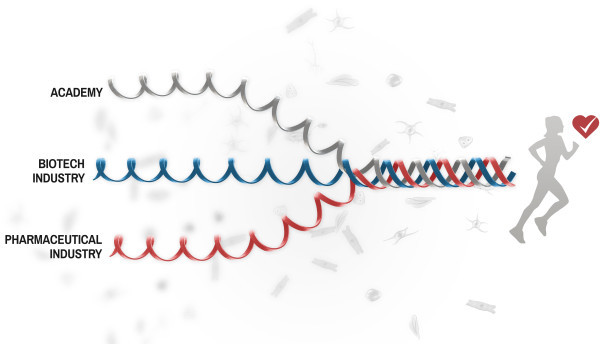
Using human pluripotent stem cells as a source to generate differentiated progenies for regenerative medicine applications has attracted substantial interest during recent years. Having the capability to produce large quantities of human cells that can replace damaged tissue due to disease or injury opens novel avenues for relieving symptoms and also potentially offers cures for many severe human diseases. Although tremendous advancements have been made, there is still much research and development left before human pluripotent stem cell derived products can be made available for cell therapy applications. In order to speed up the development processes, we argue strongly in favor of cross-disciplinary collaborative efforts which have many advantages, especially in a relatively new field such as regenerative medicine based on human pluripotent stem cells. In this review, we aim to illustrate how some of the hurdles for bringing human pluripotent stem cell derivatives from bench-to-bed can be effectively addressed through the establishment of collaborative programs involving academic institutions, biotech industries, and pharmaceutical companies. By taking advantage of the strengths from each organization, innovation and productivity can be maximized from a resource perspective and thus, the chances of successfully bringing novel regenerative medicine treatment options to patients increase.
近年来,利用人类多能干细胞作为来源来生成用于再生医学应用的分化后代引起了广泛关注。能够产生大量可替代因疾病或损伤而受损组织的人类细胞,为缓解症状开辟了新途径,也有可能为许多严重人类疾病提供治愈方法。尽管已经取得了巨大进展,但在人类多能干细胞衍生产品可用于细胞治疗应用之前,仍有许多研发工作要做。为了加快开发进程,我们强烈主张跨学科合作,这种合作有很多优势,特别是在基于人类多能干细胞的再生医学这样一个相对较新的领域。在这篇综述中,我们旨在说明如何通过建立涉及学术机构、生物技术产业和制药公司的合作项目,有效地解决将人类多能干细胞衍生物从实验室推向临床应用的一些障碍。通过利用每个组织的优势,从资源角度可以最大限度地提高创新和生产力,从而增加成功为患者带来新型再生医学治疗选择的机会。