• 文献检索
  • 文档翻译
  • 深度研究
  • 学术资讯
  • Suppr Zotero 插件Zotero 插件
  • 邀请有礼
  • 套餐&价格
  • 历史记录
应用&插件
Suppr Zotero 插件Zotero 插件浏览器插件Mac 客户端Windows 客户端微信小程序
定价
高级版会员购买积分包购买API积分包
服务
文献检索文档翻译深度研究API 文档MCP 服务
关于我们
关于 Suppr公司介绍联系我们用户协议隐私条款
关注我们

Suppr 超能文献

核心技术专利:CN118964589B侵权必究
粤ICP备2023148730 号-1Suppr @ 2026

文献检索

告别复杂PubMed语法,用中文像聊天一样搜索,搜遍4000万医学文献。AI智能推荐,让科研检索更轻松。

立即免费搜索

文件翻译

保留排版,准确专业,支持PDF/Word/PPT等文件格式,支持 12+语言互译。

免费翻译文档

深度研究

AI帮你快速写综述,25分钟生成高质量综述,智能提取关键信息,辅助科研写作。

立即免费体验

遗传成瘾风险评分(GARS):奖赏缺乏综合征(RDS)易感性的分子神经遗传学证据。

Genetic Addiction Risk Score (GARS): molecular neurogenetic evidence for predisposition to Reward Deficiency Syndrome (RDS).

作者信息

Blum Kenneth, Oscar-Berman Marlene, Demetrovics Zsolt, Barh Debmalya, Gold Mark S

机构信息

Department of Psychiatry & McKnight Brain Institute, University of Florida College of Medicine, Gainesville, FL, USA,

出版信息

Mol Neurobiol. 2014 Dec;50(3):765-96. doi: 10.1007/s12035-014-8726-5. Epub 2014 May 31.

DOI:10.1007/s12035-014-8726-5
PMID:24878765
原文链接:https://pmc.ncbi.nlm.nih.gov/articles/PMC4225054/
Abstract

We have published extensively on the neurogenetics of brain reward systems with reference to the genes related to dopaminergic function in particular. In 1996, we coined "Reward Deficiency Syndrome" (RDS), to portray behaviors found to have gene-based association with hypodopaminergic function. RDS as a useful concept has been embraced in many subsequent studies, to increase our understanding of Substance Use Disorder (SUD), addictions, and other obsessive, compulsive, and impulsive behaviors. Interestingly, albeit others, in one published study, we were able to describe lifetime RDS behaviors in a recovering addict (17 years sober) blindly by assessing resultant Genetic Addiction Risk Score (GARS™) data only. We hypothesize that genetic testing at an early age may be an effective preventive strategy to reduce or eliminate pathological substance and behavioral seeking activity. Here, we consider a select number of genes, their polymorphisms, and associated risks for RDS whereby, utilizing GWAS, there is evidence for convergence to reward candidate genes. The evidence presented serves as a plausible brain-print providing relevant genetic information that will reinforce targeted therapies, to improve recovery and prevent relapse on an individualized basis. The primary driver of RDS is a hypodopaminergic trait (genes) as well as epigenetic states (methylation and deacetylation on chromatin structure). We now have entered a new era in addiction medicine that embraces the neuroscience of addiction and RDS as a pathological condition in brain reward circuitry that calls for appropriate evidence-based therapy and early genetic diagnosis and that requires further intensive investigation.

摘要

我们已广泛发表关于大脑奖赏系统神经遗传学的研究,尤其涉及与多巴胺能功能相关的基因。1996年,我们创造了“奖赏缺乏综合征”(RDS)一词,用以描述那些被发现与多巴胺能功能减退存在基因关联的行为。作为一个有用的概念,RDS在许多后续研究中得到应用,以增进我们对物质使用障碍(SUD)、成瘾以及其他强迫性、冲动性和成瘾行为的理解。有趣的是,尽管还有其他研究,但在一项已发表的研究中,我们仅通过评估由此产生的遗传成瘾风险评分(GARS™)数据,就能盲目地描述一名康复成瘾者(已戒酒17年)一生的RDS行为。我们假设,早期进行基因检测可能是一种有效的预防策略,可减少或消除病理性物质和行为寻求活动。在此,我们考虑一些特定的基因、它们的多态性以及与RDS相关的风险,通过全基因组关联研究(GWAS),有证据表明这些基因汇聚于奖赏候选基因。所呈现的证据作为一种似是而非的脑图谱,提供了相关的遗传信息,这将加强靶向治疗,并在个体基础上改善康复效果和预防复发。RDS的主要驱动因素是多巴胺能功能减退特征(基因)以及表观遗传状态(染色质结构上的甲基化和去乙酰化)。我们现在已进入成瘾医学的新时代,该时代将成瘾神经科学和RDS视为大脑奖赏回路中的一种病理状况,这需要适当的循证治疗、早期基因诊断,并且需要进一步深入研究。
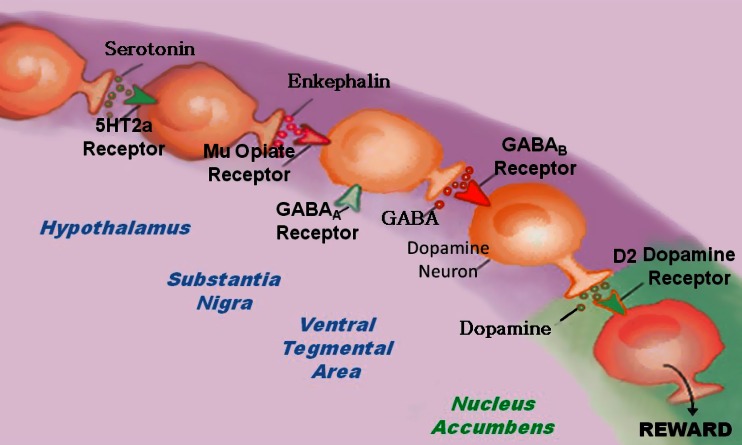
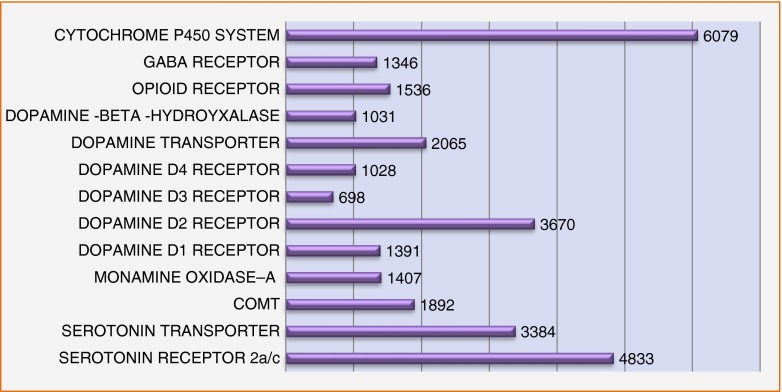
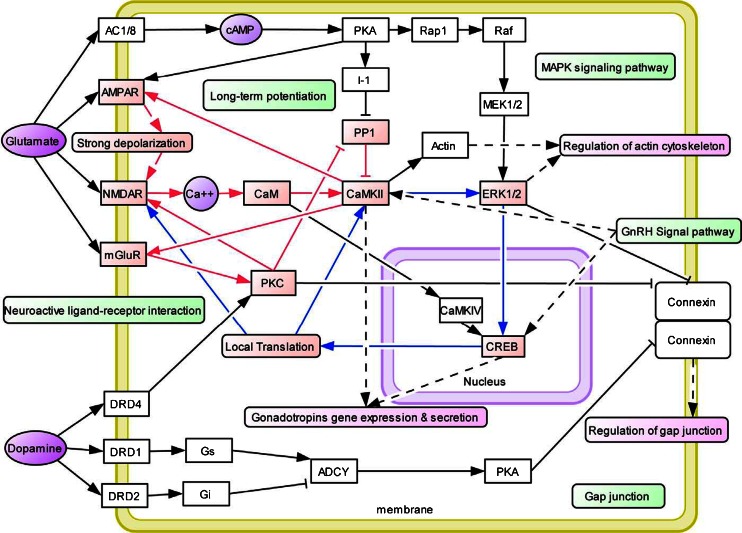
https://cdn.ncbi.nlm.nih.gov/pmc/blobs/9ac1/4225054/98fa58d92dd4/12035_2014_8726_Fig3_HTML.jpg
https://cdn.ncbi.nlm.nih.gov/pmc/blobs/9ac1/4225054/7d44088f79f4/12035_2014_8726_Fig1_HTML.jpg
https://cdn.ncbi.nlm.nih.gov/pmc/blobs/9ac1/4225054/ca78d3f5019e/12035_2014_8726_Fig2_HTML.jpg
https://cdn.ncbi.nlm.nih.gov/pmc/blobs/9ac1/4225054/98fa58d92dd4/12035_2014_8726_Fig3_HTML.jpg
https://cdn.ncbi.nlm.nih.gov/pmc/blobs/9ac1/4225054/7d44088f79f4/12035_2014_8726_Fig1_HTML.jpg
https://cdn.ncbi.nlm.nih.gov/pmc/blobs/9ac1/4225054/ca78d3f5019e/12035_2014_8726_Fig2_HTML.jpg
https://cdn.ncbi.nlm.nih.gov/pmc/blobs/9ac1/4225054/98fa58d92dd4/12035_2014_8726_Fig3_HTML.jpg

相似文献

1
Genetic Addiction Risk Score (GARS): molecular neurogenetic evidence for predisposition to Reward Deficiency Syndrome (RDS).遗传成瘾风险评分(GARS):奖赏缺乏综合征(RDS)易感性的分子神经遗传学证据。
Mol Neurobiol. 2014 Dec;50(3):765-96. doi: 10.1007/s12035-014-8726-5. Epub 2014 May 31.
2
Neurogenetic Impairments of Brain Reward Circuitry Links to Reward Deficiency Syndrome (RDS): Potential Nutrigenomic Induced Dopaminergic Activation.大脑奖赏回路的神经遗传损伤与奖赏缺乏综合征(RDS)的关联:潜在的营养基因组学诱导的多巴胺能激活。
J Genet Syndr Gene Ther. 2012 Oct 17;3(4). doi: 10.4172/2157-7412.1000e115.
3
Dopamine Genetics and Function in Food and Substance Abuse.多巴胺遗传学及其在食物与物质滥用中的作用
J Genet Syndr Gene Ther. 2013 Feb 10;4(121). doi: 10.4172/2157-7412.1000121.
4
Biotechnical development of genetic addiction risk score (GARS) and selective evidence for inclusion of polymorphic allelic risk in substance use disorder (SUD).遗传成瘾风险评分(GARS)的生物技术发展以及物质使用障碍(SUD)中纳入多态性等位基因风险的选择性证据。
J Syst Integr Neurosci. 2020 Aug;6(2). doi: 10.15761/JSIN.1000221. Epub 2019 Dec 19.
5
Coupling Neurogenetics (GARS™) and a Nutrigenomic Based Dopaminergic Agonist to Treat Reward Deficiency Syndrome (RDS): Targeting Polymorphic Reward Genes for Carbohydrate Addiction Algorithms.结合神经遗传学(GARS™)和基于营养基因组学的多巴胺能激动剂治疗奖赏缺乏综合征(RDS):针对碳水化合物成瘾算法的多态性奖赏基因
J Reward Defic Syndr. 2015;1(2):75-80. doi: 10.17756/jrds.2015-012. Epub 2015 Jun 24.
6
In Search of Reward Deficiency Syndrome (RDS)-free Controls: The "Holy Grail" in Genetic Addiction Risk Testing.寻找无奖赏缺乏综合征(RDS)的对照:基因成瘾风险测试中的“圣杯”。
Curr Psychopharmacol. 2020;9(1):7-21.
7
Reward Deficiency Syndrome (RDS): A Cytoarchitectural Common Neurobiological Trait of All Addictions.奖赏缺乏综合征(RDS):所有成瘾行为的一种细胞结构共同神经生物学特征。
Int J Environ Res Public Health. 2021 Nov 2;18(21):11529. doi: 10.3390/ijerph182111529.
8
Manipulation of catechol-O-methyl-transferase (COMT) activity to influence the attenuation of substance seeking behavior, a subtype of Reward Deficiency Syndrome (RDS), is dependent upon gene polymorphisms: a hypothesis.操纵儿茶酚-O-甲基转移酶(COMT)活性以影响奖赏缺乏综合征(RDS)的一种亚型——觅药行为的减弱,取决于基因多态性:一种假说。
Med Hypotheses. 2007;69(5):1054-60. doi: 10.1016/j.mehy.2006.12.062. Epub 2007 Apr 30.
9
The Future is Now for Precision Genomic Addiction Medicine as a Frontline Modality for Inducing "Dopamine Homeostasis" in Reward Deficiency Syndrome (RDS).精准基因组成瘾医学作为在奖赏缺乏综合征(RDS)中诱导“多巴胺稳态”的一线治疗手段,未来已来。
Curr Pharm Biotechnol. 2023 Apr 27. doi: 10.2174/1389201024666230427111117.
10
Should Reward Deficiency Syndrome (RDS) Be Considered an Umbrella Disorder for Mental Illness and Associated Genetic and Epigenetic Induced Dysregulation of Brain Reward Circuitry?奖励缺陷综合征(RDS)是否应被视为精神疾病以及相关基因和表观遗传诱导的脑奖励回路失调的一种综合性病症?
J Pers Med. 2022 Oct 14;12(10):1719. doi: 10.3390/jpm12101719.

引用本文的文献

1
Is It Scientifically Possible To 'Cure" Reward Deficiency Syndrome (RDS) Via Transplice Molecular Genetic Technology?通过转剪接分子基因技术“治愈”奖赏缺乏综合征(RDS)在科学上是否可行?
Acta Sci Neurol. 2025 Apr 1;8(4):15-20. doi: 10.31080/asne.2025.08.0815. Epub 2025 Mar 13.
2
Seeking Satisfaction Among Israeli Young Adults: The Roles of Gratification, Compensation, Reward Deficiency Syndrome, and Compulsivity in Relation to Addictive Behaviors.在以色列年轻人中寻求满足感:满足、补偿、奖励缺乏综合征以及强迫性与成瘾行为的关系
Subst Abuse Rehabil. 2025 Jul 2;16:177-191. doi: 10.2147/SAR.S527209. eCollection 2025.
3

本文引用的文献

1
Systems genetics: a paradigm to improve discovery of candidate genes and mechanisms underlying complex traits.系统遗传学:一种改善复杂性状潜在候选基因和机制发现的范式。
Plant Sci. 2014 Jun;223:45-8. doi: 10.1016/j.plantsci.2014.03.003. Epub 2014 Mar 13.
2
Clinical application of whole-genome sequencing: proceed with care.全基因组测序的临床应用:谨慎推进。
JAMA. 2014 Mar 12;311(10):1017-9. doi: 10.1001/jama.2014.1718.
3
Personality traits and vulnerability or resilience to substance use disorders.人格特质与物质使用障碍的易感性或恢复力
Psychometric properties of the Reward Deficiency Syndrome Questionnaire among a non-clinical sample and its relationship with the characteristics of potentially addictive behaviors.
非临床样本中奖励缺乏综合征问卷的心理测量学特性及其与潜在成瘾行为特征的关系。
Addict Behav Rep. 2025 Mar 24;21:100598. doi: 10.1016/j.abrep.2025.100598. eCollection 2025 Jun.
4
Is There a Natural, Non-addictive, and Non-anti-reward, Safe, Gene-based Solution to Treat Reward Deficiency Syndrome? KB220 Variants vs GLP-1 Analogs.是否存在一种天然、无成瘾性、无抗奖赏作用、安全的基于基因的疗法来治疗奖赏缺乏综合征?KB220变体与胰高血糖素样肽-1类似物的比较。
J Addict Psychiatry. 2024;8(1):34-49. Epub 2024 May 20.
5
Molecular and Environmental Determinants of Addictive Substances.成瘾物质的分子和环境决定因素。
Biomolecules. 2024 Nov 5;14(11):1406. doi: 10.3390/biom14111406.
6
A historical perspective on clonidine as an alpha-2A receptor agonist in the treatment of addictive behaviors: Focus on opioid dependence.可乐定作为α-2A受体激动剂治疗成瘾行为的历史视角:聚焦于阿片类药物依赖
INNOSC Theranostics Pharmacol Sci. 2024;7(3). doi: 10.36922/itps.1918. Epub 2024 Jul 29.
7
Summary Document Research on RDS Anti-addiction Modeling: Annotated Bibliography.RDS抗成瘾建模研究总结文档:注释书目
J Addict Psychiatry. 2024 Apr 5;8(1):1-33.
8
Stigmata that are desired: Contradictions in addiction.令人向往的特征:成瘾中的矛盾
Addict Res Theory. 2024;32(2):83-92. doi: 10.1080/16066359.2023.2238603. Epub 2023 Jul 23.
9
Evidence Based Clinical Analytics Supporting the Genetic Addiction Risk Severity (GARS) Assessment to Early Identify Probands in Preaddiction.基于证据的临床分析支持遗传成瘾风险严重程度(GARS)评估,以在预测前期早期识别先证者。
EC Psychol Psychiatr. 2024 Dec 26;13(1):1-3.
10
Are We Getting High Cause the Thrill is Gone?我们是因为刺激不再而兴奋吗?
J Addict Psychiatry. 2023;7(1):5-516. Epub 2023 Dec 8.
Trends Cogn Sci. 2014 Apr;18(4):211-7. doi: 10.1016/j.tics.2014.01.010. Epub 2014 Mar 5.
4
Pharmacogenomics in psychiatry: the relevance of receptor and transporter polymorphisms.精神病学中的药物基因组学:受体和转运体多态性的相关性
Br J Clin Pharmacol. 2014 Apr;77(4):654-72. doi: 10.1111/bcp.12312.
5
Integrating GWASs and human protein interaction networks identifies a gene subnetwork underlying alcohol dependence.整合 GWASs 和人类蛋白质相互作用网络,确定了酒精依赖的基因子网络。
Am J Hum Genet. 2013 Dec 5;93(6):1027-34. doi: 10.1016/j.ajhg.2013.10.021. Epub 2013 Nov 21.
6
Curious cases: Altered dose-response relationships in addiction genetics.好奇的案例:成瘾遗传学中改变的剂量-反应关系。
Pharmacol Ther. 2014 Mar;141(3):335-46. doi: 10.1016/j.pharmthera.2013.10.013. Epub 2013 Nov 1.
7
Have We Hatched the Addiction Egg: Reward Deficiency Syndrome Solution System™.我们孵化出成瘾之卵了吗:奖赏缺乏综合征解决方案系统™
J Genet Syndr Gene Ther. 2013 Jun 3;4(136):14318. doi: 10.4172/2157-7412.1000136.
8
Neurogenetics and Nutrigenomics of Neuro-Nutrient Therapy for Reward Deficiency Syndrome (RDS): Clinical Ramifications as a Function of Molecular Neurobiological Mechanisms.奖赏缺乏综合征(RDS)神经营养疗法的神经遗传学与营养基因组学:作为分子神经生物学机制函数的临床影响
J Addict Res Ther. 2012 Nov 27;3(5):139. doi: 10.4172/2155-6105.1000139.
9
A factor analysis of global GABAergic gene expression in human brain identifies specificity in response to chronic alcohol and cocaine exposure.对人类大脑中全球 GABA 能基因表达的因子分析确定了对慢性酒精和可卡因暴露反应的特异性。
PLoS One. 2013 May 22;8(5):e64014. doi: 10.1371/journal.pone.0064014. Print 2013.
10
Long-term stimulant treatment affects brain dopamine transporter level in patients with attention deficit hyperactive disorder.长期兴奋剂治疗会影响注意缺陷多动障碍患者的大脑多巴胺转运体水平。
PLoS One. 2013 May 15;8(5):e63023. doi: 10.1371/journal.pone.0063023. Print 2013.