Pauls S, Foley N C, Foley D K, LeSauter J, Hastings M H, Maywood E S, Silver R
Department of Mathematics, Dartmouth College, 6188 Kemeny Hall, Hanover, NH, 03755, USA.
Eur J Neurosci. 2014 Aug;40(3):2528-40. doi: 10.1111/ejn.12631. Epub 2014 Jun 2.
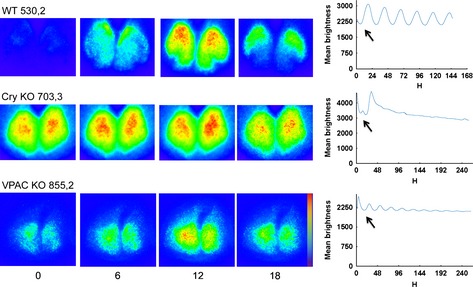
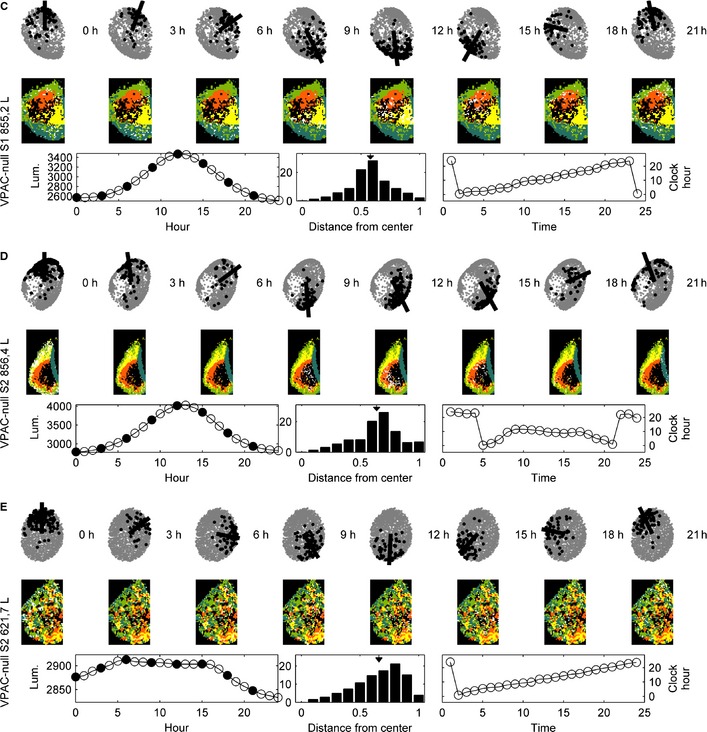
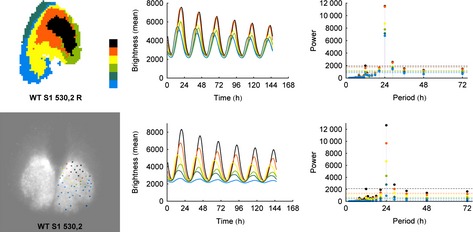
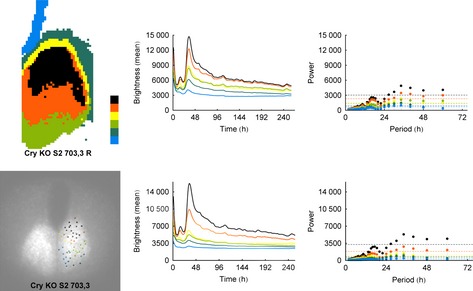
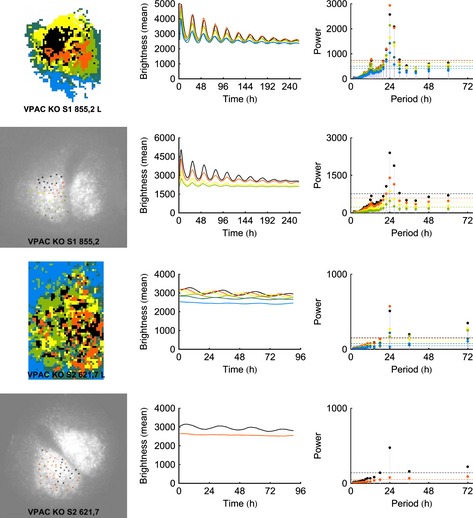
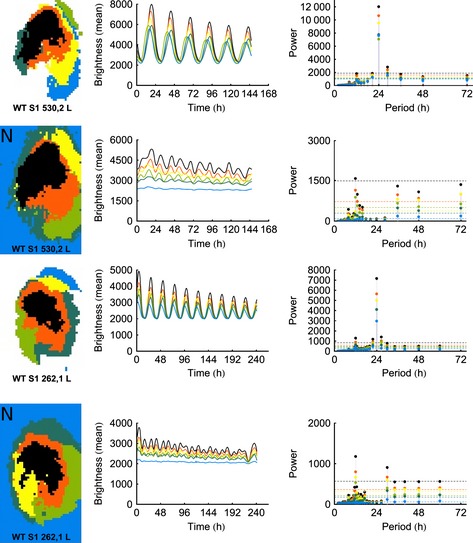
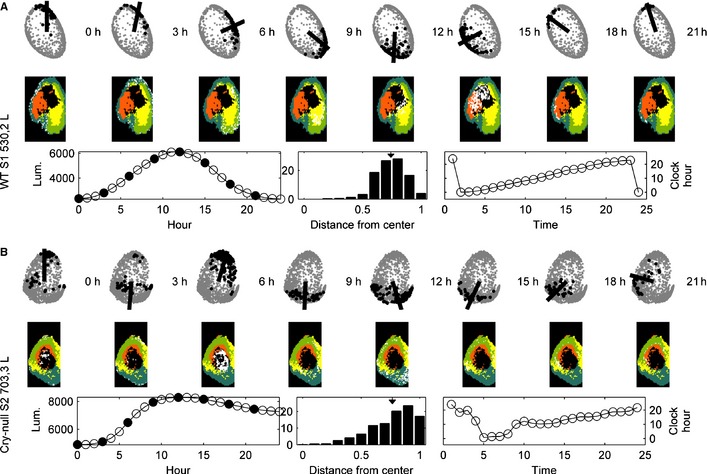
To serve as a robust internal circadian clock, the cell-autonomous molecular and electrophysiological activities of the individual neurons of the mammalian suprachiasmatic nucleus (SCN) are coordinated in time and neuroanatomical space. Although the contributions of the chemical and electrical interconnections between neurons are essential to this circuit-level orchestration, the features upon which they operate to confer robustness to the ensemble signal are not known. To address this, we applied several methods to deconstruct the interactions between the spatial and temporal organisation of circadian oscillations in organotypic slices from mice with circadian abnormalities. We studied the SCN of mice lacking Cryptochrome genes (Cry1 and Cry2), which are essential for cell-autonomous oscillation, and the SCN of mice lacking the vasoactive intestinal peptide receptor 2 (VPAC2-null), which is necessary for circuit-level integration, in order to map biological mechanisms to the revealed oscillatory features. The SCN of wild-type mice showed a strong link between the temporal rhythm of the bioluminescence profiles of PER2::LUC and regularly repeated spatially organised oscillation. The Cry-null SCN had stable spatial organisation but lacked temporal organisation, whereas in VPAC2-null SCN some specimens exhibited temporal organisation in the absence of spatial organisation. The results indicated that spatial and temporal organisation were separable, that they may have different mechanistic origins (cell-autonomous vs. interneuronal signaling) and that both were necessary to maintain robust and organised circadian rhythms throughout the SCN. This study therefore provided evidence that the coherent emergent properties of the neuronal circuitry, revealed in the spatially organised clusters, were essential to the pacemaking function of the SCN.
为了充当强大的内部昼夜节律时钟,哺乳动物视交叉上核(SCN)单个神经元的细胞自主分子和电生理活动在时间和神经解剖空间上是协调一致的。尽管神经元之间的化学和电连接对这种回路水平的协调至关重要,但它们赖以运作以使整体信号具有稳健性的特征尚不清楚。为了解决这个问题,我们应用了几种方法来解构来自昼夜节律异常小鼠的器官型切片中昼夜节律振荡的空间和时间组织之间的相互作用。我们研究了缺乏隐花色素基因(Cry1和Cry2)的小鼠的SCN,这两种基因对细胞自主振荡至关重要,以及缺乏血管活性肠肽受体2(VPAC2基因敲除)的小鼠的SCN,这对回路水平的整合是必需的,以便将生物学机制映射到所揭示的振荡特征上。野生型小鼠的SCN显示出PER2::LUC生物发光图谱的时间节律与规则重复的空间组织振荡之间有很强的联系。Cry基因敲除的SCN具有稳定的空间组织,但缺乏时间组织,而在VPAC2基因敲除的SCN中,一些标本在没有空间组织的情况下表现出时间组织。结果表明,空间和时间组织是可分离的,它们可能有不同的机制起源(细胞自主与神经元间信号传导),并且两者对于在整个SCN中维持稳健且有组织的昼夜节律都是必需的。因此,这项研究提供了证据,表明在空间组织的簇中揭示的神经元回路的连贯涌现特性对于SCN的起搏功能至关重要。