Tagliafico Alberto, Bignotti Bianca, Tagliafico Giulio, Astengo Davide, Martino Lucia, Airaldi Sonia, Signori Alessio, Sormani Maria Pia, Houssami Nehmat, Calabrese Massimo
Institute of Anatomy, Department of Experimental Medicine, University of Genova, Genova, Italy.
Radiology Department, University of Genova, Genova, Italy.
PLoS One. 2014 Jun 3;9(6):e99027. doi: 10.1371/journal.pone.0099027. eCollection 2014.
To compare MRI sequences for breast density measurements on a 3T MRI system using IDEAL (Iterative Decomposition of water and fat with Echo Asymmetry and Least squares estimation) as possible physiology-like reference.
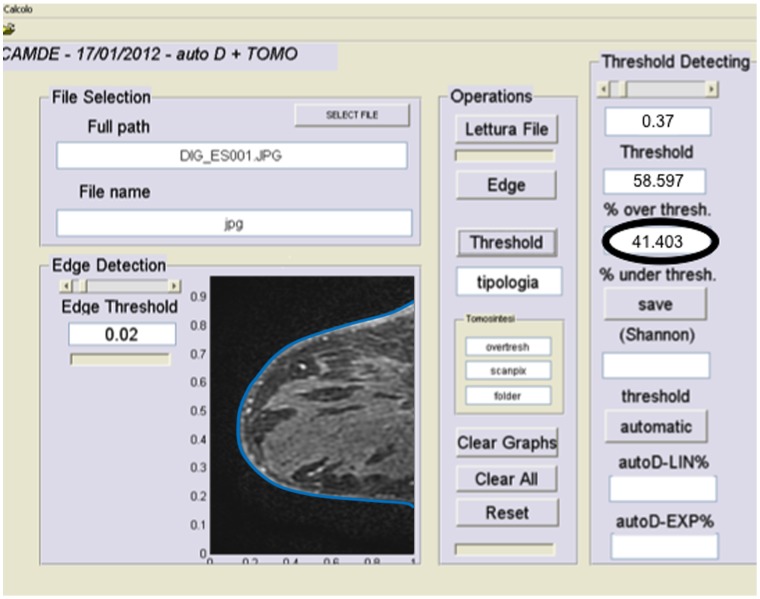
MRI examination was performed in 48 consecutive patients (mean age 41, years; range, 35-67 years) on a 3.0T scanner and 46 were included. All (fertile) women, were examined between days 5 and 15 of their menstrual cycle. MRI protocol included: T1-turbo spin-echo (T1-tSE), T2-turbo spin-echo (T2-tSE), VIBRANT (Volume Imaging for Breast Assessment) before and after injection of contrast media and IDEAL. Breast density was calculated with semi-automated software. Statistical analysis was performed with non-parametric tests.
Mean percentage of breast density calculated in each sequence was: T1-tSE = 56%; T2-tSE = 52%; IDEAL FatOnly = 55%; IDEAL WaterOnly = 53%, VIBRANT = 55%. Significant differences were observed between T2-tSE and both T1-tSE (p<0.001), VIBRANT sequences (p = 0.009), T1-tSE and both IDEAL WaterOnly (p = 0.007) and IDEAL FatOnly (p = 0.047). Breast density percentage showed a positive linear correlation among different sequences: r ≥ 0.93.
Differences exist between MRI sequences used to assess breast density percentage. T1-weighted sequences values were similar to IDEAL sequences.
在3T磁共振成像(MRI)系统上,比较使用迭代分解水和脂肪与回波不对称及最小二乘估计(IDEAL)作为可能的类似生理参考的MRI序列用于乳腺密度测量的情况。
对48例连续患者(平均年龄41岁;范围35 - 67岁)在3.0T扫描仪上进行MRI检查,纳入46例。所有(育龄)女性在月经周期的第5至15天接受检查。MRI检查方案包括:T1加权快速自旋回波(T1-tSE)、T2加权快速自旋回波(T2-tSE)、注射造影剂前后的乳腺容积成像(VIBRANT)以及IDEAL。使用半自动软件计算乳腺密度。采用非参数检验进行统计分析。
各序列计算出的乳腺密度平均百分比为:T1-tSE = 56%;T2-tSE = 52%;IDEAL仅脂肪图像 = 55%;IDEAL仅水图像 = 53%,VIBRANT = 55%。观察到T2-tSE与T1-tSE(p<0.001)、VIBRANT序列(p = 0.009)、T1-tSE与IDEAL仅水图像(p = 0.007)以及IDEAL仅脂肪图像(p = 0.047)之间存在显著差异。不同序列间乳腺密度百分比呈正线性相关:r≥0.93。
用于评估乳腺密度百分比的MRI序列之间存在差异。T1加权序列值与IDEAL序列相似。