Jones Jason D, Cassidy Jude
a Department of Psychology , University of Maryland , College Park , USA.
Attach Hum Dev. 2014;16(5):437-61. doi: 10.1080/14616734.2014.921718. Epub 2014 Jun 5.
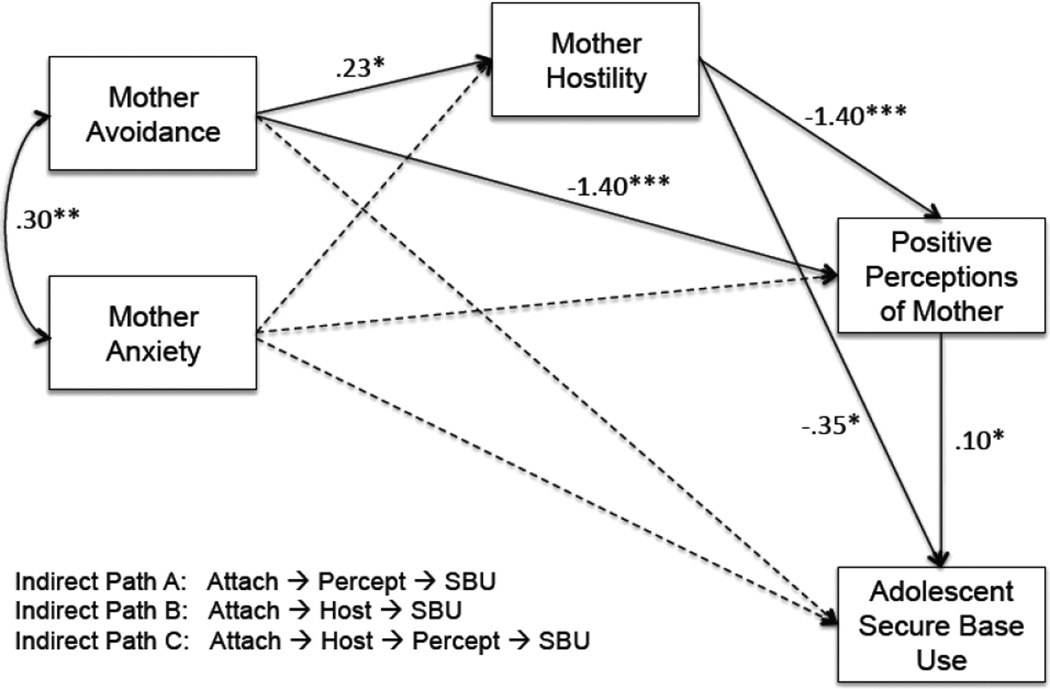
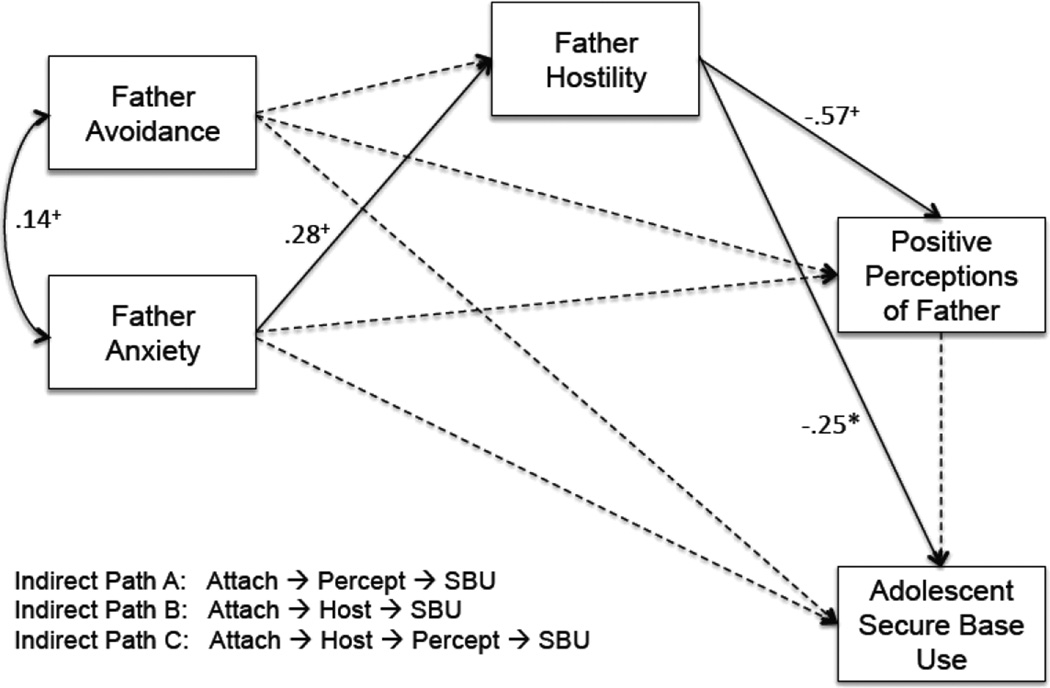
The secure base construct represents one of attachment theory's most important contributions to our understanding of parent-child relationships and child development. The present study represents the first examination of how parents' self-reported attachment styles relate to parental secure base provision and adolescent (mean age = 16.6 years, SE = .59) secure base use during an observed parent-adolescent interaction. Further, the present study is the first to examine how fathers', as well as mothers', attachment styles relate to observed behavior in a parent-child interaction. At the bivariate level, maternal avoidance, but not anxiety, was negatively associated with observed adolescent secure base use. In addition, path analysis revealed that maternal avoidance was indirectly related to less adolescent secure base use through mothers' self-reported hostile behavior toward their adolescents and through adolescents' less positive perceptions of their mothers. Further, paternal anxiety, but not avoidance, was indirectly related to less adolescent secure base use through fathers' self-reported hostile behavior toward their adolescents. No significant findings emerged in relation to parental secure base provision. We discuss these results in the context of attachment theory and suggest directions for future research.
安全基地概念是依恋理论对我们理解亲子关系和儿童发展的最重要贡献之一。本研究首次考察了父母自我报告的依恋风格与在观察到的亲子互动中父母提供安全基地以及青少年(平均年龄 = 16.6岁,标准误 = 0.59)使用安全基地之间的关系。此外,本研究首次考察了父亲以及母亲的依恋风格与亲子互动中观察到的行为之间的关系。在双变量水平上,母亲的回避而非焦虑与观察到的青少年使用安全基地呈负相关。此外,路径分析表明,母亲的回避通过母亲自我报告的对青少年的敌意行为以及青少年对母亲的较不积极看法,与青少年较少使用安全基地间接相关。此外,父亲的焦虑而非回避通过父亲自我报告的对青少年的敌意行为与青少年较少使用安全基地间接相关。在父母提供安全基地方面未出现显著结果。我们在依恋理论的背景下讨论这些结果,并提出未来研究的方向。