Biehl Anna, Hovengen Ragnhild, Grøholt Else-Karin, Hjelmesæth Jøran, Strand Bjørn Heine, Meyer Haakon E
Division of Epidemiology, Norwegian Institute of Public Health, Oslo, Norway The Morbid Obesity Centre, Vestfold Hospital Trust, Tønsberg, Norway.
Division of Epidemiology, Norwegian Institute of Public Health, Oslo, Norway.
BMJ Open. 2014 Jun 4;4(6):e004502. doi: 10.1136/bmjopen-2013-004502.
Sociodemographic changes in Norway and other western industrialised countries, including family structure and an increasing proportion of cohabiting and divorced parents, might affect the prevalence of childhood overweight and obesity issues. We aimed to examine whether parental marital status was associated with general and abdominal obesity among children. We also sought to explore whether the associations differed by gender.
Cross-sectional.
127 primary schools across Norway.
3166 third graders (mean age 8.3 years) participating in the nationally representative Norwegian Child Growth Study in 2010.
Height, weight and waist circumference were objectively measured. The main outcome measures were general overweight (including obesity; body mass index ≥25 kg/m(2)) using International Obesity Task Force (IOTF) cut-offs and abdominal obesity (waist-to-height ratio ≥0.5) by gender and parental marital status. Prevalence ratios, adjusted for possible confounders, were calculated by log-binomial regression.
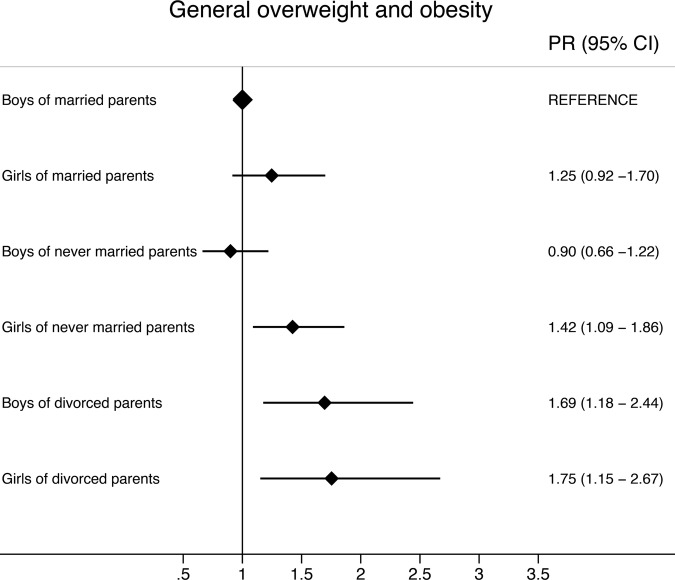
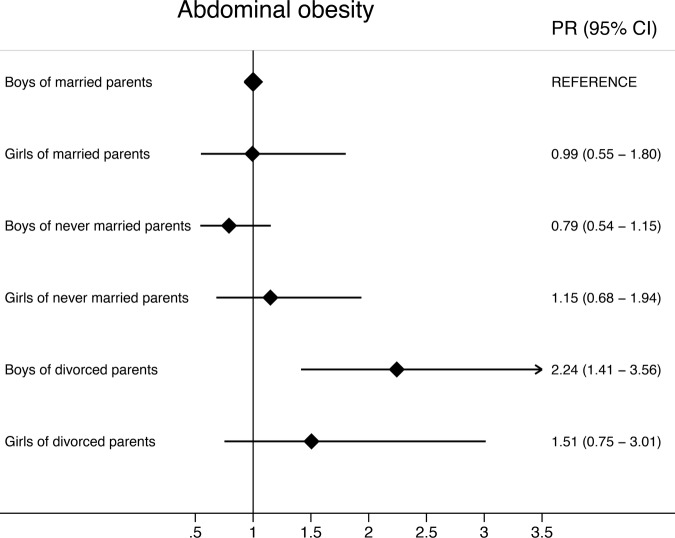
General overweight (including obesity) was 1.54 (95% CI 1.21 to 1.95) times more prevalent among children of divorced parents compared with children of married parents, and the corresponding prevalence ratio for abdominal obesity was 1.89 (95% CI 1.35 to 2.65). Formal tests of the interaction term parental marital status by gender were not statistically significant. However, in gender-specific analyses the association between parental marital status and adiposity measures was only statistically significant in boys (p=0.04 for general overweight (including obesity) and p=0.01 for abdominal obesity). The estimates were robust against adjustment for maternal education, family country background and current area of residence.
General and abdominal obesities were more prevalent among children of divorced parents. This study provides valuable information by focusing on societal changes in order to identify vulnerable groups.
挪威及其他西方工业化国家的社会人口结构变化,包括家庭结构以及同居和离异父母比例的增加,可能会影响儿童超重和肥胖问题的患病率。我们旨在研究父母的婚姻状况是否与儿童的全身性肥胖和腹部肥胖有关。我们还试图探究这种关联是否因性别而异。
横断面研究。
挪威的127所小学。
2010年参与具有全国代表性的挪威儿童生长发育研究的3166名三年级学生(平均年龄8.3岁)。
客观测量身高、体重和腰围。主要结局指标为根据国际肥胖特别工作组(IOTF)的标准界定的全身性超重(包括肥胖;体重指数≥25kg/m²)以及按性别和父母婚姻状况划分的腹部肥胖(腰高比≥0.5)。通过对数二项回归计算调整了可能混杂因素后的患病率比值。
与父母已婚的儿童相比,父母离异的儿童全身性超重(包括肥胖)的患病率高出1.54倍(95%置信区间1.21至1.95),腹部肥胖的相应患病率比值为1.89(95%置信区间1.35至2.65)。父母婚姻状况与性别交互项的正式检验无统计学意义。然而,在按性别进行的分析中,父母婚姻状况与肥胖指标之间的关联仅在男孩中具有统计学意义(全身性超重(包括肥胖)p = 0.04,腹部肥胖p = 0.01)。在对母亲教育程度、家庭国家背景和当前居住地区进行调整后,这些估计值依然稳健。
父母离异的儿童中全身性肥胖和腹部肥胖更为普遍。本研究通过关注社会变化以识别弱势群体,提供了有价值的信息。