Institute of Parasitology and Centre for Host-Parasite Interactions, McGill University, Ste-Anne-de-Bellevue, Quebec, Canada.
Department of Biomedical Sciences, College of Veterinary Medicine, Iowa State University, Ames, Iowa, United States of America.
PLoS Negl Trop Dis. 2014 Jun 5;8(6):e2939. doi: 10.1371/journal.pntd.0002939. eCollection 2014 Jun.
Strategies employed by parasites to establish infections are poorly understood. The host-parasite interface is maintained through a molecular dialog that, among other roles, protects parasites from host immune responses. Parasite excretory/secretory products (ESP) play major roles in this process. Understanding the biology of protein secretion by parasites and their associated functional processes will enhance our understanding of the roles of ESP in host-parasite interactions.
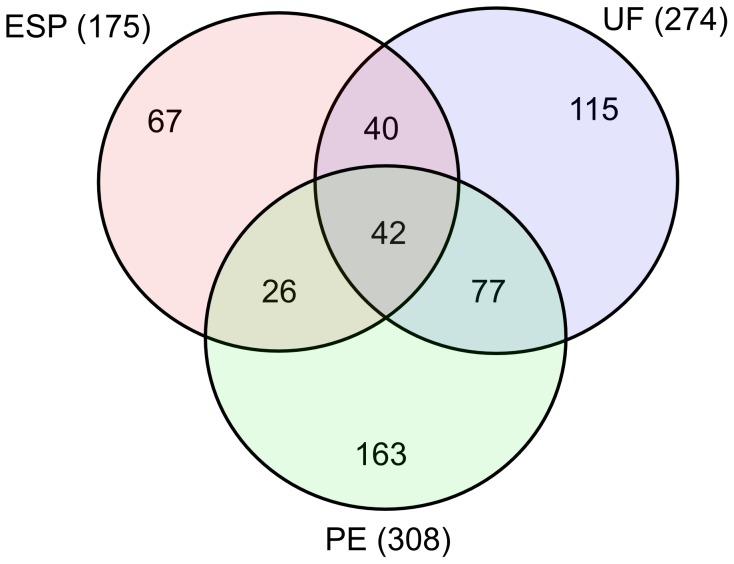
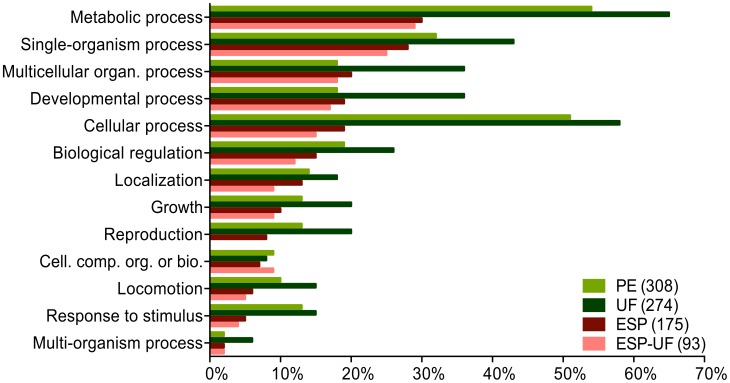
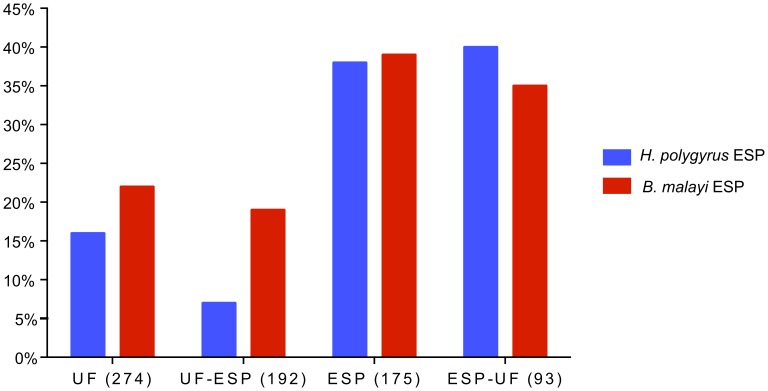
METHODOLOGY/PRINCIPAL FINDINGS: ESP was collected after culturing 10 adult female Ascaris suum. Perienteric fluid (PE) and uterine fluid (UF) were collected directly from adult females by dissection. Using SDS-PAGE coupled with LC-MS/MS, we identified 175, 308 and 274 proteins in ESP, PE and UF, respectively. Although many proteins were shared among the samples, the protein composition of ESP was distinct from PE and UF, whereas PE and UF were highly similar. The distribution of gene ontology (GO) terms for proteins in ESP, PE and UF supports this claim. Comparison of ESP composition in A. suum, Brugia malayi and Heligmosoides polygyrus showed that proteins found in UF were also secreted by males and by larval stages of other species, suggesting that multiple routes of secretion may be used for homologous proteins. ESP composition of nematodes is both phylogeny- and niche-dependent.
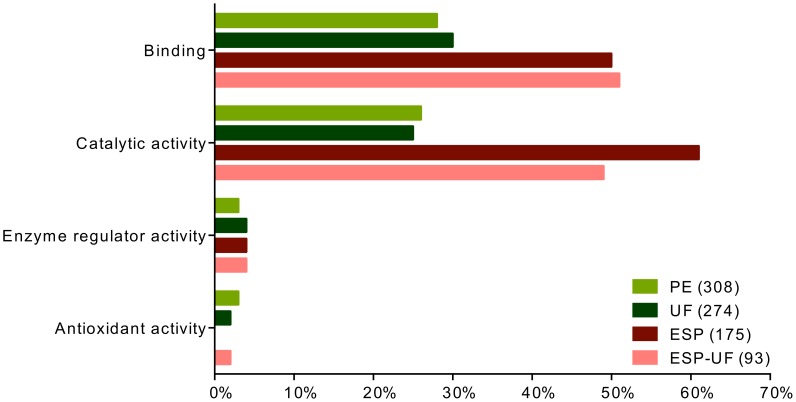
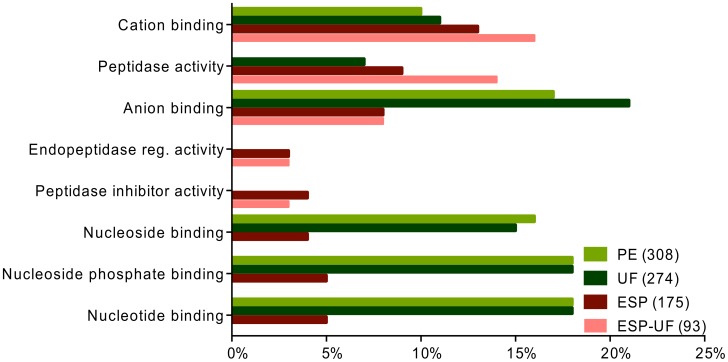
CONCLUSIONS/SIGNIFICANCE: Analysis of the protein composition of A. suum ESP and UF leads to the conclusion that the excretory-secretory apparatus and uterus are separate routes for protein release. Proteins detected in ESP have distinct patterns of biological functions compared to those in UF. PE is likely to serve as the source of the majority of proteins in UF. This analysis expands our knowledge of the biology of protein secretion from nematodes and will inform new studies on the function of secreted proteins in the orchestration of host-parasite interactions.
寄生虫用来建立感染的策略还了解甚少。宿主-寄生虫界面通过分子对话来维持,除其他作用外,该对话还保护寄生虫免受宿主免疫反应的影响。寄生虫排泄/分泌产物(ESP)在这个过程中起主要作用。了解寄生虫的蛋白质分泌生物学及其相关的功能过程将增强我们对 ESP 在宿主-寄生虫相互作用中的作用的理解。
方法/主要发现:ESP 是在培养 10 只成年雌性猪蛔虫后收集的。通过解剖直接从成年雌性体内采集体腔液(PE)和子宫液(UF)。使用 SDS-PAGE 结合 LC-MS/MS,我们分别在 ESP、PE 和 UF 中鉴定出 175、308 和 274 种蛋白质。尽管许多蛋白质在样本中共享,但 ESP 的蛋白质组成与 PE 和 UF 不同,而 PE 和 UF 则非常相似。ESP、PE 和 UF 中蛋白质的基因本体(GO)术语分布支持这一说法。对猪蛔虫、班氏丝虫和旋毛虫 ESP 组成的比较表明,UF 中发现的蛋白质也由雄性和其他物种的幼虫阶段分泌,这表明可能有多种分泌途径用于同源蛋白。线虫的 ESP 组成既依赖于系统发育又依赖于生态位。
结论/意义:对猪蛔虫 ESP 和 UF 蛋白质组成的分析得出结论,排泄-分泌器官和子宫是蛋白质释放的不同途径。ESP 中检测到的蛋白质与 UF 中的蛋白质相比具有明显不同的生物学功能模式。PE 可能是 UF 中大多数蛋白质的来源。该分析扩展了我们对线虫蛋白质分泌生物学的认识,并为研究分泌蛋白在宿主-寄生虫相互作用中的功能提供了新的信息。