Sigaut Lorena, Pearson John E, Colman-Lerner Alejandro, Ponce Dawson Silvina
Departamento de Física and IFIBA, FCEN-UBA - CONICET, Buenos Aires, Argentina.
Theoretical Biology and Biophysics, Los Alamos National Laboratory, Los Alamos, New Mexico, United States of America.
PLoS Comput Biol. 2014 Jun 5;10(6):e1003629. doi: 10.1371/journal.pcbi.1003629. eCollection 2014 Jun.
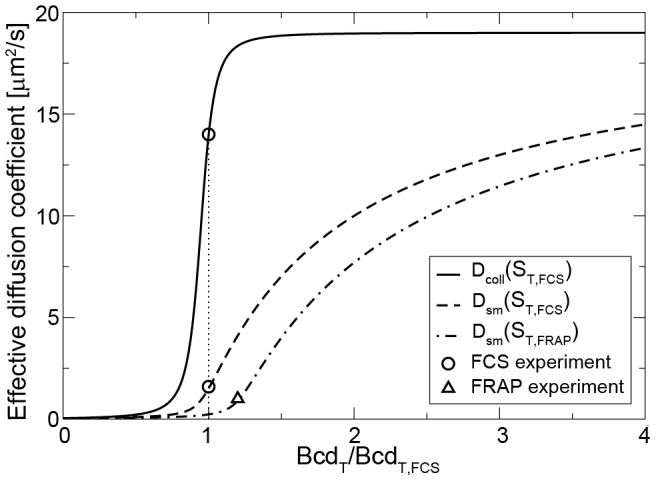
The gradient of Bicoid (Bcd) is key for the establishment of the anterior-posterior axis in Drosophila embryos. The gradient properties are compatible with the SDD model in which Bcd is synthesized at the anterior pole and then diffuses into the embryo and is degraded with a characteristic time. Within this model, the Bcd diffusion coefficient is critical to set the timescale of gradient formation. This coefficient has been measured using two optical techniques, Fluorescence Recovery After Photobleaching (FRAP) and Fluorescence Correlation Spectroscopy (FCS), obtaining estimates in which the FCS value is an order of magnitude larger than the FRAP one. This discrepancy raises the following questions: which estimate is "correct''; what is the reason for the disparity; and can the SDD model explain Bcd gradient formation within the experimentally observed times? In this paper, we use a simple biophysical model in which Bcd diffuses and interacts with binding sites to show that both the FRAP and the FCS estimates may be correct and compatible with the observed timescale of gradient formation. The discrepancy arises from the fact that FCS and FRAP report on different effective (concentration dependent) diffusion coefficients, one of which describes the spreading rate of the individual Bcd molecules (the messengers) and the other one that of their concentration (the message). The latter is the one that is more relevant for the gradient establishment and is compatible with its formation within the experimentally observed times.
双尾(Bcd)梯度对于果蝇胚胎前后轴的建立至关重要。该梯度特性与SDD模型相符,在该模型中,Bcd在前极合成,然后扩散到胚胎中,并在特定时间内降解。在此模型中,Bcd扩散系数对于设定梯度形成的时间尺度至关重要。已使用两种光学技术,即光漂白后荧光恢复(FRAP)和荧光相关光谱(FCS)来测量该系数,得到的估计值中FCS值比FRAP值大一个数量级。这种差异引发了以下问题:哪个估计值是“正确的”;差异的原因是什么;以及SDD模型能否在实验观察到的时间内解释Bcd梯度的形成?在本文中,我们使用一个简单的生物物理模型,其中Bcd扩散并与结合位点相互作用,以表明FRAP和FCS估计值可能都是正确的,并且与观察到的梯度形成时间尺度相符。差异源于FCS和FRAP报告的是不同的有效(浓度依赖性)扩散系数,其中一个描述单个Bcd分子(信使)的扩散速率,另一个描述其浓度(信息)的扩散速率。后者对于梯度建立更相关,并且与其在实验观察到的时间内形成相符。