Fernández Eva, Pérez-Pérez Alejandro, Gamba Cristina, Prats Eva, Cuesta Pedro, Anfruns Josep, Molist Miquel, Arroyo-Pardo Eduardo, Turbón Daniel
Research Centre in Evolutionary Anthropology and Paleoecology, Liverpool John Moores University, Liverpool, United Kingdom; Laboratorio de Genética Forense y Genética de Poblaciones, Dpto. Toxicología y Legislación Sanitaria, Facultad de Medicina, Universidad Complutense de Madrid, Madrid, Spain.
Dpto. Biología Animal-Unidad de Antropología, Facultad de Biología, Universitat de Barcelona, Barcelona, Spain.
PLoS Genet. 2014 Jun 5;10(6):e1004401. doi: 10.1371/journal.pgen.1004401. eCollection 2014 Jun.
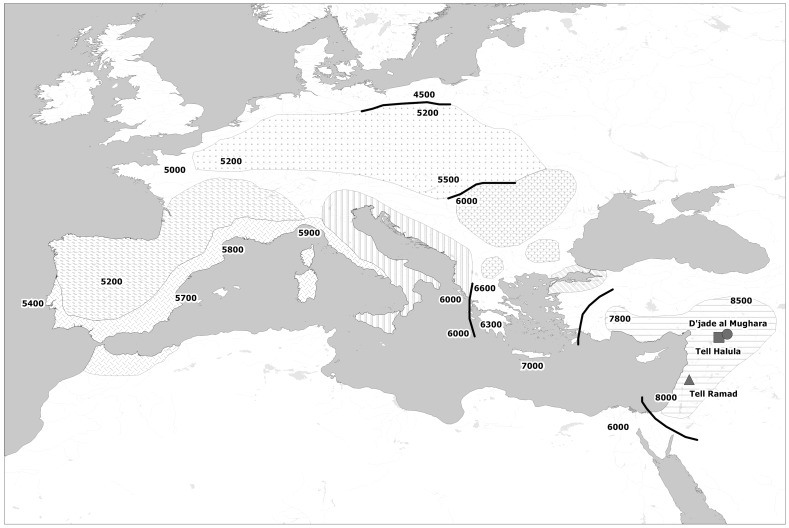
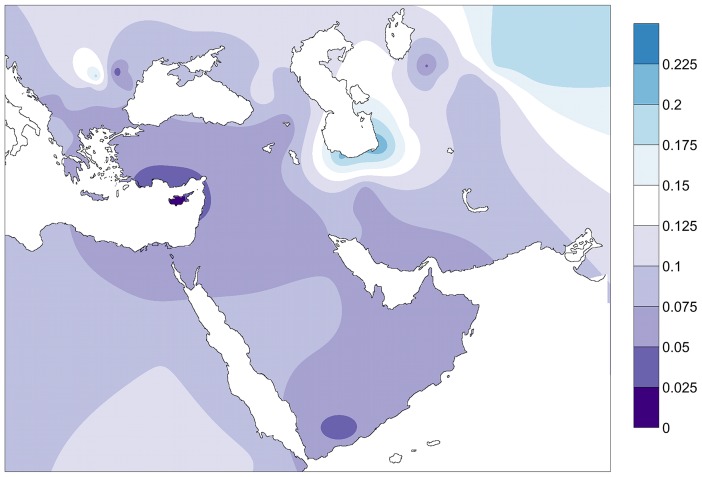
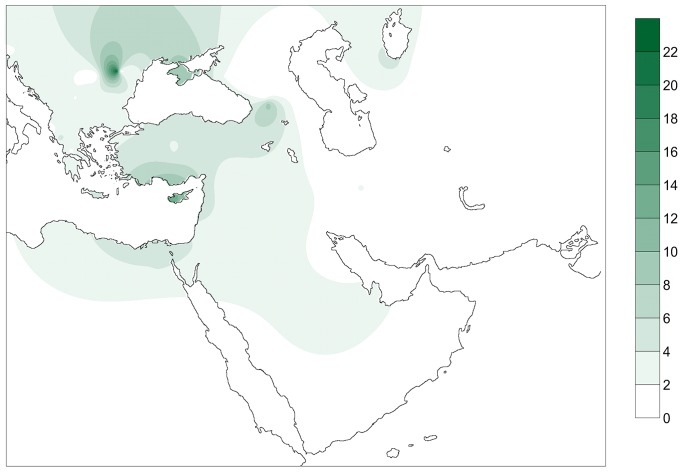
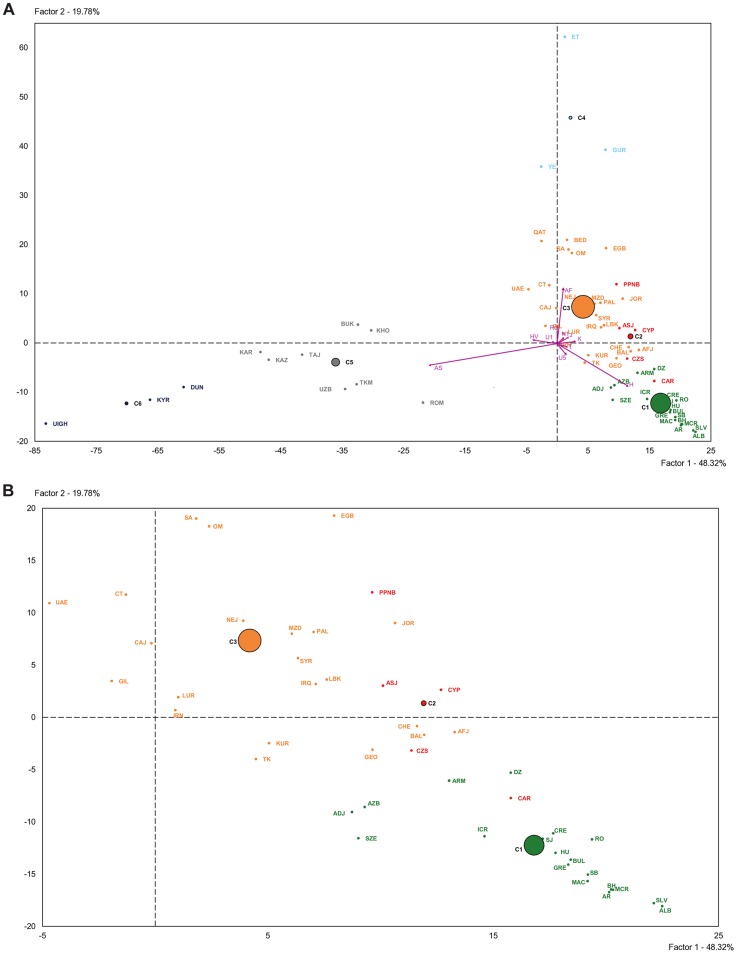
The genetic impact associated to the Neolithic spread in Europe has been widely debated over the last 20 years. Within this context, ancient DNA studies have provided a more reliable picture by directly analyzing the protagonist populations at different regions in Europe. However, the lack of available data from the original Near Eastern farmers has limited the achieved conclusions, preventing the formulation of continental models of Neolithic expansion. Here we address this issue by presenting mitochondrial DNA data of the original Near-Eastern Neolithic communities with the aim of providing the adequate background for the interpretation of Neolithic genetic data from European samples. Sixty-three skeletons from the Pre Pottery Neolithic B (PPNB) sites of Tell Halula, Tell Ramad and Dja'de El Mughara dating between 8,700-6,600 cal. B.C. were analyzed, and 15 validated mitochondrial DNA profiles were recovered. In order to estimate the demographic contribution of the first farmers to both Central European and Western Mediterranean Neolithic cultures, haplotype and haplogroup diversities in the PPNB sample were compared using phylogeographic and population genetic analyses to available ancient DNA data from human remains belonging to the Linearbandkeramik-Alföldi Vonaldiszes Kerámia and Cardial/Epicardial cultures. We also searched for possible signatures of the original Neolithic expansion over the modern Near Eastern and South European genetic pools, and tried to infer possible routes of expansion by comparing the obtained results to a database of 60 modern populations from both regions. Comparisons performed among the 3 ancient datasets allowed us to identify K and N-derived mitochondrial DNA haplogroups as potential markers of the Neolithic expansion, whose genetic signature would have reached both the Iberian coasts and the Central European plain. Moreover, the observed genetic affinities between the PPNB samples and the modern populations of Cyprus and Crete seem to suggest that the Neolithic was first introduced into Europe through pioneer seafaring colonization.
在过去20年里,与新石器时代在欧洲传播相关的基因影响一直备受争议。在此背景下,古DNA研究通过直接分析欧洲不同地区的主要人群,提供了更可靠的情况。然而,原始近东农民缺乏可用数据限制了所得出的结论,阻碍了新石器时代扩张的大陆模型的形成。在这里,我们通过展示原始近东新石器时代社区的线粒体DNA数据来解决这个问题,目的是为解释来自欧洲样本的新石器时代基因数据提供适当的背景。对来自公元前8700 - 6600年的泰勒哈卢拉、泰勒拉马德和贾德伊勒穆加拉的前陶新石器时代B期(PPNB)遗址的63具骨骼进行了分析,并获得了15个经过验证的线粒体DNA图谱。为了估计第一批农民对中欧和西地中海新石器时代文化的人口贡献,使用系统发育地理和群体遗传学分析,将PPNB样本中的单倍型和单倍群多样性与来自线性带纹陶 - 阿尔földi Vonaldiszes Kerámia和卡迪尔/心外膜文化的人类遗骸的现有古DNA数据进行了比较。我们还在现代近东和南欧基因库中寻找原始新石器时代扩张的可能特征,并通过将所得结果与来自这两个地区的60个现代人群的数据库进行比较,试图推断可能的扩张路线。在这3个古代数据集之间进行的比较使我们能够确定源自K和N的线粒体DNA单倍群是新石器时代扩张的潜在标记,其基因特征已到达伊比利亚海岸和中欧平原。此外,PPNB样本与塞浦路斯和克里特现代人群之间观察到的基因亲和力似乎表明,新石器时代是通过先驱航海殖民首次引入欧洲的。