Baumard Josselin, Osiurak François, Lesourd Mathieu, Le Gall Didier
Laboratoire de Psychologie des Pays de la Loire, Université d'Angers Angers, France.
Laboratoire d'Etude des Mécanismes Cognitifs, Institut de Psychologie, Université Lyon 2 Bron, France.
Front Psychol. 2014 May 21;5:473. doi: 10.3389/fpsyg.2014.00473. eCollection 2014.
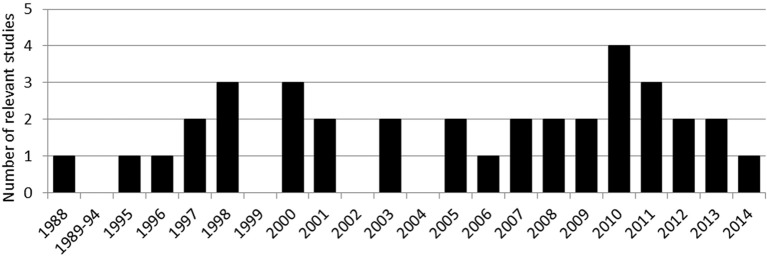
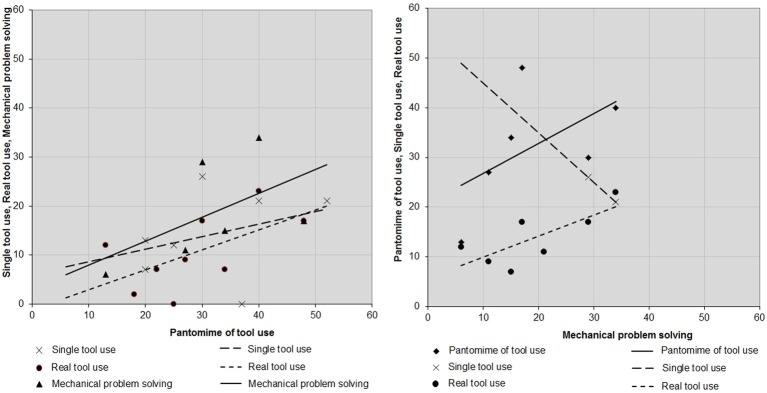
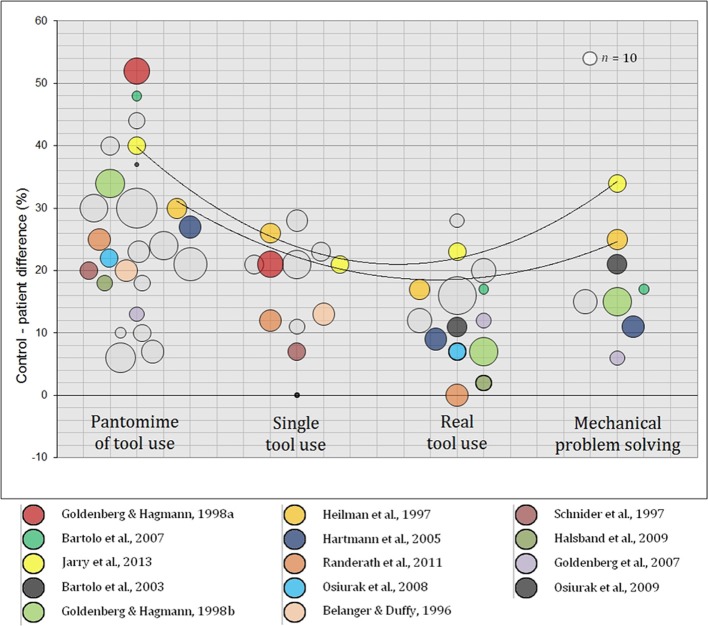
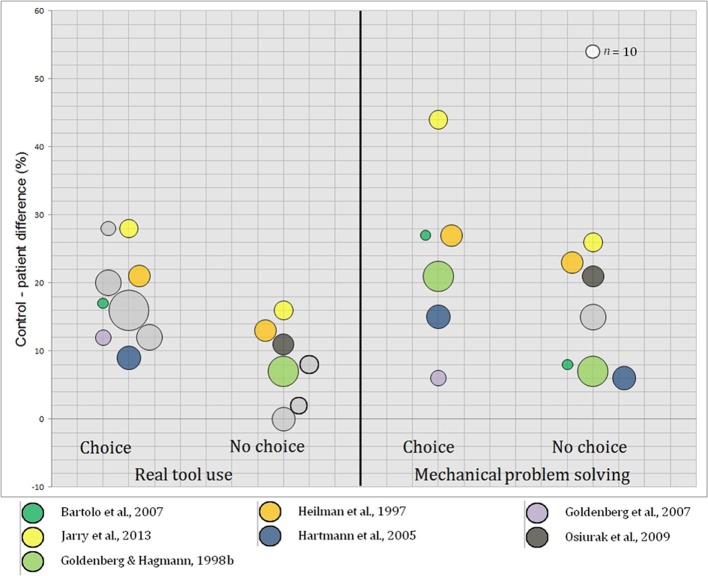
In this paper we review studies that investigated tool use disorders in left-brain damaged (LBD) patients over the last 30 years. Four tasks are classically used in the field of apraxia: Pantomime of tool use, single tool use, real tool use and mechanical problem solving. Our aim was to address two issues, namely, (1) the role of mechanical knowledge in real tool use and (2) the cognitive mechanisms underlying pantomime of tool use, a task widely employed by clinicians and researchers. To do so, we extracted data from 36 papers and computed the difference between healthy subjects and LBD patients. On the whole, pantomime of tool use is the most difficult task and real tool use is the easiest one. Moreover, associations seem to appear between pantomime of tool use, real tool use and mechanical problem solving. These results suggest that the loss of mechanical knowledge is critical in LBD patients, even if all of those tasks (and particularly pantomime of tool use) might put differential demands on semantic memory and working memory.
在本文中,我们回顾了过去30年中对左脑损伤(LBD)患者工具使用障碍进行研究的相关文献。失用症领域通常使用四项任务:工具使用的手势模仿、单一工具使用、实际工具使用和机械问题解决。我们的目的是解决两个问题,即:(1)机械知识在实际工具使用中的作用;(2)工具使用手势模仿背后的认知机制,这是临床医生和研究人员广泛采用的一项任务。为此,我们从36篇论文中提取数据,并计算健康受试者与LBD患者之间的差异。总体而言,工具使用的手势模仿是最难的任务,而实际工具使用是最容易的任务。此外,工具使用的手势模仿、实际工具使用和机械问题解决之间似乎存在关联。这些结果表明,机械知识的缺失在LBD患者中至关重要,即使所有这些任务(尤其是工具使用的手势模仿)可能对语义记忆和工作记忆有不同的要求。