Bagga Sumedha, Bouchard Michael J
Department of Biochemistry and Molecular Biology, Drexel University College of Medicine, 245 N 15th Street, MS 497, Philadelphia, PA, 19102, USA.
Methods Mol Biol. 2014;1170:165-227. doi: 10.1007/978-1-4939-0888-2_10.
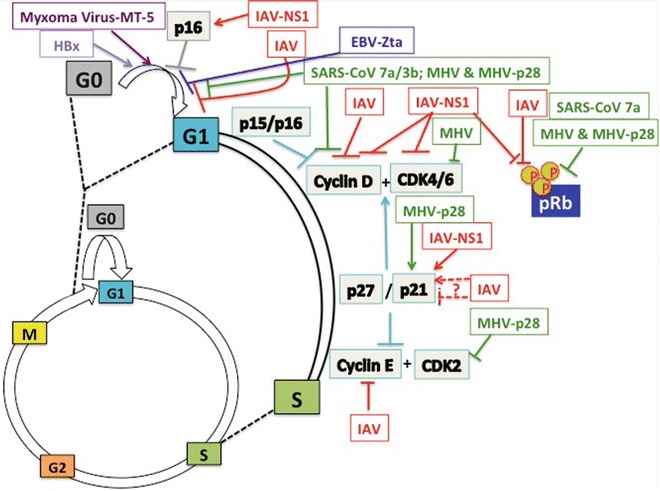
To replicate their genomes in cells and generate new progeny, viruses typically require factors provided by the cells that they have infected. Subversion of the cellular machinery that controls replication of the infected host cell is a common activity of many viruses. Viruses employ different strategies to deregulate cell cycle checkpoint controls and modulate cell proliferation pathways. A number of DNA and RNA viruses encode proteins that target critical cell cycle regulators to achieve cellular conditions that are beneficial for viral replication. Many DNA viruses induce quiescent cells to enter the cell cycle; this is thought to increase pools of deoxynucleotides and thus, facilitate viral replication. In contrast, some viruses can arrest cells in a particular phase of the cell cycle that is favorable for replication of the specific virus. Cell cycle arrest may inhibit early cell death of infected cells, allow the cells to evade immune defenses, or help promote virus assembly. Although beneficial for the viral life cycle, virus-mediated alterations in normal cell cycle control mechanisms could have detrimental effects on cellular physiology and may ultimately contribute to pathologies associated with the viral infection, including cell transformation and cancer progression and maintenance. In this chapter, we summarize various strategies employed by DNA and RNA viruses to modulate the replication cycle of the virus-infected cell. When known, we describe how these virus-associated effects influence replication of the virus and contribute to diseases associated with infection by that specific virus.
为了在细胞中复制其基因组并产生新的子代病毒,病毒通常需要其所感染细胞提供的因子。破坏控制受感染宿主细胞复制的细胞机制是许多病毒的常见行为。病毒采用不同策略来解除细胞周期检查点控制并调节细胞增殖途径。许多DNA和RNA病毒编码靶向关键细胞周期调节因子的蛋白质,以实现有利于病毒复制的细胞条件。许多DNA病毒诱导静止细胞进入细胞周期;这被认为会增加脱氧核苷酸池,从而促进病毒复制。相反,一些病毒可使细胞停滞在特定的细胞周期阶段,这有利于特定病毒的复制。细胞周期停滞可能抑制受感染细胞的早期死亡,使细胞逃避免疫防御,或有助于促进病毒组装。尽管对病毒生命周期有益,但病毒介导的正常细胞周期控制机制改变可能对细胞生理学产生有害影响,并最终可能导致与病毒感染相关的病理学变化,包括细胞转化、癌症进展和维持。在本章中,我们总结了DNA和RNA病毒用于调节病毒感染细胞复制周期的各种策略。在已知的情况下,我们描述这些与病毒相关的效应如何影响病毒复制,并导致与该特定病毒感染相关的疾病。