Esmaeelpour Marieh, Kajic Vedran, Zabihian Behrooz, Othara Richu, Ansari-Shahrezaei Siamak, Kellner Lukas, Krebs Ilse, Nemetz Susanne, Kraus Martin F, Hornegger Joachim, Fujimoto James G, Drexler Wolfgang, Binder Susanne
Ludwig Boltzmann Institute of Retinology and Biomicroscopic Laser Surgery, Department of Ophthalmology, Rudolf Foundation Clinic, Vienna, Austria; Center for Medical Physics and Biomedical Engineering, Medical University of Vienna, Vienna, Austria.
Center for Medical Physics and Biomedical Engineering, Medical University of Vienna, Vienna, Austria.
PLoS One. 2014 Jun 9;9(6):e99690. doi: 10.1371/journal.pone.0099690. eCollection 2014.
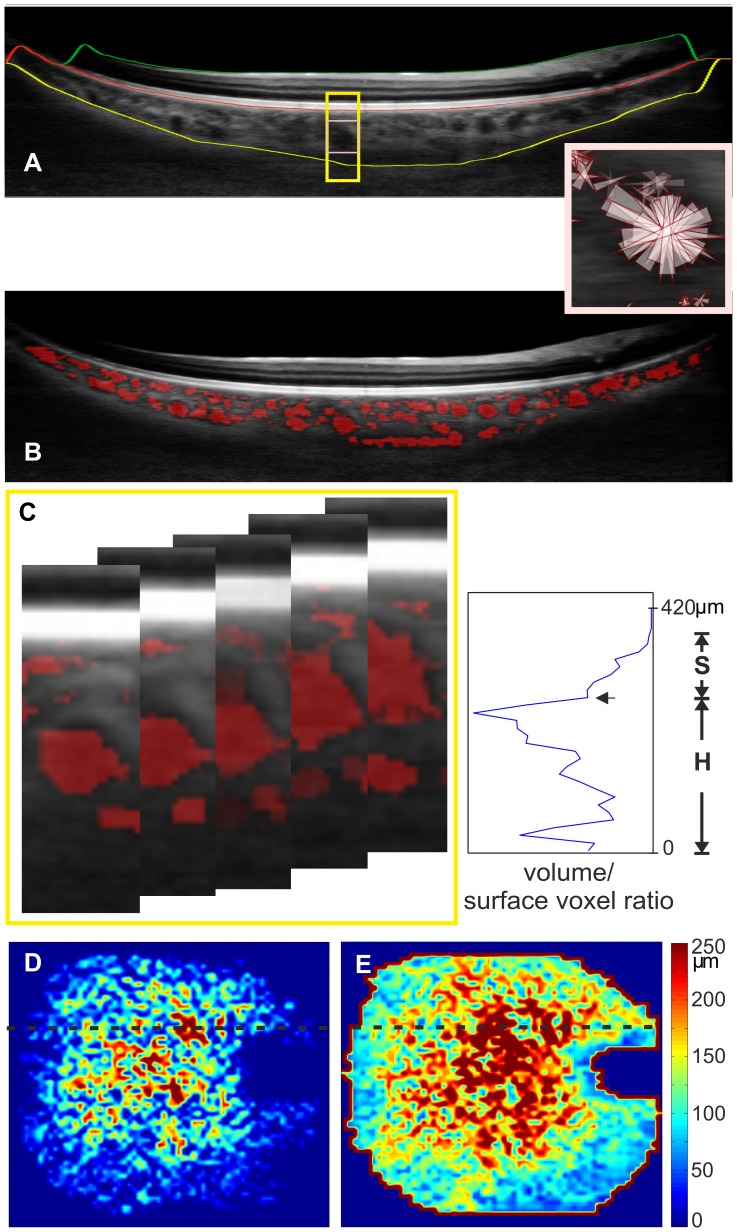
To examine the feasibility of automatically segmented choroidal vessels in three-dimensional (3D) 1060-nmOCT by testing repeatability in healthy and AMD eyes and by mapping Haller's and Sattler's layer thickness in healthy eyes.
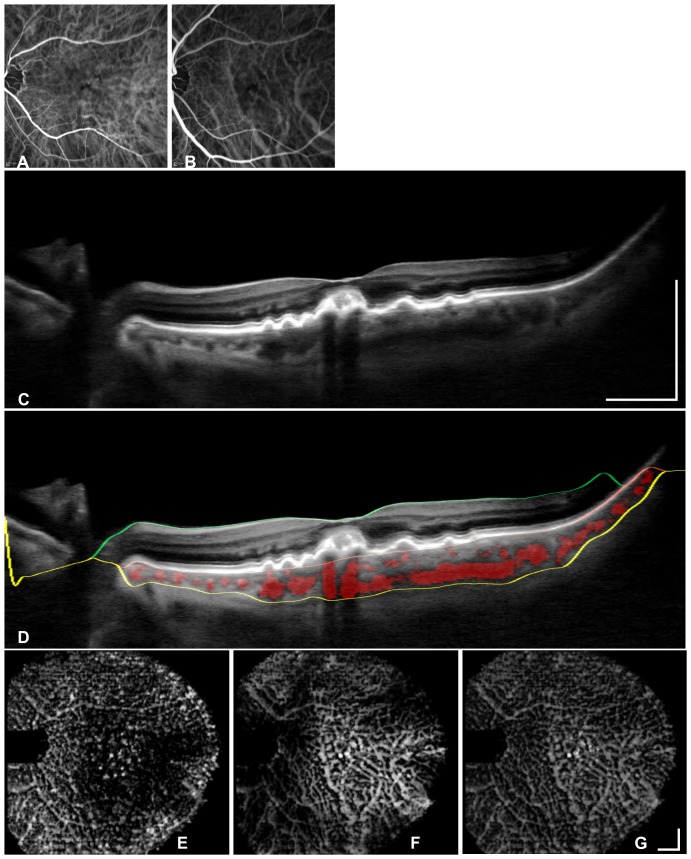
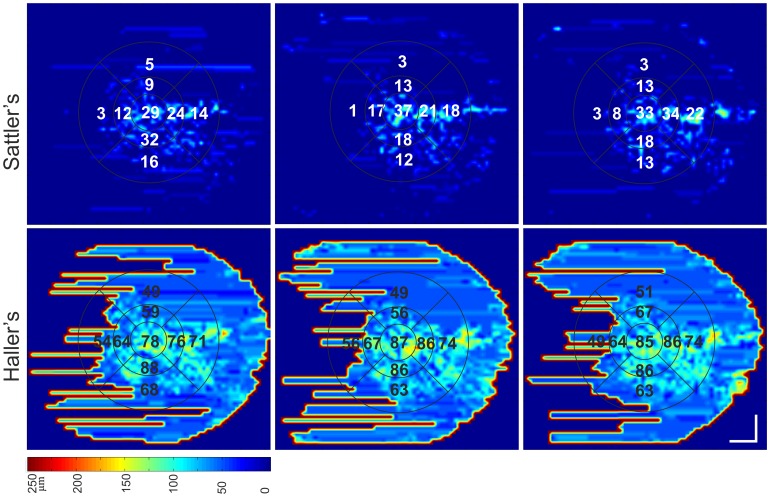
Fifty-five eyes (from 45 healthy subjects and 10 with non-neovascular age-related macular degeneration (AMD) subjects) were imaged by 3D-1060-nmOCT over a 36°x36° field of view. Haller's and Sattler's layer were automatically segmented, mapped and averaged across the Early Treatment Diabetic Retinopathy Study grid. For ten AMD eyes and ten healthy eyes, imaging was repeated within the same session and on another day. Outcomes were the repeatability agreement of Haller's and Sattler's layer thicknesses in healthy and AMD eyes, the validation with ICGA and the statistical analysis of the effect of age and axial eye length (AL) on both healthy choroidal sublayers.
The coefficients of repeatability for Sattler's and Haller's layers were 35% and 21% in healthy eyes and 44% and 31% in AMD eyes, respectively. The mean±SD healthy central submacular field thickness for Sattler's and Haller's was 87±56 µm and 141±50 µm, respectively, with a significant relationship for AL (P<.001).
Automated Sattler's and Haller's thickness segmentation generates rapid 3D measurements with a repeatability corresponding to reported manual segmentation. Sublayers in healthy eyes thinned significantly with increasing AL. In the presence of the thinned Sattler's layer in AMD, careful measurement interpretation is needed. Automatic choroidal vascular layer mapping may help to explain if pathological choroidal thinning affects medium and large choroidal vasculature in addition to choriocapillaris loss.
通过检测健康眼和年龄相关性黄斑变性(AMD)眼中的重复性,并绘制健康眼中哈勒层和萨特勒层的厚度,来研究在三维(3D)1060nm光学相干断层扫描(OCT)中自动分割脉络膜血管的可行性。
对55只眼(来自45名健康受试者和10名非新生血管性年龄相关性黄斑变性(AMD)受试者)进行3D-1060nm OCT成像,视野为36°×36°。在糖尿病视网膜病变早期治疗研究网格上自动分割、绘制并平均哈勒层和萨特勒层。对10只AMD眼和10只健康眼在同一检查期间和另一天重复成像。结果包括健康眼和AMD眼中哈勒层和萨特勒层厚度的重复性一致性、与吲哚青绿血管造影(ICGA)的验证以及年龄和眼轴长度(AL)对健康脉络膜两个亚层影响的统计分析。
在健康眼中,萨特勒层和哈勒层的重复性系数分别为35%和21%,在AMD眼中分别为44%和31%。萨特勒层和哈勒层的健康中央黄斑下平均厚度±标准差分别为87±56μm和141±50μm,与AL有显著相关性(P<0.001)。
自动分割萨特勒层和哈勒层厚度可快速进行3D测量,其重复性与报道的手动分割相当。健康眼中的亚层随着AL增加而显著变薄。在AMD患者中,当萨特勒层变薄时,需要仔细解读测量结果。自动脉络膜血管层绘制可能有助于解释病理性脉络膜变薄是否除了影响脉络膜毛细血管丧失外,还会影响中、大脉络膜血管。