Consultants in Epilepsy and Neurology, PLLC, Boise, Idaho, U.S.A.
Epilepsia. 2014 Jul;55(7):1088-98. doi: 10.1111/epi.12681. Epub 2014 Jun 10.
To evaluate the efficacy and safety of conversion to lacosamide 400 mg/day monotherapy in adults with focal epilepsy.
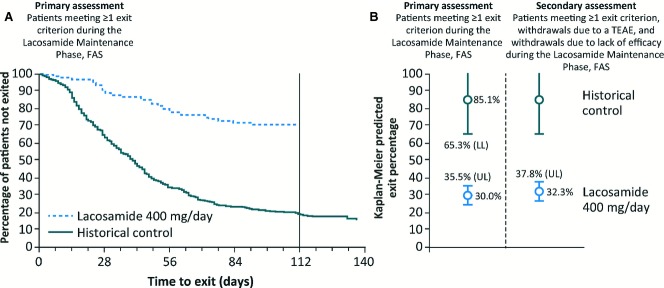
This historical-controlled, double-blind study (NCT00520741) enrolled patients aged 16-70 years on stable doses of 1-2 antiepileptic drugs (AEDs) and experiencing 2-40 partial-onset seizures per 28 days during the 8-week prospective Baseline. Patients were randomized to lacosamide 400 or 300 mg/day (3:1 ratio), starting at 200 mg/day and titrated over 3 weeks to randomized dose. Patients then withdrew background AEDs over 6 weeks and entered a 10-week Monotherapy Phase. The primary assessment was the Kaplan-Meier-predicted percentage of patients on 400 mg/day in the full analysis set (FAS) meeting ≥ 1 predefined seizure-related exit criterion by day 112, compared with the historical-control threshold (65.3%).
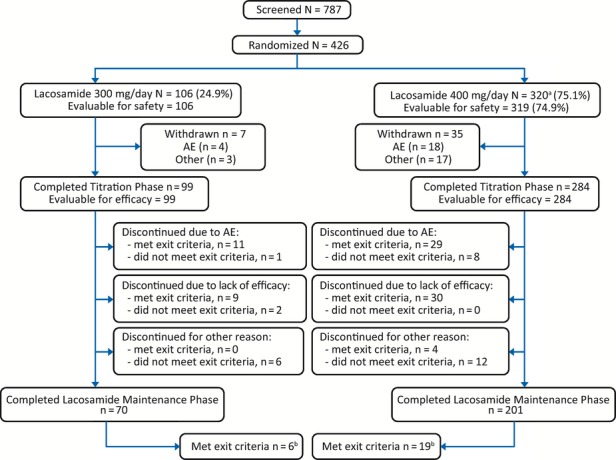
Four hundred twenty-five patients were enrolled and were eligible for safety analyses (400 mg/day, n = 319; 300 mg/day, n = 106). A total of 271 (63.8%) of 425 patients completed the Lacosamide Maintenance Phase (combined AED Withdrawal and Monotherapy Phases). Among 284 patients in the 400 mg/day group in the FAS, 82 (28.9%) met ≥ 1 exit criterion; the Kaplan-Meier-predicted exit percentage at day 112 for 400 mg/day (30.0%; 95% confidence interval [CI] 24.6-35.5%) was lower than the historical control. When exit events, withdrawal due to treatment-emergent adverse events (TEAEs), and withdrawal due to lack of efficacy were summed (n = 90), the predicted exit percentage (32.3%; 95% CI 26.8-37.8%) was also lower than the historical control. Most patients receiving 400 mg/day reported some improvement on the Clinical Global Impression of Change (75.4%) and Patient Global Impression of Change (74.3%). Overall, the most common (>10%) TEAEs were dizziness (24.0%), headache (14.4%), nausea (13.4%), convulsion (11.5%), somnolence (10.4%), and fatigue (10.1%); most (74.1%) were mild-to-moderate in intensity. Seventy-two patients (16.9%) discontinued due to TEAEs. Seventeen patients (4%, all receiving 400 mg/day) experienced serious AEs.
Lacosamide 400 mg/day monotherapy was effective, with a favorable safety profile in patients with focal epilepsy.
评估转换为左乙拉西坦 400mg/日单药治疗成人局灶性癫痫的疗效和安全性。
这是一项历史对照、双盲研究(NCT00520741),纳入了年龄在 16-70 岁之间、正在服用 1-2 种抗癫痫药物(AEDs)且在 8 周前瞻性基线期内每 28 天经历 2-40 次部分发作的患者。患者随机分为左乙拉西坦 400mg 或 300mg/日(3:1 比例),起始剂量为 200mg/日,3 周内滴定至随机剂量。然后,患者在 6 周内逐渐停用背景 AEDs,并进入 10 周的单药治疗期。主要评估是在全分析集(FAS)中,接受 400mg/日治疗的患者在第 112 天达到≥1 项预先设定的与癫痫发作相关的退出标准的 Kaplan-Meier 预测百分比,与历史对照阈值(65.3%)相比。
共纳入 425 例患者进行安全性分析(400mg/日组,n=319;300mg/日组,n=106)。共有 271 例(63.8%)425 例患者完成了左乙拉西坦维持期(联合 AED 停药和单药治疗期)。在 400mg/日组的 284 例 FAS 患者中,82 例(28.9%)达到≥1 项退出标准;400mg/日组第 112 天的 Kaplan-Meier 预测退出率为 30.0%(95%CI 24.6-35.5%),低于历史对照。当退出事件、因治疗引起的不良事件(TEAE)停药和因疗效不佳而停药(n=90)相加时,预测的退出率(32.3%,95%CI 26.8-37.8%)也低于历史对照。大多数接受 400mg/日治疗的患者在临床总体印象变化量表(75.4%)和患者总体印象变化量表(74.3%)上报告了一些改善。总体而言,最常见(>10%)的不良事件为头晕(24.0%)、头痛(14.4%)、恶心(13.4%)、抽搐(11.5%)、嗜睡(10.4%)和疲劳(10.1%);大多数(74.1%)为轻至中度。72 例(16.9%)因不良事件停药。17 例(4%,均接受 400mg/日治疗)发生严重不良事件。
左乙拉西坦 400mg/日单药治疗对局灶性癫痫患者有效,安全性良好。