Schulz Kurt P, Bédard Anne-Claude V, Fan Jin, Clerkin Suzanne M, Dima Danai, Newcorn Jeffrey H, Halperin Jeffrey M
Department of Psychiatry, Icahn School of Medicine at Mount Sinai, New York, NY, USA.
Department of Psychiatry, Icahn School of Medicine at Mount Sinai, New York, NY, USA ; Department of Psychology, Queens College of the City University of New York, Flushing, NY, USA.
Neuroimage Clin. 2014 Jun 2;5:1-9. doi: 10.1016/j.nicl.2014.05.016. eCollection 2014.
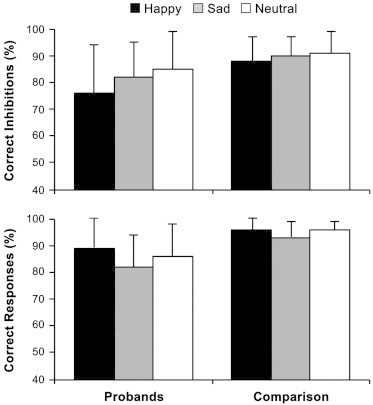
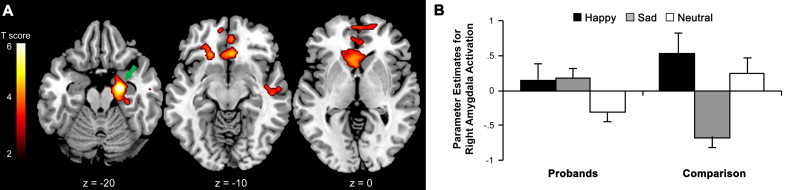
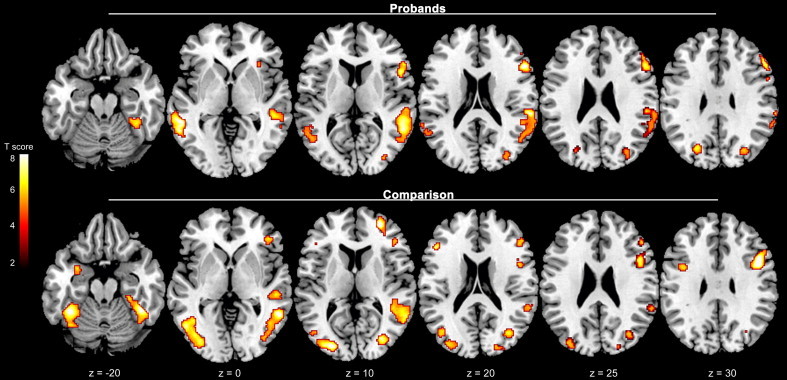
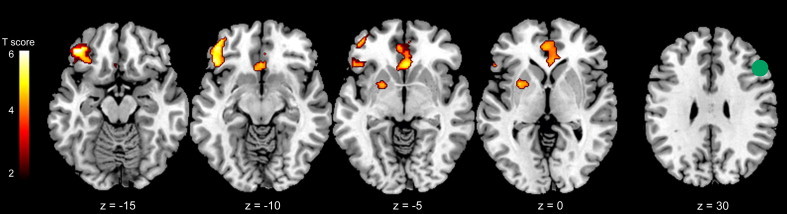
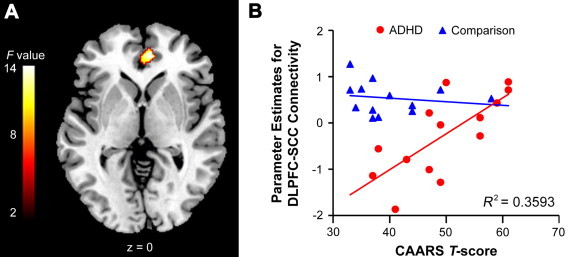
Affect recognition deficits found in individuals with attention-deficit/hyperactivity disorder (ADHD) across the lifespan may bias the development of cognitive control processes implicated in the pathophysiology of the disorder. This study aimed to determine the mechanism through which facial expressions influence cognitive control in young adults diagnosed with ADHD in childhood. Fourteen probands with childhood ADHD and 14 comparison subjects with no history of ADHD were scanned with functional magnetic resonance imaging while performing a face emotion go/no-go task. Event-related analyses contrasted activation and functional connectivity for cognitive control collapsed over face valence and tested for variations in activation for response execution and inhibition as a function of face valence. Probands with childhood ADHD made fewer correct responses and inhibitions overall than comparison subjects, but demonstrated comparable effects of face emotion on response execution and inhibition. The two groups showed similar frontotemporal activation for cognitive control collapsed across face valence, but differed in the functional connectivity of the right dorsolateral prefrontal cortex, with fewer interactions with the subgenual cingulate cortex, inferior frontal gyrus, and putamen in probands than in comparison subjects. Further, valence-dependent activation for response execution was seen in the amygdala, ventral striatum, subgenual cingulate cortex, and orbitofrontal cortex in comparison subjects but not in probands. The findings point to functional anomalies in limbic networks for both the valence-dependent biasing of cognitive control and the valence-independent cognitive control of face emotion processing in probands with childhood ADHD. This limbic dysfunction could impact cognitive control in emotional contexts and may contribute to the social and emotional problems associated with ADHD.
在患有注意力缺陷多动障碍(ADHD)的个体一生中发现的情感识别缺陷,可能会使与该疾病病理生理学相关的认知控制过程的发展产生偏差。本研究旨在确定面部表情影响童年期被诊断为ADHD的年轻成年人认知控制的机制。14名患有童年期ADHD的先证者和14名无ADHD病史的对照受试者在执行面部情绪执行/不执行任务时接受了功能磁共振成像扫描。事件相关分析对比了认知控制在面部效价上的激活和功能连接,并测试了作为面部效价函数的反应执行和抑制的激活变化。与对照受试者相比,患有童年期ADHD的先证者总体上正确反应和抑制较少,但在反应执行和抑制方面表现出类似的面部情绪效应。两组在面部效价上的认知控制方面表现出相似的额颞叶激活,但在右侧背外侧前额叶皮层的功能连接方面存在差异,与对照受试者相比,先证者与膝下扣带回皮层、额下回和壳核的相互作用较少。此外,在对照受试者的杏仁核、腹侧纹状体、膝下扣带回皮层和眶额皮层中观察到反应执行的效价依赖性激活,而在先证者中未观察到。这些发现表明,童年期ADHD先证者在认知控制的效价依赖性偏差和面部情绪处理的效价独立性认知控制方面,边缘网络存在功能异常。这种边缘功能障碍可能会影响情绪背景下的认知控制,并可能导致与ADHD相关的社会和情感问题。