School of Life Science and Technology, Harbin Institute of Technology, Harbin 150090, China ; State Key Laboratory of Urban Water Resource and Environment, Harbin Institute of Technology, Harbin 150090, China.
State Key Laboratory of Urban Water Resource and Environment, Harbin Institute of Technology, Harbin 150090, China.
Biotechnol Biofuels. 2014 Jun 3;7:82. doi: 10.1186/1754-6834-7-82. eCollection 2014.
Consolidated bioprocessing (CBP) of lignocellulosic biomass to hydrogen offers great potential for lower cost and higher efficiency compared to processes featuring dedicated cellulase production. Current studies on CBP-based hydrogen production mainly focus on using the thermophilic cellulolytic bacterium Clostridium thermocellum and the extremely thermophilic cellulolytic bacterium Caldicellulosiruptor saccharolyticus. However, no studies have demonstrated that the strains in the genus Thermoanaerobacterium could be used as the sole microorganism to accomplish both cellulose degradation and H2 generation.
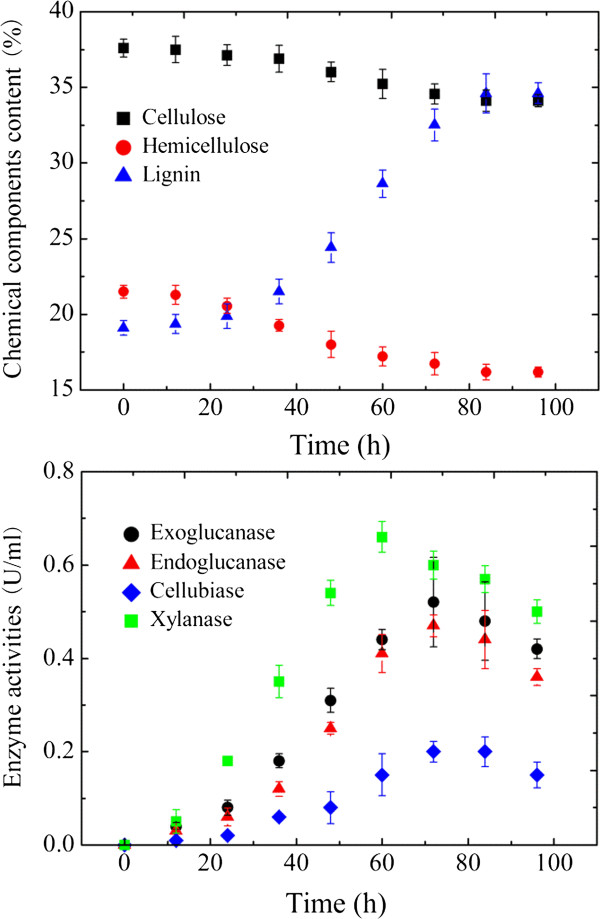
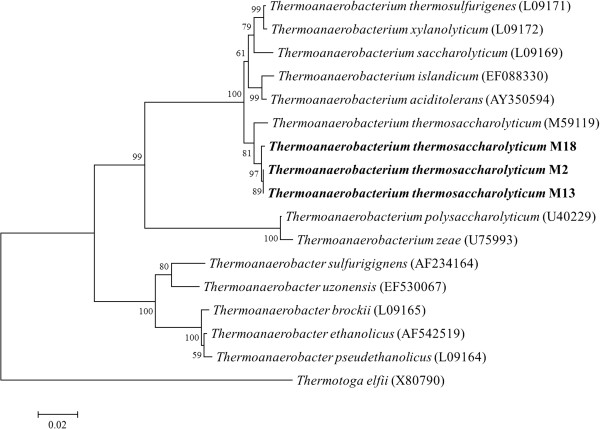
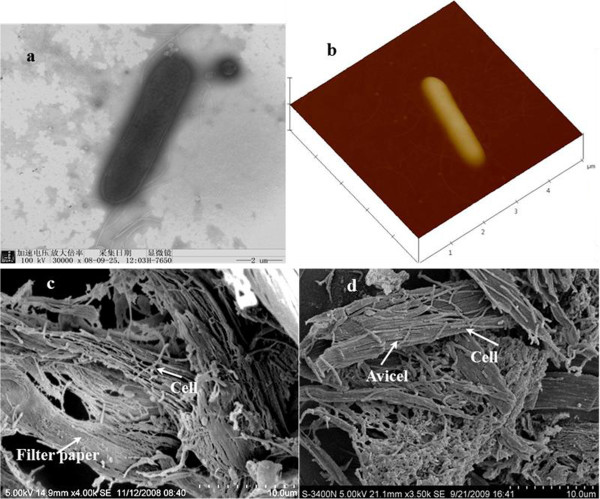
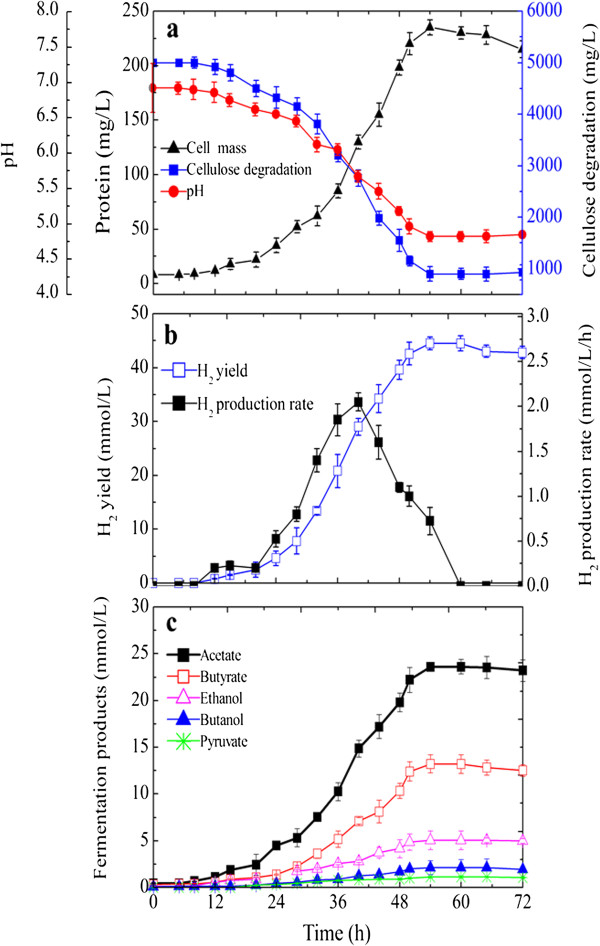
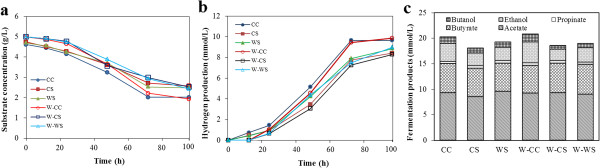
We have specifically screened for moderately thermophilic cellulolytic bacteria enabling to produce hydrogen directly from conversion of lignocellulosic materials. Three new strains of thermophilic cellulolytic bacteria in the genus Thermoanaerobacterium growing at a temperature of 60°C were isolated. All of them grew well on various plant polymers including microcrystalline cellulose, filter paper, xylan, glucose, and xylose. In particular, the isolated bacterium, designated as Thermoanaerobacterium thermosaccharolyticum M18, showed high cellulolytic activity and a high yield of H2. When it was grown in 0.5% microcrystalline cellulose, approximately 82% cellulose was consumed, and the H2 yield and maximum production rate reached 10.86 mmol/g Avicel and 2.05 mmol/L/h, respectively. Natural lignocellulosic materials without any physicochemical or biological pretreatment also supported appreciable growth of strain M18, which resulted in 56.07% to 62.71% of insoluble cellulose and hemicellulose polymer degradation in corn cob, corn stalk, and wheat straw with a yield of 3.23 to 3.48 mmol H2/g substrate and an average production rate of 0.10 to 0.13 mmol H2/L/h.
The newly isolated strain T. thermosaccharolyticum M18 displayed effective degradation of lignocellulose and produced large amounts of hydrogen. This is the first report of a Thermoanaerobacterium species presenting cellulolytic characteristics, and this species thus represents a novel cellulolytic bacterium distinguished from all other known cellulolytic bacteria. In comparison, the extraordinary yield and specific rate of hydrogen for strain M18 obtained from lignocellulose make it more attractive in monoculture fermentation. T. thermosaccharolyticum M18 is thus a potential candidate for rapid conversion of lignocellulose to biohydrogen in a single step.
与专门生产纤维素酶的工艺相比,木质纤维素生物质的综合生物加工(CBP)生产氢气具有成本更低、效率更高的巨大潜力。目前基于 CBP 的氢气生产的研究主要集中在使用嗜热纤维素分解菌热纤维梭菌和极其嗜热纤维素分解菌卡尔迪克西鲁普托斯 saccharolyticus。然而,尚无研究表明热厌氧杆菌属中的菌株可作为唯一微生物同时完成纤维素降解和 H2 生成。
我们专门筛选了能够直接从木质纤维素材料转化中生产氢气的中温嗜热纤维素分解菌。从 60°C 下生长的热厌氧杆菌属中分离到 3 株新的嗜热纤维素分解菌。它们都能很好地生长在各种植物聚合物上,包括微晶纤维素、滤纸、木聚糖、葡萄糖和木糖。特别是分离到的菌株,命名为 Thermoanaerobacterium thermosaccharolyticum M18,表现出较高的纤维素酶活性和较高的氢气产量。当在 0.5%微晶纤维素中生长时,约 82%的纤维素被消耗,H2 产量和最大产率分别达到 10.86mmol/g Avicel 和 2.05mmol/L/h。未经任何物理化学或生物预处理的天然木质纤维素材料也能支持菌株 M18 的可观生长,导致玉米芯、玉米秸秆和麦草中不溶性纤维素和半纤维素聚合物降解 56.07%至 62.71%,产量为 3.23 至 3.48mmol H2/g 基质,平均产率为 0.10 至 0.13mmol H2/L/h。
新分离的 Thermoanaerobacterium thermosaccharolyticum M18 表现出有效的木质纤维素降解能力,并产生大量氢气。这是第一个报道具有纤维素分解特性的热厌氧杆菌属物种的报告,因此该物种代表了一种新型的纤维素分解菌,与所有其他已知的纤维素分解菌不同。相比之下,从木质纤维素中获得的 M18 的氢气产量和比生产率非常高,使其在单一培养发酵中更具吸引力。因此,Thermoanaerobacterium thermosaccharolyticum M18 是木质纤维素一步快速转化为生物氢气的潜在候选者。