Kung Kevin S, Greco Kael, Sobolevsky Stanislav, Ratti Carlo
Massachusetts Institute of Technology (MIT) Senseable City Laboratory, Cambridge, Massachusetts, United States of America; Department of Biological Engineering, Massachusetts Institute of Technology, Cambridge, Massachusetts, United States of America.
Massachusetts Institute of Technology (MIT) Senseable City Laboratory, Cambridge, Massachusetts, United States of America; Department of Urban Studies and Planning, Massachusetts Institute of Technology, Cambridge, Massachusetts, United States of America.
PLoS One. 2014 Jun 16;9(6):e96180. doi: 10.1371/journal.pone.0096180. eCollection 2014.
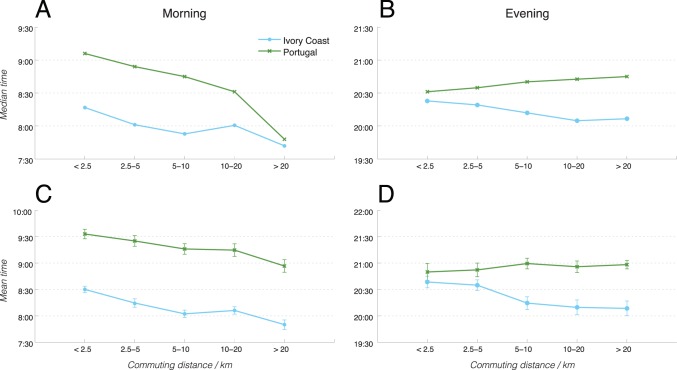
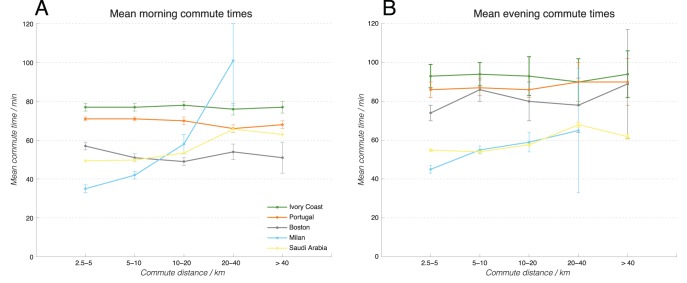
Home-work commuting has always attracted significant research attention because of its impact on human mobility. One of the key assumptions in this domain of study is the universal uniformity of commute times. However, a true comparison of commute patterns has often been hindered by the intrinsic differences in data collection methods, which make observation from different countries potentially biased and unreliable. In the present work, we approach this problem through the use of mobile phone call detail records (CDRs), which offers a consistent method for investigating mobility patterns in wholly different parts of the world. We apply our analysis to a broad range of datasets, at both the country (Portugal, Ivory Coast, and Saudi Arabia), and city (Boston) scale. Additionally, we compare these results with those obtained from vehicle GPS traces in Milan. While different regions have some unique commute time characteristics, we show that the home-work time distributions and average values within a single region are indeed largely independent of commute distance or country (Portugal, Ivory Coast, and Boston)-despite substantial spatial and infrastructural differences. Furthermore, our comparative analysis demonstrates that such distance-independence holds true only if we consider multimodal commute behaviors-as consistent with previous studies. In car-only (Milan GPS traces) and car-heavy (Saudi Arabia) commute datasets, we see that commute time is indeed influenced by commute distance. Finally, we put forth a testable hypothesis and suggest ways for future work to make more accurate and generalizable statements about human commute behaviors.
由于其对人类出行的影响,上下班通勤一直吸引着大量的研究关注。该研究领域的一个关键假设是通勤时间的普遍一致性。然而,通勤模式的真正比较常常受到数据收集方法内在差异的阻碍,这使得来自不同国家的观察结果可能存在偏差且不可靠。在本研究中,我们通过使用手机通话记录(CDR)来解决这个问题,它为研究世界不同地区的出行模式提供了一种一致的方法。我们将分析应用于广泛的数据集,包括国家(葡萄牙、科特迪瓦和沙特阿拉伯)和城市(波士顿)层面。此外,我们将这些结果与从米兰的车辆GPS轨迹获得的结果进行比较。虽然不同地区有一些独特的通勤时间特征,但我们表明,尽管存在巨大的空间和基础设施差异,单个地区内的上下班时间分布和平均值实际上在很大程度上与通勤距离或国家(葡萄牙、科特迪瓦和波士顿)无关。此外,我们的比较分析表明,只有当我们考虑多模式通勤行为时,这种距离独立性才成立——这与之前的研究一致。在仅使用汽车(米兰GPS轨迹)和以汽车为主(沙特阿拉伯)的通勤数据集中,我们发现通勤时间确实受到通勤距离的影响。最后,我们提出了一个可检验的假设,并为未来的工作提出了一些方法,以便对人类通勤行为做出更准确和更具普遍性的陈述。