• 文献检索
  • 文档翻译
  • 深度研究
  • 学术资讯
  • Suppr Zotero 插件Zotero 插件
  • 邀请有礼
  • 套餐&价格
  • 历史记录
应用&插件
Suppr Zotero 插件Zotero 插件浏览器插件Mac 客户端Windows 客户端微信小程序
定价
高级版会员购买积分包购买API积分包
服务
文献检索文档翻译深度研究API 文档MCP 服务
关于我们
关于 Suppr公司介绍联系我们用户协议隐私条款
关注我们

Suppr 超能文献

核心技术专利:CN118964589B侵权必究
粤ICP备2023148730 号-1Suppr @ 2026

文献检索

告别复杂PubMed语法,用中文像聊天一样搜索,搜遍4000万医学文献。AI智能推荐,让科研检索更轻松。

立即免费搜索

文件翻译

保留排版,准确专业,支持PDF/Word/PPT等文件格式,支持 12+语言互译。

免费翻译文档

深度研究

AI帮你快速写综述,25分钟生成高质量综述,智能提取关键信息,辅助科研写作。

立即免费体验

利用人类移动代理进行传染病建模。

On the use of human mobility proxies for modeling epidemics.

机构信息

Computational Epidemiology Laboratory, Institute for Scientific Interchange (ISI), Torino, Italy.

Department of Veterinary Science, University of Turin, Torino, Italy.

出版信息

PLoS Comput Biol. 2014 Jul 10;10(7):e1003716. doi: 10.1371/journal.pcbi.1003716. eCollection 2014 Jul.

DOI:10.1371/journal.pcbi.1003716
PMID:25010676
原文链接:https://pmc.ncbi.nlm.nih.gov/articles/PMC4091706/
Abstract

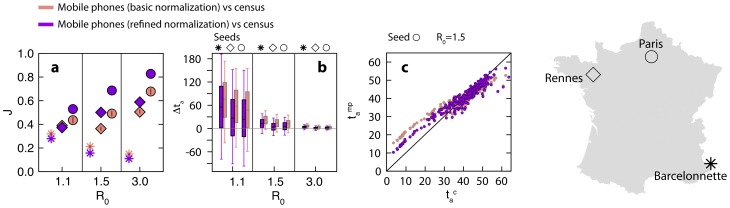
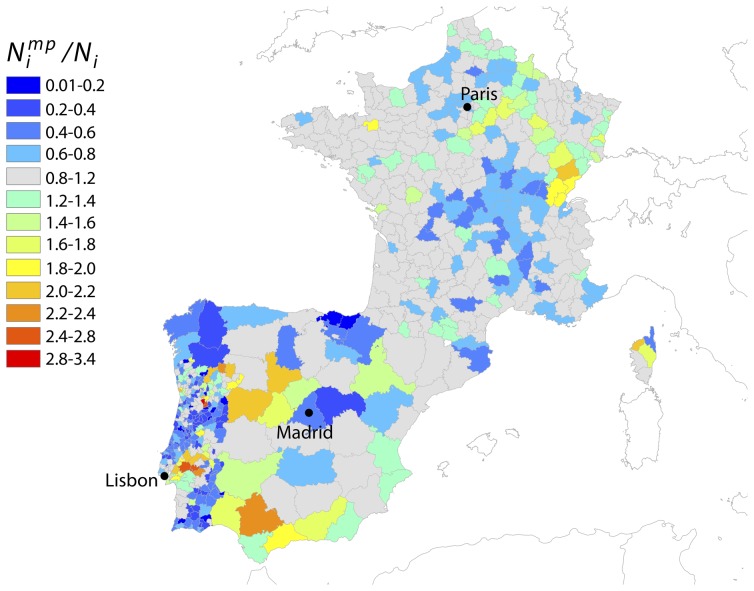
Human mobility is a key component of large-scale spatial-transmission models of infectious diseases. Correctly modeling and quantifying human mobility is critical for improving epidemic control, but may be hindered by data incompleteness or unavailability. Here we explore the opportunity of using proxies for individual mobility to describe commuting flows and predict the diffusion of an influenza-like-illness epidemic. We consider three European countries and the corresponding commuting networks at different resolution scales, obtained from (i) official census surveys, (ii) proxy mobility data extracted from mobile phone call records, and (iii) the radiation model calibrated with census data. Metapopulation models defined on these countries and integrating the different mobility layers are compared in terms of epidemic observables. We show that commuting networks from mobile phone data capture the empirical commuting patterns well, accounting for more than 87% of the total fluxes. The distributions of commuting fluxes per link from mobile phones and census sources are similar and highly correlated, however a systematic overestimation of commuting traffic in the mobile phone data is observed. This leads to epidemics that spread faster than on census commuting networks, once the mobile phone commuting network is considered in the epidemic model, however preserving to a high degree the order of infection of newly affected locations. Proxies' calibration affects the arrival times' agreement across different models, and the observed topological and traffic discrepancies among mobility sources alter the resulting epidemic invasion patterns. Results also suggest that proxies perform differently in approximating commuting patterns for disease spread at different resolution scales, with the radiation model showing higher accuracy than mobile phone data when the seed is central in the network, the opposite being observed for peripheral locations. Proxies should therefore be chosen in light of the desired accuracy for the epidemic situation under study.

摘要

人口流动是传染病大规模空间传播模型的关键组成部分。正确地对人口流动进行建模和量化对于改善疫情控制至关重要,但可能会受到数据不完整或不可用的阻碍。在这里,我们探索了使用个体流动代理来描述通勤流并预测流感样疾病流行扩散的机会。我们考虑了三个欧洲国家和不同分辨率尺度的相应通勤网络,这些网络来自(i)官方人口普查调查、(ii)从移动电话通话记录中提取的代理移动数据,以及(iii)用人口普查数据校准的辐射模型。在这些国家定义的元种群模型,并整合不同的流动层,根据传染病的可观察结果进行比较。我们表明,来自移动电话数据的通勤网络很好地捕捉了经验性的通勤模式,占总通量的 87%以上。移动电话和人口普查来源的每条链路的通勤通量分布相似且高度相关,但观察到移动电话数据中通勤流量存在系统性高估。一旦在传染病模型中考虑到移动电话通勤网络,这将导致流行病传播速度比人口普查通勤网络更快,但是在很大程度上保留了新受感染地点的感染顺序。代理的校准会影响不同模型之间到达时间的一致性,并且在移动性来源之间观察到的拓扑和流量差异会改变由此产生的流行病入侵模式。结果还表明,代理在不同分辨率尺度下用于模拟疾病传播的通勤模式的性能不同,辐射模型在网络中心的种子时比移动电话数据具有更高的准确性,而对于外围位置则相反。因此,应该根据所研究的疫情情况的所需准确性来选择代理。
https://cdn.ncbi.nlm.nih.gov/pmc/blobs/830c/4091706/3b2f4317300a/pcbi.1003716.g006.jpg
https://cdn.ncbi.nlm.nih.gov/pmc/blobs/830c/4091706/6841f17dc2b3/pcbi.1003716.g001.jpg
https://cdn.ncbi.nlm.nih.gov/pmc/blobs/830c/4091706/ade394369658/pcbi.1003716.g002.jpg
https://cdn.ncbi.nlm.nih.gov/pmc/blobs/830c/4091706/9400d25c4a59/pcbi.1003716.g003.jpg
https://cdn.ncbi.nlm.nih.gov/pmc/blobs/830c/4091706/b41ba7318154/pcbi.1003716.g004.jpg
https://cdn.ncbi.nlm.nih.gov/pmc/blobs/830c/4091706/3a89070f5b67/pcbi.1003716.g005.jpg
https://cdn.ncbi.nlm.nih.gov/pmc/blobs/830c/4091706/3b2f4317300a/pcbi.1003716.g006.jpg
https://cdn.ncbi.nlm.nih.gov/pmc/blobs/830c/4091706/6841f17dc2b3/pcbi.1003716.g001.jpg
https://cdn.ncbi.nlm.nih.gov/pmc/blobs/830c/4091706/ade394369658/pcbi.1003716.g002.jpg
https://cdn.ncbi.nlm.nih.gov/pmc/blobs/830c/4091706/9400d25c4a59/pcbi.1003716.g003.jpg
https://cdn.ncbi.nlm.nih.gov/pmc/blobs/830c/4091706/b41ba7318154/pcbi.1003716.g004.jpg
https://cdn.ncbi.nlm.nih.gov/pmc/blobs/830c/4091706/3a89070f5b67/pcbi.1003716.g005.jpg
https://cdn.ncbi.nlm.nih.gov/pmc/blobs/830c/4091706/3b2f4317300a/pcbi.1003716.g006.jpg

相似文献

1
On the use of human mobility proxies for modeling epidemics.利用人类移动代理进行传染病建模。
PLoS Comput Biol. 2014 Jul 10;10(7):e1003716. doi: 10.1371/journal.pcbi.1003716. eCollection 2014 Jul.
2
Assessing the use of mobile phone data to describe recurrent mobility patterns in spatial epidemic models.评估在空间流行病模型中使用手机数据描述反复出现的流动模式的情况。
R Soc Open Sci. 2017 May 17;4(5):160950. doi: 10.1098/rsos.160950. eCollection 2017 May.
3
Commuter mobility and the spread of infectious diseases: application to influenza in France.通勤流动性与传染病传播:在法国流感中的应用
PLoS One. 2014 Jan 9;9(1):e83002. doi: 10.1371/journal.pone.0083002. eCollection 2014.
4
The impact of mobility network properties on predicted epidemic dynamics in Dhaka and Bangkok.移动网络属性对达卡和曼谷预测疫情动态的影响。
Epidemics. 2021 Jun;35:100441. doi: 10.1016/j.epidem.2021.100441. Epub 2021 Feb 22.
5
Multiscale mobility networks and the spatial spreading of infectious diseases.多尺度移动性网络与传染病的空间传播。
Proc Natl Acad Sci U S A. 2009 Dec 22;106(51):21484-9. doi: 10.1073/pnas.0906910106. Epub 2009 Dec 14.
6
Gaps in mobility data and implications for modelling epidemic spread: A scoping review and simulation study.流动性数据缺口及其对流行病传播建模的影响:一项范围综述和模拟研究。
Epidemics. 2023 Mar;42:100666. doi: 10.1016/j.epidem.2023.100666. Epub 2023 Jan 12.
7
Human mobility patterns predict divergent epidemic dynamics among cities.人类流动模式可预测城市间不同的疫情动态。
Proc Biol Sci. 2013 Jul 17;280(1766):20130763. doi: 10.1098/rspb.2013.0763. Print 2013 Sep 7.
8
Examining the Effect of the Environment and Commuting Flow from/to Epidemic Areas on the Spread of Dengue Fever.探讨环境和疫区往返通勤流对登革热传播的影响。
Int J Environ Res Public Health. 2019 Dec 10;16(24):5013. doi: 10.3390/ijerph16245013.
9
The Scaling of Human Contacts and Epidemic Processes in Metapopulation Networks.异质种群网络中人际接触与流行过程的标度
Sci Rep. 2015 Oct 19;5:15111. doi: 10.1038/srep15111.
10
Epidemic modeling in metapopulation systems with heterogeneous coupling pattern: theory and simulations.具有异质耦合模式的集合种群系统中的流行病建模:理论与模拟
J Theor Biol. 2008 Apr 7;251(3):450-67. doi: 10.1016/j.jtbi.2007.11.028. Epub 2007 Nov 29.

引用本文的文献

1
Assessing the impact of interregional mobility on COVID19 spread in Spain using transfer entropy.使用转移熵评估区域间人口流动对西班牙新冠疫情传播的影响。
Sci Rep. 2025 Aug 26;15(1):31504. doi: 10.1038/s41598-025-17218-4.
2
A novel framework for inferring dynamic infectious disease transmission with graph attention: a COVID-19 case study in Korea.一种基于图注意力推断动态传染病传播的新框架:韩国新冠肺炎案例研究
BMC Public Health. 2025 May 22;25(1):1884. doi: 10.1186/s12889-025-23059-7.
3
Model predicted human mobility explains COVID-19 transmission in urban space without behavioral data.

本文引用的文献

1
Assessment of the Middle East respiratory syndrome coronavirus (MERS-CoV) epidemic in the Middle East and risk of international spread using a novel maximum likelihood analysis approach.中东呼吸综合征冠状病毒(MERS-CoV)在中东的流行评估及采用新型最大似然分析方法评估国际传播风险。
Euro Surveill. 2014 Jun 12;19(23):20824. doi: 10.2807/1560-7917.es2014.19.23.20824.
2
Commuter mobility and the spread of infectious diseases: application to influenza in France.通勤流动性与传染病传播:在法国流感中的应用
PLoS One. 2014 Jan 9;9(1):e83002. doi: 10.1371/journal.pone.0083002. eCollection 2014.
3
Delineating geographical regions with networks of human interactions in an extensive set of countries.
模型预测的人类流动性在没有行为数据的情况下解释了城市空间中的新冠病毒传播。
Sci Rep. 2025 Feb 21;15(1):6365. doi: 10.1038/s41598-025-87363-3.
4
Resilience of mobility network to dynamic population response across COVID-19 interventions: Evidences from Chile.移动网络在新冠疫情干预措施下对动态人口响应的恢复力:来自智利的证据。
PLoS Comput Biol. 2025 Feb 20;21(2):e1012802. doi: 10.1371/journal.pcbi.1012802. eCollection 2025 Feb.
5
Epidemiological methods in transition: Minimizing biases in classical and digital approaches.转型中的流行病学方法:最大限度减少传统方法和数字方法中的偏差。
PLOS Digit Health. 2025 Jan 13;4(1):e0000670. doi: 10.1371/journal.pdig.0000670. eCollection 2025 Jan.
6
Bias in mobility datasets drives divergence in modeled outbreak dynamics.移动性数据集中的偏差导致模型化疫情动态的差异。
Commun Med (Lond). 2025 Jan 7;5(1):8. doi: 10.1038/s43856-024-00714-5.
7
Hotspot analysis of COVID-19 infection in Tokyo based on influx patterns.基于流入模式的东京新冠病毒感染热点分析。
Sci Rep. 2025 Jan 7;15(1):1081. doi: 10.1038/s41598-024-82962-y.
8
Machine learning analysis of the effects of COVID-19 on migration patterns.机器学习分析 COVID-19 对移民模式的影响。
Sci Rep. 2024 Nov 30;14(1):29815. doi: 10.1038/s41598-024-80841-0.
9
Online bilateral matching methodology for anti-epidemic resources based on spatial transmission risk.基于空间传播风险的抗疫资源在线双边匹配方法。
Sci Rep. 2024 Oct 18;14(1):24523. doi: 10.1038/s41598-024-75534-7.
10
Exploring infectious disease spread as a function of seasonal and pandemic-induced changes in human mobility.探讨传染病传播作为人类流动性季节性和大流行引发变化的函数。
Front Public Health. 2024 Aug 27;12:1410824. doi: 10.3389/fpubh.2024.1410824. eCollection 2024.
描绘广泛国家中人类互动网络的地理区域。
PLoS One. 2013 Dec 18;8(12):e81707. doi: 10.1371/journal.pone.0081707. eCollection 2013.
4
Approaching the limit of predictability in human mobility.接近人类流动性可预测性的极限。
Sci Rep. 2013 Oct 11;3:2923. doi: 10.1038/srep02923.
5
Gravity versus radiation models: on the importance of scale and heterogeneity in commuting flows.重力模型与辐射模型:论通勤流中规模和异质性的重要性
Phys Rev E Stat Nonlin Soft Matter Phys. 2013 Aug;88(2):022812. doi: 10.1103/PhysRevE.88.022812. Epub 2013 Aug 22.
6
Human mobility patterns predict divergent epidemic dynamics among cities.人类流动模式可预测城市间不同的疫情动态。
Proc Biol Sci. 2013 Jul 17;280(1766):20130763. doi: 10.1098/rspb.2013.0763. Print 2013 Sep 7.
7
Unravelling daily human mobility motifs.揭示日常人类移动模式。
J R Soc Interface. 2013 May 8;10(84):20130246. doi: 10.1098/rsif.2013.0246. Print 2013 Jul 6.
8
Human infection with a novel avian-origin influenza A (H7N9) virus.人感染新型甲型 H7N9 流感病毒。
N Engl J Med. 2013 May 16;368(20):1888-97. doi: 10.1056/NEJMoa1304459. Epub 2013 Apr 11.
9
Unique in the Crowd: The privacy bounds of human mobility.独一无二的人群:人类流动的隐私边界。
Sci Rep. 2013;3:1376. doi: 10.1038/srep01376.
10
The impact of biases in mobile phone ownership on estimates of human mobility.手机拥有量偏差对人类流动性估计的影响。
J R Soc Interface. 2013 Feb 6;10(81):20120986. doi: 10.1098/rsif.2012.0986. Print 2013 Apr 6.