Weng Chunhua, Payne Philip R O, Velez Mark, Johnson Stephen B, Bakken Suzanne
Department of Biomedical Informatics, Columbia University, New York, New York.
Department of Biomedical Informatics, The Ohio State University, Columbus, OH.
Stud Health Technol Inform. 2014;201:461-9.
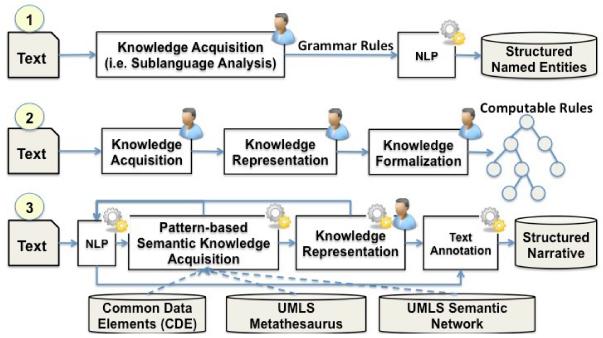
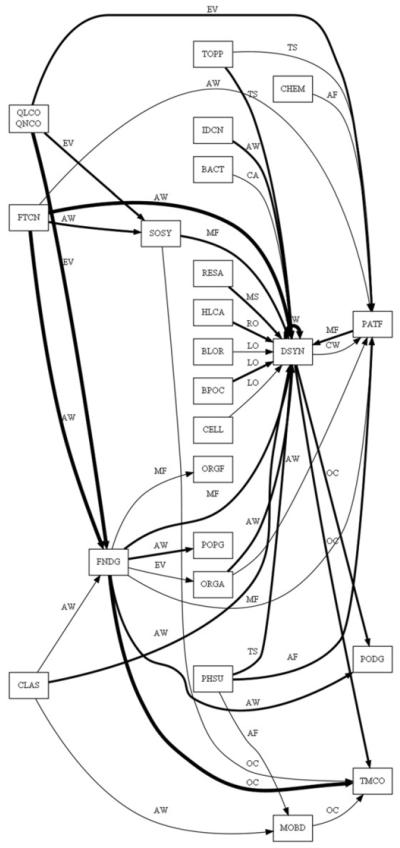
The successful adoption by clinicians of evidence-based clinical practice guidelines (CPGs) contained in clinical information systems requires efficient translation of free-text guidelines into computable formats. Natural language processing (NLP) has the potential to improve the efficiency of such translation. However, it is laborious to develop NLP to structure free-text CPGs using existing formal knowledge representations (KR). In response to this challenge, this vision paper discusses the value and feasibility of supporting symbiosis in text-based knowledge acquisition (KA) and KR. We compare two ontologies: (1) an ontology manually created by domain experts for CPG eligibility criteria and (2) an upper-level ontology derived from a semantic pattern-based approach for automatic KA from CPG eligibility criteria text. Then we discuss the strengths and limitations of interweaving KA and NLP for KR purposes and important considerations for achieving the symbiosis of KR and NLP for structuring CPGs to achieve evidence-based clinical practice.
临床医生要成功采用临床信息系统中包含的循证临床实践指南(CPG),需要将自由文本指南高效转换为可计算格式。自然语言处理(NLP)有潜力提高这种转换的效率。然而,利用现有的形式化知识表示(KR)来开发NLP以构建自由文本CPG是一项艰巨的任务。针对这一挑战,本文探讨了在基于文本的知识获取(KA)和KR中支持共生的价值和可行性。我们比较了两种本体:(1)由领域专家手动创建的用于CPG资格标准的本体,以及(2)从基于语义模式的方法派生的上层本体,该方法用于从CPG资格标准文本中进行自动KA。然后,我们讨论了为实现KR目的而交织KA和NLP的优势和局限性,以及为构建CPG以实现循证临床实践而实现KR和NLP共生的重要考虑因素。