Ji Xiao-Wei, Wu Chun-Ling, Wang Xing-Chen, Liu Jie, Bi Jian-Zhong, Wang Dian-Yun
Department of Neurology, Second Hospital Affiliated to Shandong University of Traditional Chinese Medicine, Jinan, Shandong 250001, P.R. China.
Blood Purification Center, Jinan Central Hospital Affiliated to Shandong University, Jinan, Shandong 250013, P.R. China.
Exp Ther Med. 2014 Jul;8(1):159-164. doi: 10.3892/etm.2014.1674. Epub 2014 Apr 8.
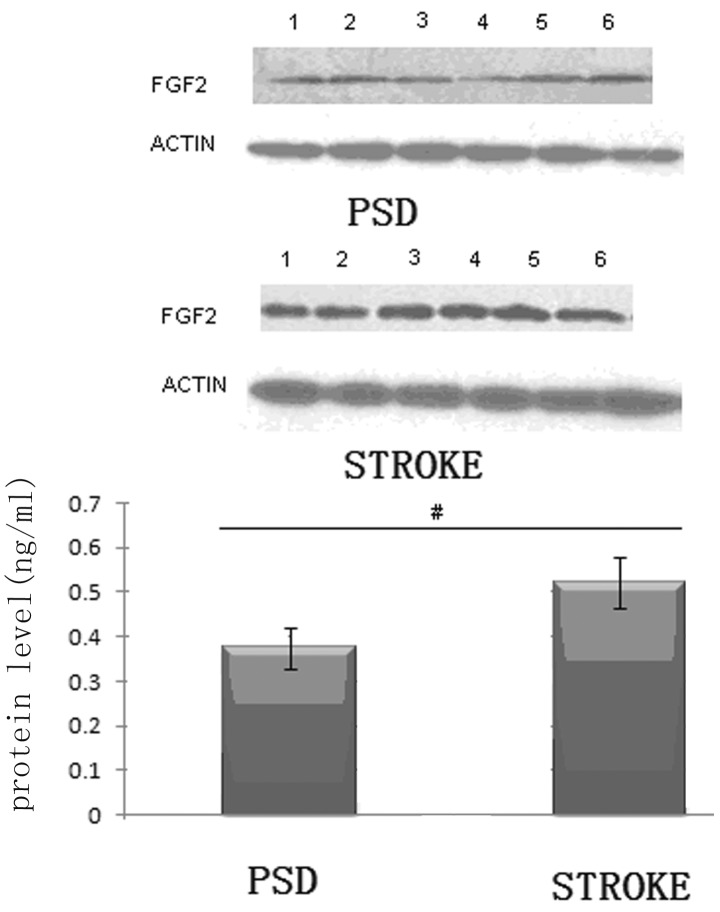
The aim of the present study was to investigate the changes in the levels of serotonin (5-HT), dopamine (DA), norepinephrine (NE) and fibroblast growth factor-2 (FGF-2) in the brains of rats with post-stroke depression (PSD). A rat model of stroke was established by middle cerebral artery occlusion and the rats were randomly divided into two groups: Control and modification groups. The rats in the modification group had PSD, while the rats in the control group had experienced a stroke only. The PSD model was established by applying chronic mild stress to the individually housed rats. High-performance liquid chromatography was used to detect the levels of 5-HT, DA and NE, while western blotting was used to detect the FGF-2 protein expression levels in the frontal lobe and hippocampus. Quantitative polymerase chain reaction was also used to determine the mRNA expression levels of FGF-2 in the frontal lobes of the two groups. The levels of 5-HT, DA and NE in the frontal lobe and hippocampus of the rats in the PSD group were significantly lower than the levels observed in the rats in the stroke group (P<0.01). In addition, protein expression levels of FGF-2 in the frontal lobe of the rats in the PSD group were significantly lower when compared with the control group rats (P<0.01), however, the protein expression levels of FGF-2 in the hippocampus did not exhibit a statistically significant difference (P>0.05). The mRNA expression levels of FGF-2 in the frontal lobe of the rats in the modification group were significantly lower than the levels in the control group rats (P<0.01). Therefore, reduced levels of monoamine neurotransmitters and FGF-2 expression in the brains of rats with PSD are associated with the incidence of PSD.
本研究旨在探讨脑卒中后抑郁(PSD)大鼠脑内5-羟色胺(5-HT)、多巴胺(DA)、去甲肾上腺素(NE)和成纤维细胞生长因子-2(FGF-2)水平的变化。采用大脑中动脉闭塞法建立大鼠脑卒中模型,并将大鼠随机分为两组:对照组和模型组。模型组大鼠患有PSD,而对照组大鼠仅经历了脑卒中。通过对单独饲养的大鼠施加慢性轻度应激建立PSD模型。采用高效液相色谱法检测5-HT、DA和NE的水平,同时采用蛋白质印迹法检测额叶和海马中FGF-2蛋白表达水平。还采用定量聚合酶链反应测定两组大鼠额叶中FGF-2的mRNA表达水平。PSD组大鼠额叶和海马中5-HT、DA和NE的水平显著低于脑卒中组大鼠(P<0.01)。此外,与对照组大鼠相比,PSD组大鼠额叶中FGF-2的蛋白表达水平显著降低(P<0.01),然而,海马中FGF-2的蛋白表达水平未显示出统计学显著差异(P>0.05)。模型组大鼠额叶中FGF-2的mRNA表达水平显著低于对照组大鼠(P<0.01)。因此,PSD大鼠脑内单胺类神经递质水平降低和FGF-2表达与PSD的发生有关。