Kemp John P, Medina-Gomez Carolina, Estrada Karol, St Pourcain Beate, Heppe Denise H M, Warrington Nicole M, Oei Ling, Ring Susan M, Kruithof Claudia J, Timpson Nicholas J, Wolber Lisa E, Reppe Sjur, Gautvik Kaare, Grundberg Elin, Ge Bing, van der Eerden Bram, van de Peppel Jeroen, Hibbs Matthew A, Ackert-Bicknell Cheryl L, Choi Kwangbom, Koller Daniel L, Econs Michael J, Williams Frances M K, Foroud Tatiana, Zillikens M Carola, Ohlsson Claes, Hofman Albert, Uitterlinden André G, Davey Smith George, Jaddoe Vincent W V, Tobias Jonathan H, Rivadeneira Fernando, Evans David M
MRC Integrative Epidemiology Unit at the University of Bristol, Bristol, United Kingdom; University of Queensland Diamantina Institute, Translational Research Institute, Brisbane, Queensland, Australia.
Department of Internal Medicine, Erasmus University Medical Center, Rotterdam, The Netherlands; The Generation R Study Group, Erasmus University Medical Center, Rotterdam, The Netherlands; Department of Epidemiology, Erasmus University Medical Center, Rotterdam, The Netherlands; Netherlands Genomics Initiative (NGI)-sponsored Netherlands Consortium for Healthy Aging (NCHA), The Netherlands.
PLoS Genet. 2014 Jun 19;10(6):e1004423. doi: 10.1371/journal.pgen.1004423. eCollection 2014 Jun.
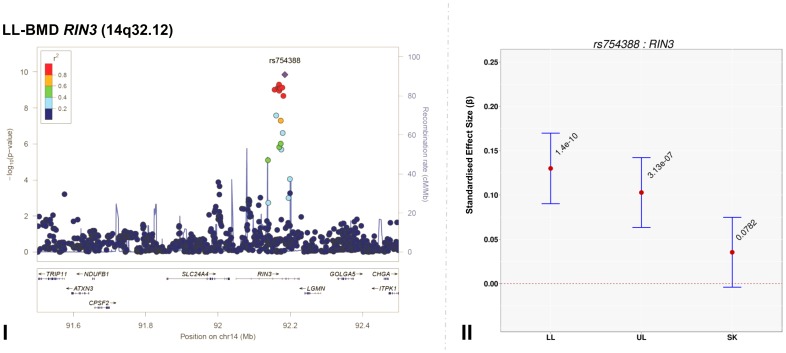
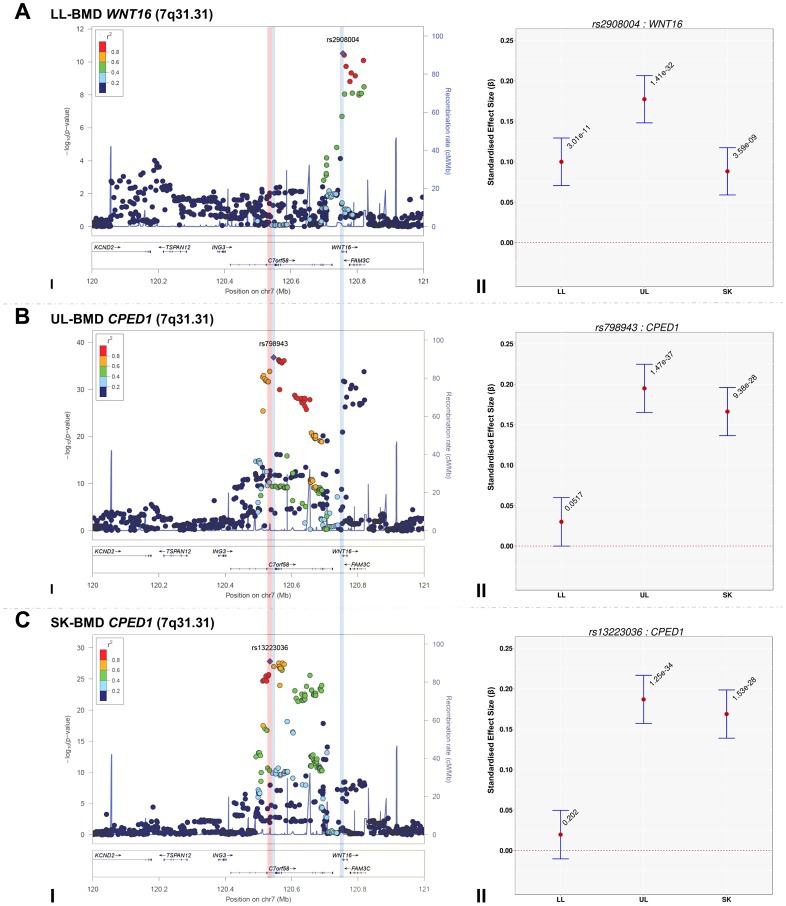
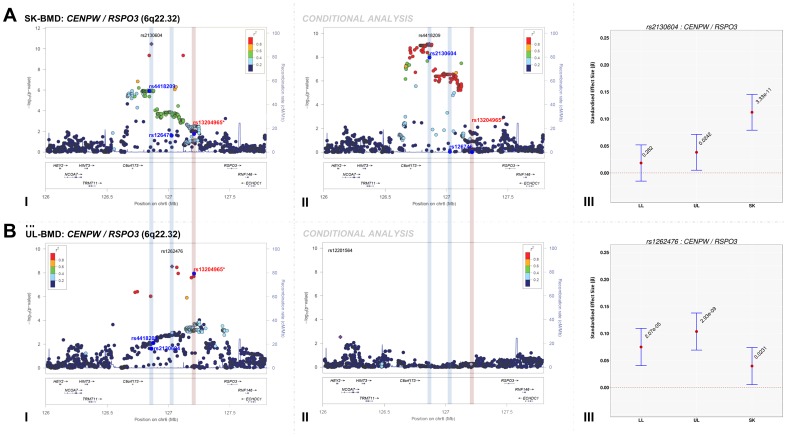
Heritability of bone mineral density (BMD) varies across skeletal sites, reflecting different relative contributions of genetic and environmental influences. To quantify the degree to which common genetic variants tag and environmental factors influence BMD, at different sites, we estimated the genetic (rg) and residual (re) correlations between BMD measured at the upper limbs (UL-BMD), lower limbs (LL-BMD) and skull (SK-BMD), using total-body DXA scans of ∼ 4,890 participants recruited by the Avon Longitudinal Study of Parents and their Children (ALSPAC). Point estimates of rg indicated that appendicular sites have a greater proportion of shared genetic architecture (LL-/UL-BMD rg = 0.78) between them, than with the skull (UL-/SK-BMD rg = 0.58 and LL-/SK-BMD rg = 0.43). Likewise, the residual correlation between BMD at appendicular sites (r(e) = 0.55) was higher than the residual correlation between SK-BMD and BMD at appendicular sites (r(e) = 0.20-0.24). To explore the basis for the observed differences in rg and re, genome-wide association meta-analyses were performed (n ∼ 9,395), combining data from ALSPAC and the Generation R Study identifying 15 independent signals from 13 loci associated at genome-wide significant level across different skeletal regions. Results suggested that previously identified BMD-associated variants may exert site-specific effects (i.e. differ in the strength of their association and magnitude of effect across different skeletal sites). In particular, variants at CPED1 exerted a larger influence on SK-BMD and UL-BMD when compared to LL-BMD (P = 2.01 × 10(-37)), whilst variants at WNT16 influenced UL-BMD to a greater degree when compared to SK- and LL-BMD (P = 2.31 × 10(-14)). In addition, we report a novel association between RIN3 (previously associated with Paget's disease) and LL-BMD (rs754388: β = 0.13, SE = 0.02, P = 1.4 × 10(-10)). Our results suggest that BMD at different skeletal sites is under a mixture of shared and specific genetic and environmental influences. Allowing for these differences by performing genome-wide association at different skeletal sites may help uncover new genetic influences on BMD.
骨矿物质密度(BMD)的遗传度在不同骨骼部位有所不同,这反映了遗传和环境影响的不同相对贡献。为了量化常见基因变异标签和环境因素在不同部位对BMD的影响程度,我们利用雅芳亲子纵向研究(ALSPAC)招募的约4890名参与者的全身双能X线吸收法(DXA)扫描数据,估算了上肢(UL-BMD)、下肢(LL-BMD)和颅骨(SK-BMD)测量的BMD之间的遗传(rg)和残差(re)相关性。rg的点估计表明,四肢部位之间共享遗传结构的比例更大(LL-/UL-BMD的rg = 0.78),高于与颅骨之间的比例(UL-/SK-BMD的rg = 0.58,LL-/SK-BMD的rg = 0.43)。同样,四肢部位BMD之间的残差相关性(r(e) = 0.55)高于SK-BMD与四肢部位BMD之间的残差相关性(r(e) = 0.20 - 0.24)。为了探究观察到的rg和re差异的基础,进行了全基因组关联荟萃分析(n ∼ 9395),整合了ALSPAC和Generation R研究的数据,在全基因组显著水平上识别出1个来自13个基因座的15个独立信号,这些基因座分布在不同骨骼区域。结果表明,先前确定的与BMD相关的变异可能具有部位特异性效应(即它们在不同骨骼部位的关联强度和效应大小有所不同)。特别是,与LL-BMD相比,CPED1基因座的变异对SK-BMD和UL-BMD的影响更大(P = 2.01 × 10(-37)),而与SK-BMD和LL-BMD相比,WNT16基因座的变异对UL-BMD的影响更大(P = 2.