de Cabo Rafael, Carmona-Gutierrez Didac, Bernier Michel, Hall Michael N, Madeo Frank
Translational Gerontology Branch, National Institute on Aging, National Institutes of Health, Baltimore, Maryland 21224, USA.
Institute of Molecular Biosciences, University of Graz, Graz 8010, Austria.
Cell. 2014 Jun 19;157(7):1515-26. doi: 10.1016/j.cell.2014.05.031.
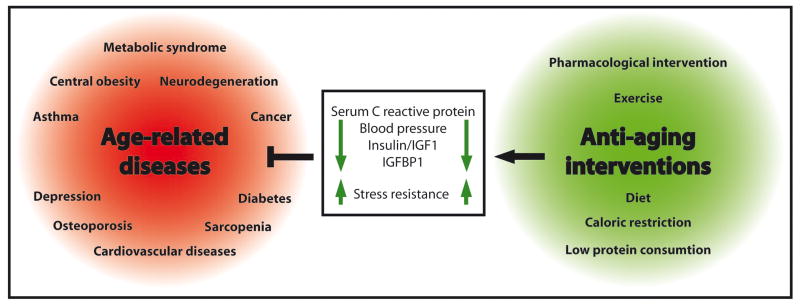
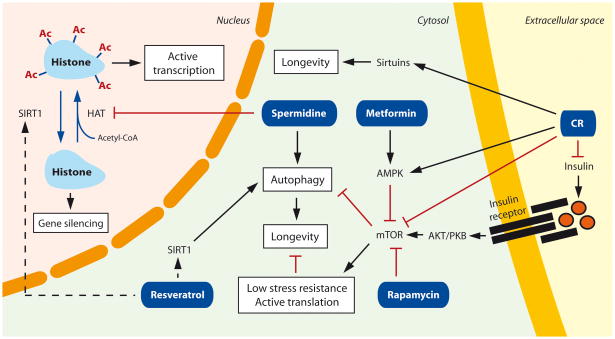
The phenomenon of aging is an intrinsic feature of life. Accordingly, the possibility to manipulate it has fascinated humans likely since time immemorial. Recent evidence is shaping a picture where low caloric regimes and exercise may improve healthy senescence, and several pharmacological strategies have been suggested to counteract aging. Surprisingly, the most effective interventions proposed to date converge on only a few cellular processes, in particular nutrient signaling, mitochondrial efficiency, proteostasis, and autophagy. Here, we critically examine drugs and behaviors to which life- or healthspan-extending properties have been ascribed and discuss the underlying molecular mechanisms.
衰老现象是生命的固有特征。因此,自远古时代起,操控衰老的可能性就可能一直吸引着人类。最近的证据描绘出这样一幅图景:低热量饮食和运动可能改善健康衰老,并且已经提出了几种药理学策略来对抗衰老。令人惊讶的是,迄今为止提出的最有效的干预措施仅集中在少数细胞过程上,特别是营养信号传导、线粒体效率、蛋白质稳态和自噬。在这里,我们批判性地审视了具有延长寿命或健康寿命特性的药物和行为,并讨论了其潜在的分子机制。