Hassan Fatemat, Xu Xiaohua, Nuovo Gerard, Killilea David W, Tyrrell Jean, Da Tan Chong, Tarran Robert, Diaz Philip, Jee Junbae, Knoell Daren, Boyaka Prosper N, Cormet-Boyaka Estelle
Department of Veterinary Biosciences, The Ohio State University, 1925 Coffey Road, Columbus, OH 43210, USA.
Respir Res. 2014 Jun 23;15(1):69. doi: 10.1186/1465-9921-15-69.
The Cystic Fibrosis Transmembrane conductance Regulator (CFTR) is a chloride channel that primarily resides in airway epithelial cells. Decreased CFTR expression and/or function lead to impaired airway surface liquid (ASL) volume homeostasis, resulting in accumulation of mucus, reduced clearance of bacteria, and chronic infection and inflammation.
Expression of CFTR and the cigarette smoke metal content were assessed in lung samples of controls and COPD patients with established GOLD stage 4. CFTR protein and mRNA were quantified by immunohistochemistry and quantitative RT-PCR, respectively. Metals present in lung samples were quantified by ICP-AES. The effect of cigarette smoke on down-regulation of CFTR expression and function was assessed using primary human airway epithelial cells. The role of leading metal(s) found in lung samples of GOLD 4 COPD patients involved in the alteration of CFTR was confirmed by exposing human bronchial epithelial cells 16HBE14o- to metal-depleted cigarette smoke extracts.
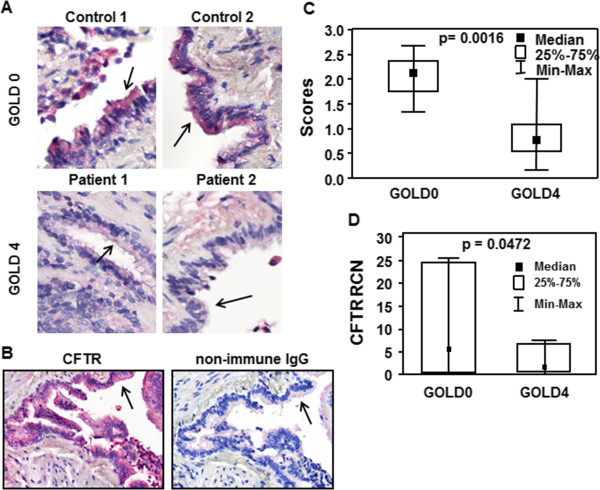
We found that CFTR expression is reduced in the lungs of GOLD 4 COPD patients, especially in bronchial epithelial cells. Assessment of metals present in lung samples revealed that cadmium and manganese were significantly higher in GOLD 4 COPD patients when compared to control smokers (GOLD 0). Primary human airway epithelial cells exposed to cigarette smoke resulted in decreased expression of CFTR protein and reduced airway surface liquid height. 16HBE14o-cells exposed to cigarette smoke also exhibited reduced levels of CFTR protein and mRNA. Removal and/or addition of metals to cigarette smoke extracts before exposure established their role in decrease of CFTR in airway epithelial cells.
CFTR expression is reduced in the lungs of patients with severe COPD. This effect is associated with the accumulation of cadmium and manganese suggesting a role for these metals in the pathogenesis of COPD.
囊性纤维化跨膜传导调节因子(CFTR)是一种主要存在于气道上皮细胞中的氯离子通道。CFTR表达和/或功能的降低会导致气道表面液体(ASL)体积稳态受损,从而导致黏液积聚、细菌清除减少以及慢性感染和炎症。
在确诊为GOLD 4期的对照组和慢性阻塞性肺疾病(COPD)患者的肺样本中评估CFTR的表达和香烟烟雾中的金属含量。分别通过免疫组织化学和定量逆转录聚合酶链反应(RT-PCR)对CFTR蛋白和mRNA进行定量。通过电感耦合等离子体发射光谱法(ICP-AES)对肺样本中存在的金属进行定量。使用原代人气道上皮细胞评估香烟烟雾对CFTR表达和功能下调的影响。通过将人支气管上皮细胞16HBE14o-暴露于无金属的香烟烟雾提取物中,证实了在GOLD 4期COPD患者肺样本中发现的主要金属在CFTR改变中的作用。
我们发现GOLD 4期COPD患者的肺中CFTR表达降低,尤其是在支气管上皮细胞中。对肺样本中存在的金属进行评估发现,与对照吸烟者(GOLD 0)相比,GOLD 4期COPD患者的镉和锰含量显著更高。暴露于香烟烟雾的原代人气道上皮细胞导致CFTR蛋白表达降低和气道表面液体高度降低。暴露于香烟烟雾的16HBE14o-细胞也表现出CFTR蛋白和mRNA水平降低。在暴露前去除和/或添加香烟烟雾提取物中的金属确定了它们在气道上皮细胞中降低CFTR的作用。
重度COPD患者的肺中CFTR表达降低。这种效应与镉和锰的积累有关,表明这些金属在COPD发病机制中起作用。