Department of Family Medicine, McGill University, Montreal, QC, Canada.
Clin Interv Aging. 2014 Jun 11;9:915-28. doi: 10.2147/CIA.S64723. eCollection 2014.
The purpose of this study was to examine factors associated with the implementation of case management (CM) interventions in primary health care (PHC) and to develop strategies to enhance its adoption by PHC practices.
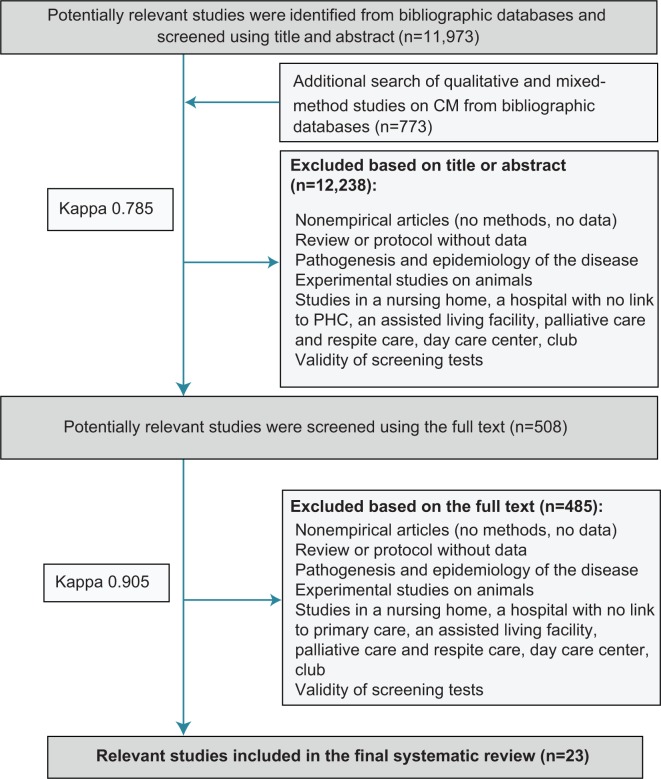
This study was designed as a systematic mixed studies review (including quantitative and qualitative studies) with synthesis based on the diffusion of innovation model. A literature search was performed using MEDLINE, PsycInfo, EMBASE, and the Cochrane Database (1995 to August 2012) to identify quantitative (randomized controlled and nonrandomized) and qualitative studies describing the conditions limiting and facilitating successful CM implementation in PHC. The methodological quality of each included study was assessed using the validated Mixed Methods Appraisal Tool.
Twenty-three studies (eleven quantitative and 12 qualitative) were included. The characteristics of CM that negatively influence implementation are low CM intensity (eg, infrequent follow-up), large caseload (more than 60 patients per full-time case manager), and approach, ie, reactive rather than proactive. Case managers need specific skills to perform their role (eg, good communication skills) and their responsibilities in PHC need to be clearly delineated.
Our systematic review supports a better understanding of factors that can explain inconsistent evidence with regard to the outcomes of dementia CM in PHC. Lastly, strategies are proposed to enhance implementation of dementia CM in PHC.
本研究旨在探讨与初级卫生保健中实施病例管理(CM)干预相关的因素,并制定增强该方法被采纳的策略。
本研究设计为系统的混合研究综述(包括定量和定性研究),根据创新传播模型进行综合。使用 MEDLINE、PsycInfo、EMBASE 和 Cochrane 数据库(1995 年至 2012 年 8 月)进行文献检索,以确定描述限制和促进初级卫生保健中成功实施 CM 的条件的定量(随机对照和非随机)和定性研究。使用经过验证的混合方法评估工具评估每个纳入研究的方法学质量。
共纳入 23 项研究(11 项定量和 12 项定性研究)。对实施产生负面影响的 CM 特征包括 CM 强度低(例如,随访不频繁)、病例量大(每位全职病例经理超过 60 名患者)和方法,即反应性而非主动型。病例管理者需要具备执行其角色的特定技能(例如,良好的沟通技巧),并且需要明确界定其在初级卫生保健中的职责。
我们的系统综述支持对可以解释与初级卫生保健中痴呆病例管理结果不一致的证据的因素有更好的理解。最后,提出了增强痴呆病例管理在初级卫生保健中的实施的策略。