Liu Te, Huang Yongyi, Chen Jiulin, Chi Huiying, Yu Zhihua, Wang Jian, Chen Chuan
Central Laboratory, Shanghai Geriatric Institute of Chinese Medicine, Longhua Hospital, Shanghai University of Traditional Chinese Medicine, Shanghai 200031, P.R. China.
Central Laboratory, School of Life Science and Technology, Tongji University, Shanghai 200092, P.R. China.
Mol Med Rep. 2014 Sep;10(3):1275-81. doi: 10.3892/mmr.2014.2351. Epub 2014 Jun 23.
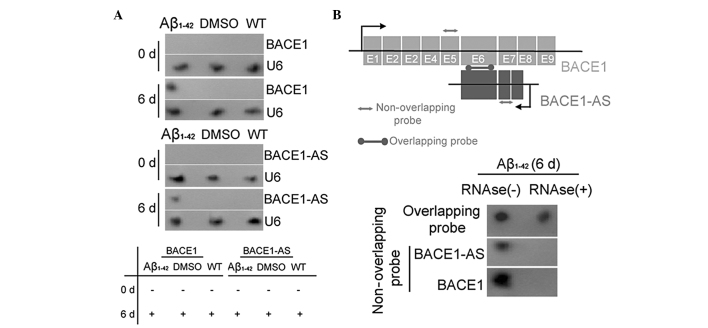
Although large numbers of long noncoding RNAs (lncRNAs) expressed in the mammalian nervous system have been detected, their functions and mechanisms of regulation remain to be fully clarified. It has been reported that the lncRNA antisense transcript for β‑secretase‑1 (BACE1‑AS) is elevated in Alzheimer's disease (AD) and drives the rapid feed‑forward regulation of β‑secretase, suggesting that it is critical in AD development. In the present study, the senile plaque (SP) AD SH‑SY5Y cell model was established using the synthetic amyloid β‑protein (Aβ) 1‑42 in vitro. Using this model, the potential of siRNA‑mediated silencing of lncRNA BACE1‑AS expression to attenuate the ability of β‑secretase‑1 (BACE1) to cleave amyloid precursor protein (APP) and to reduce the production of Aβ1‑42 oligomers was investigated. MTT assays demonstrated that exogenous Aβ1‑42 suppressed SH‑SY5Y cell proliferation and induced APP‑related factor expression and SP formation. Furthermore, quantitative polymerase chain reaction and western blot analysis revealed that the mRNA and protein expression of Aβ1‑42 and Aβ1‑40 was significantly increased in the AD model group, with a marked decrease in Ki‑67 expression at day six. RNase protection assays (RPA) and northern blotting analysis confirmed that exogenous Aβ1‑42 not only promoted the expression of the APP‑cleaving enzyme BACE1, but also induced lncRNA BACE1‑AS expression. Furthermore, lncRNA BACE1‑AS formed RNA duplexes and increased the stability of BACE1 mRNA. Downregulation of lncRNA BACE1‑AS expression in SH‑SY5Y cells by siRNA silencing resulted in the attenuation of the ability of BACE1 to cleave APP and delayed the induction of SP formation in the SP AD SH‑SY5Y cell model.
尽管已检测到大量在哺乳动物神经系统中表达的长链非编码RNA(lncRNA),但其功能和调控机制仍有待充分阐明。据报道,β-分泌酶-1(BACE1-AS)的lncRNA反义转录本在阿尔茨海默病(AD)中升高,并驱动β-分泌酶的快速前馈调节,这表明它在AD发展中至关重要。在本研究中,体外使用合成淀粉样β蛋白(Aβ)1-42建立了老年斑(SP)AD SH-SY5Y细胞模型。利用该模型,研究了siRNA介导的lncRNA BACE1-AS表达沉默减弱β-分泌酶-1(BACE1)切割淀粉样前体蛋白(APP)的能力以及减少Aβ1-42寡聚体产生的潜力。MTT分析表明,外源性Aβ1-42抑制SH-SY5Y细胞增殖,并诱导APP相关因子表达和SP形成。此外,定量聚合酶链反应和蛋白质印迹分析显示,AD模型组中Aβ1-42和Aβ1-40的mRNA和蛋白质表达显著增加,在第6天时Ki-67表达明显降低。核糖核酸酶保护分析(RPA)和Northern印迹分析证实,外源性Aβ1-42不仅促进了APP切割酶BACE1的表达,还诱导了lncRNA BACE1-AS表达。此外,lncRNA BACE1-AS形成RNA双链体并增加了BACE1 mRNA的稳定性。通过siRNA沉默下调SH-SY5Y细胞中lncRNA BACE1-AS的表达,导致BACE1切割APP的能力减弱,并延迟了SP AD SH-SY5Y细胞模型中SP形成的诱导。