Yang Yi, Matsuzaki Motomichi, Takahashi Fumio, Qu Lei, Nozaki Hisayoshi
Department of Biological Sciences, Graduate School of Science, University of Tokyo, Bunkyo, Tokyo, Japan.
Department of Biomedical Chemistry, Graduate School of Medicine, University of Tokyo, Bunkyo, Tokyo, Japan.
PLoS One. 2014 Jun 27;9(6):e101158. doi: 10.1371/journal.pone.0101158. eCollection 2014.
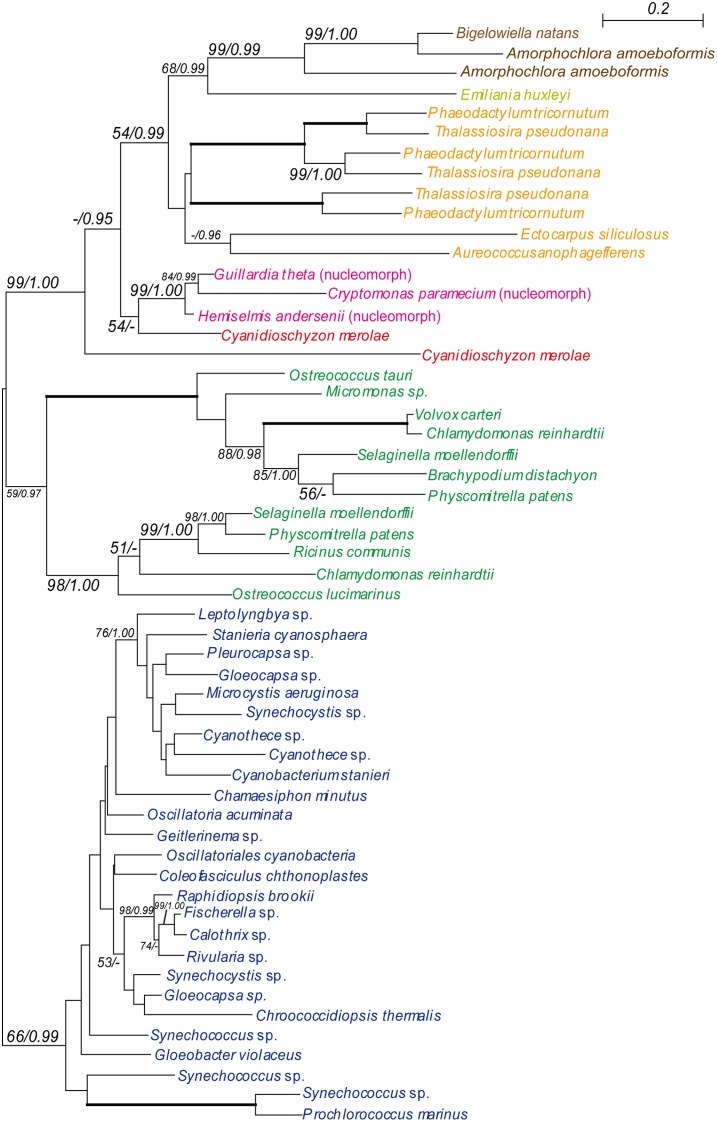
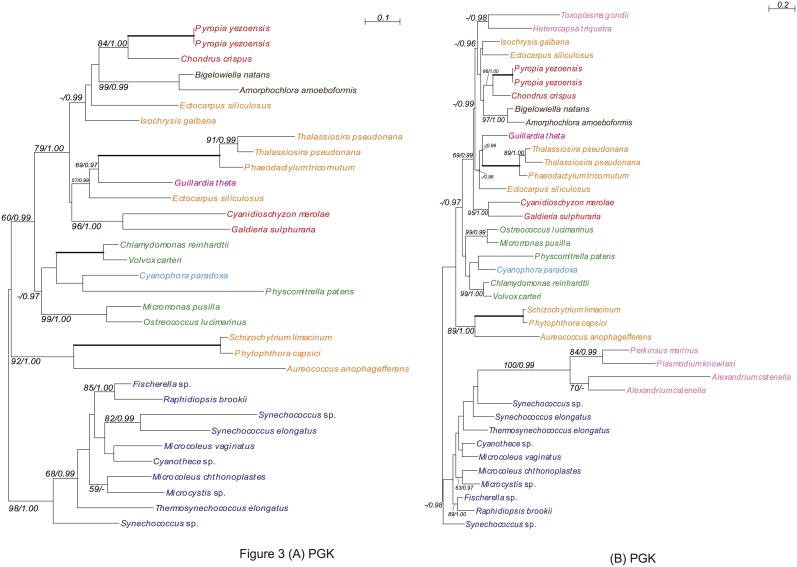
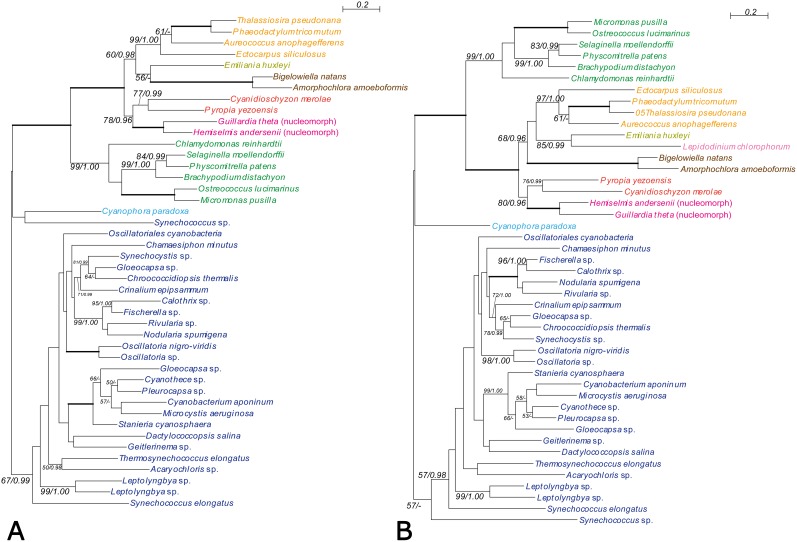
The plastids of chlorarachniophytes were derived from an ancestral green alga via secondary endosymbiosis. Thus, genes from the "green" lineage via secondary endosymbiotic gene transfer (EGT) are expected in the nuclear genomes of the Chlorarachniophyta. However, several recent studies have revealed the presence of "red" genes in their nuclear genomes. To elucidate the origin of such "red" genes in chlorarachniophyte nuclear genomes, we carried out exhaustive single-gene phylogenetic analyses, including two operational taxonomic units (OTUs) that represent two divergent sister lineages of the Chlorarachniophyta, Amorphochlora amoeboformis ( = Lotharella amoeboformis; based on RNA sequences newly determined here) and Bigelowiella natans (based on the published genome sequence). We identified 10 genes of cyanobacterial origin, phylogenetic analysis of which showed the chlorarachniophytes to branch with the red lineage (red algae and/or red algal secondary or tertiary plastid-containing eukaryotes). Of the 10 genes, 7 demonstrated robust monophyly of the two chlorarachniophyte OTUs. Thus, the common ancestor of the extant chlorarachniophytes likely experienced multiple horizontal gene transfers from the red lineage. Because 4 of the 10 genes are obviously photosynthesis- and/or plastid-related, and almost all of the eukaryotic OTUs in the 10 trees possess plastids, such red genes most likely originated directly from photosynthetic eukaryotes. This situation could be explained by a possible cryptic endosymbiosis of a red algal plastid before the secondary endosymbiosis of the green algal plastid, or a long-term feeding on a single (or multiple closely related) red algal plastid-containing eukaryote(s) after the green secondary endosymbiosis.
绿藻虫的质体是通过二次内共生从一个祖先绿藻衍生而来的。因此,通过二次内共生基因转移(EGT)来自“绿色”谱系的基因有望出现在绿藻虫的核基因组中。然而,最近的几项研究揭示了它们的核基因组中存在“红色”基因。为了阐明绿藻虫核基因组中此类“红色”基因的起源,我们进行了详尽的单基因系统发育分析,包括两个代表绿藻虫两个不同姐妹谱系的操作分类单元(OTU),变形绿藻(=变形洛氏藻;基于此处新测定的RNA序列)和比氏硅藻(基于已发表的基因组序列)。我们鉴定出10个蓝细菌起源的基因,对其进行系统发育分析表明绿藻虫与红色谱系(红藻和/或含有红藻次生或三生质体的真核生物)分支。在这10个基因中,7个显示出两个绿藻虫OTU的强烈单系性。因此,现存绿藻虫的共同祖先可能经历了来自红色谱系的多次水平基因转移。由于这10个基因中有4个明显与光合作用和/或质体相关,并且10棵树中的几乎所有真核OTU都拥有质体,此类红色基因很可能直接起源于光合真核生物。这种情况可以通过绿藻质体二次内共生之前红藻质体可能的隐秘内共生,或者绿藻二次内共生之后长期以单一(或多个密切相关的)含有红藻质体的真核生物为食来解释。