Instituto de Parasitología y Biomedicina "López-Neyra," Consejo Superior de Investigaciones Científicas Granada, Spain.
Front Mol Neurosci. 2014 Jun 17;7:53. doi: 10.3389/fnmol.2014.00053. eCollection 2014.
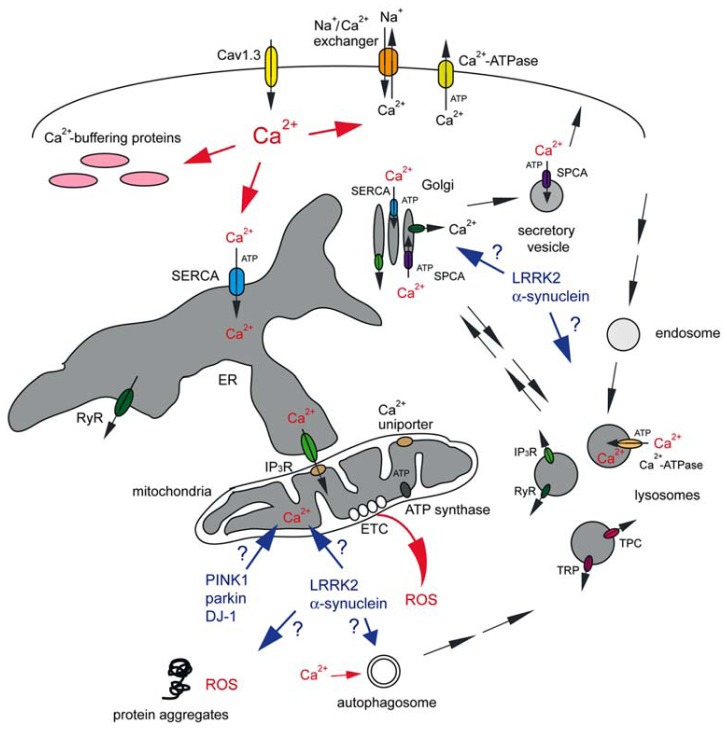
Parkinson's disease (PD) is a major health problem affecting millions of people worldwide. Recent studies provide compelling evidence that altered Ca(2) (+) homeostasis may underlie disease pathomechanism and be an inherent feature of all vulnerable neurons. The downstream effects of altered Ca(2) (+) handling in the distinct subcellular organelles for proper cellular function are beginning to be elucidated. Here, we summarize the evidence that vulnerable neurons may be exposed to homeostatic Ca(2) (+) stress which may determine their selective vulnerability, and suggest how abnormal Ca(2) (+) handling in the distinct intracellular compartments may compromise neuronal health in the context of aging, environmental, and genetic stress. Gaining a better understanding of the varied effects of Ca(2) (+) dyshomeostasis may allow novel combinatorial therapeutic strategies to slow PD progression.
帕金森病(PD)是一个全球性的重大健康问题,影响着数以百万计的人。最近的研究提供了令人信服的证据,表明钙(Ca(2)+)稳态的改变可能是疾病发病机制的基础,也是所有易损神经元的固有特征。改变 Ca(2)+ 在不同亚细胞细胞器中的处理对适当的细胞功能的下游影响开始被阐明。在这里,我们总结了易损神经元可能暴露于维持性 Ca(2)+应激下的证据,这种应激可能决定了它们的选择性易损性,并提出了在衰老、环境和遗传应激的情况下,不同细胞内隔室中异常的 Ca(2)+处理如何损害神经元健康。更好地了解 Ca(2)+ 稳态失调的各种影响可能允许新的组合治疗策略来减缓 PD 的进展。