Nicolasjilwan Manal, Hu Ying, Yan Chunhua, Meerzaman Daoud, Holder Chad A, Gutman David, Jain Rajan, Colen Rivka, Rubin Daniel L, Zinn Pascal O, Hwang Scott N, Raghavan Prashant, Hammoud Dima A, Scarpace Lisa M, Mikkelsen Tom, Chen James, Gevaert Olivier, Buetow Kenneth, Freymann John, Kirby Justin, Flanders Adam E, Wintermark Max
Division of Neuroradiology, University of Virginia Health System, Charlottesville, VA, United States.
Center for Biomedical Informatics & Information Technology, National Cancer Institute, Bethesda, MD, United States.
J Neuroradiol. 2015 Jul;42(4):212-21. doi: 10.1016/j.neurad.2014.02.006. Epub 2014 Jul 2.
The purpose of our study was to assess whether a model combining clinical factors, MR imaging features, and genomics would better predict overall survival of patients with glioblastoma (GBM) than either individual data type.
The study was conducted leveraging The Cancer Genome Atlas (TCGA) effort supported by the National Institutes of Health. Six neuroradiologists reviewed MRI images from The Cancer Imaging Archive (http://cancerimagingarchive.net) of 102 GBM patients using the VASARI scoring system. The patients' clinical and genetic data were obtained from the TCGA website (http://www.cancergenome.nih.gov/). Patient outcome was measured in terms of overall survival time. The association between different categories of biomarkers and survival was evaluated using Cox analysis.
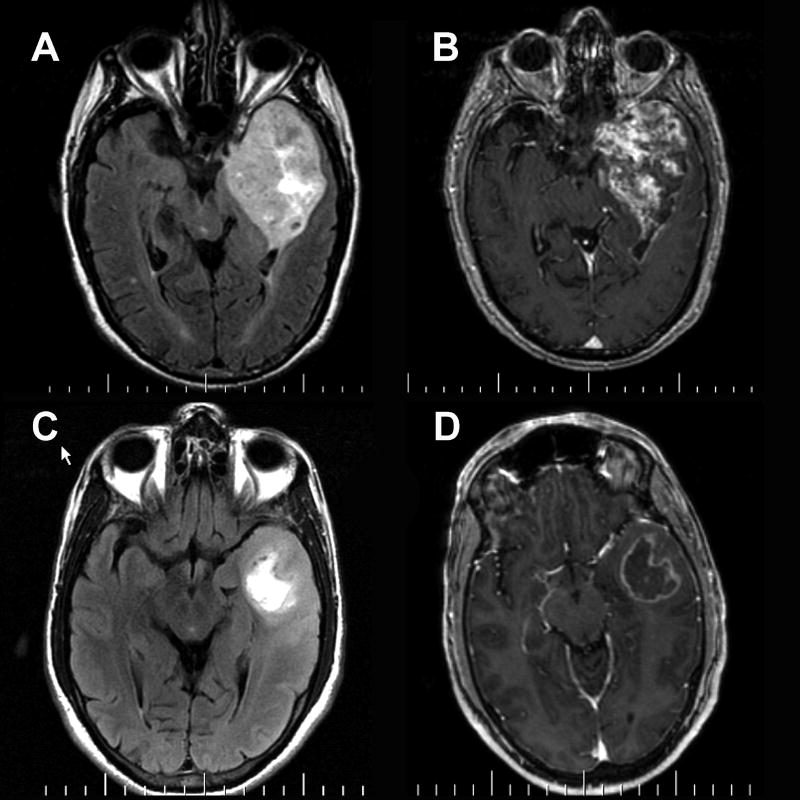
The features that were significantly associated with survival were: (1) clinical factors: chemotherapy; (2) imaging: proportion of tumor contrast enhancement on MRI; and (3) genomics: HRAS copy number variation. The combination of these three biomarkers resulted in an incremental increase in the strength of prediction of survival, with the model that included clinical, imaging, and genetic variables having the highest predictive accuracy (area under the curve 0.679±0.068, Akaike's information criterion 566.7, P<0.001).
A combination of clinical factors, imaging features, and HRAS copy number variation best predicts survival of patients with GBM.
我们研究的目的是评估一个结合临床因素、磁共振成像(MR)特征和基因组学的模型,相较于单一数据类型,是否能更好地预测胶质母细胞瘤(GBM)患者的总生存期。
本研究利用美国国立卫生研究院支持的癌症基因组图谱(TCGA)项目开展。六名神经放射科医生使用VASARI评分系统,对来自癌症影像存档库(http://cancerimagingarchive.net)的102例GBM患者的MRI图像进行了评估。患者的临床和基因数据从TCGA网站(http://www.cancergenome.nih.gov/)获取。患者预后通过总生存时间衡量。使用Cox分析评估不同类别的生物标志物与生存之间的关联。
与生存显著相关的特征包括:(1)临床因素:化疗;(2)影像:MRI上肿瘤对比增强比例;(3)基因组学:HRAS拷贝数变异。这三种生物标志物的组合使生存预测强度逐步增加,包含临床、影像和基因变量的模型具有最高的预测准确性(曲线下面积0.679±0.068,赤池信息准则566.7,P<0.001)。
临床因素、影像特征和HRAS拷贝数变异的组合能最好地预测GBM患者的生存情况。