
自发性结肠炎及其病理进展改变了小鼠的阑尾微生物组。
The murine appendiceal microbiome is altered in spontaneous colitis and its pathological progression.
机构信息
Mucosal Biology Laboratory, School of School of Health Sciences, University of Tasmania, Launceston, TAS, Australia.
Department of Medicine, St. George Clinical School, University of New South Wales, Sydney, NSW, Australia.
出版信息
Gut Pathog. 2014 Jun 21;6:25. doi: 10.1186/1757-4749-6-25. eCollection 2014.
BACKGROUND
Inflammatory bowel disease (comprising ulcerative colitis and Crohn's disease) is a multifactorial disease that is extensively associated with stool microbiome changes (dysbiosis). Appendicitis and appendectomy limits subsequent colitis, clinically, and in animal models. We wanted to examine how the appendiceal and stool microbiome fared in our spontaneous colitic Winnie (Muc2(-/-)) mice model.
METHODS
Two C57BL/6 and 10 Winnie mice at ages 12 and 15 weeks were euthanized for stool and caecal patch samples. DNA was extracted using the QIAamp DNA Stool Mini Kit then the V1-V3 hypervariable region of the 16S rRNA gene was sequenced using the Roche/454 GS FLX + pyrosequencing instrument. A Galaxy metagenomic pipeline was used to define phyla and families at sequence similarity threshold of ≥ 80%.
RESULTS
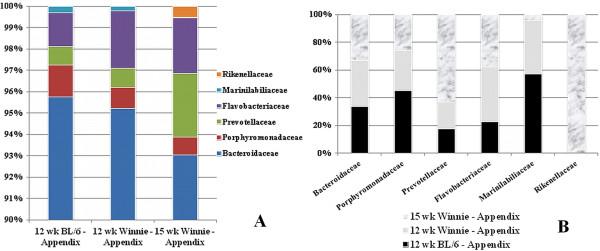
Bacteriodetes was decreased in 15-week Winnie mice appendices compared to corresponding stool samples (P < 0.01). Proteobacteria was increased in appendices of Winnie mice compared to corresponding stool samples (P < 0.05). The Bacteroidetes family Rikenellaceae could be identified only in 15-week-old Winnie mice appendices. A higher quantity of Acetobacteraceae (Proteobacteria phylum) was present in 15-week Winnie mice when compared to 12-week Winnie mice (P < 0.01). Helicobacteraceae (Proteobacteria phylum), which is prominent in all Winnie mice, is absent in control mice.
CONCLUSIONS
The appendiceal dysbiosis observed in our Winnie mice is commensurate with, and adds to extant literature data. The presence of Helicobacteraceae (Proteobacteria) only in colitic Winnie mice (but not control mice) is consistent with reports of increased Helicobacter in IBD patients. Bacteroides (Bacteroidetes) decreases may be a reflection of reduced anti-inflammatory commensal species such as B. fragilis. Further research is warranted to expand and delineate the relationship between IBD and the appendix microbiome.
背景
炎症性肠病(包括溃疡性结肠炎和克罗恩病)是一种多因素疾病,与粪便微生物组变化(失调)广泛相关。阑尾和阑尾切除术在临床上和动物模型中限制了随后的结肠炎。我们想研究自发性结肠炎 Winnie(Muc2(-/-))小鼠模型中阑尾和粪便微生物组的情况。
方法
12 周和 15 周龄的 2 只 C57BL/6 和 10 只 Winnie 小鼠被安乐死,用于粪便和盲肠斑块样本。使用 QIAamp DNA 粪便 Mini 试剂盒提取 DNA,然后使用 Roche/454 GS FLX+焦磷酸测序仪对 16S rRNA 基因的 V1-V3 高变区进行测序。使用 Galaxy 宏基因组分析管道,以序列相似性阈值≥80%定义门和科。
结果
与相应的粪便样本相比,15 周龄 Winnie 小鼠阑尾中的拟杆菌门减少(P<0.01)。与相应的粪便样本相比,Winnie 小鼠阑尾中的变形菌门增加(P<0.05)。仅在 15 周龄 Winnie 小鼠阑尾中可识别 Rikenellaceae 菌科。与 12 周龄 Winnie 小鼠相比,15 周龄 Winnie 小鼠中存在更多的醋酸杆菌科(变形菌门)(P<0.01)。在所有 Winnie 小鼠中都很突出的螺旋杆菌科(变形菌门)在对照小鼠中不存在。
结论
我们在 Winnie 小鼠中观察到的阑尾微生物失调与现有文献数据相符,并有所补充。仅在结肠炎 Winnie 小鼠(而非对照小鼠)中存在的螺旋杆菌科(变形菌门)表明,IBD 患者的幽门螺旋杆菌增加。拟杆菌门(拟杆菌门)的减少可能反映了抗炎共生物种如脆弱拟杆菌的减少。需要进一步研究来扩展和阐明 IBD 与阑尾微生物组之间的关系。



 Zotero 插件