Burström Lena, Letterstål Anna, Engström Marie-Louise, Berglund Anders, Enlund Mats
Centre for Clinical Research, Uppsala University, Västmanlands County Hospital, Västerås, Sweden.
BMC Health Serv Res. 2014 Jul 9;14:296. doi: 10.1186/1472-6963-14-296.
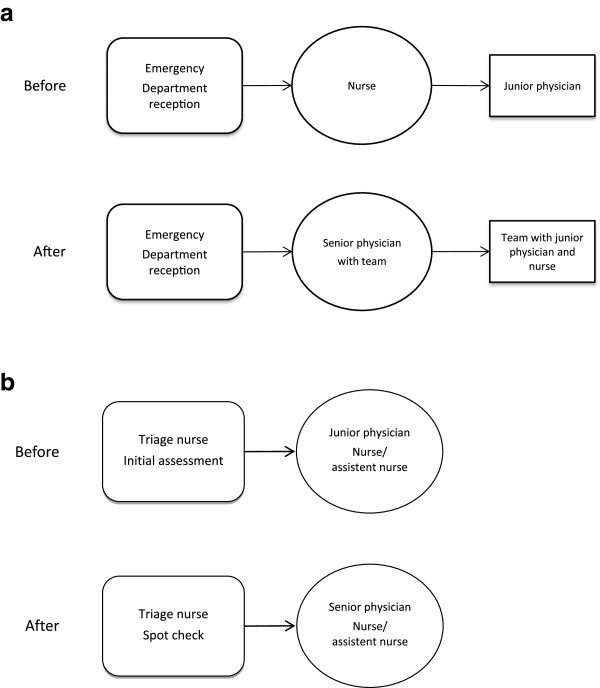
Patient safety is of the utmost importance in health care. The patient safety culture in an institution has great impact on patient safety. To enhance patient safety and to design strategies to reduce medical injuries, there is a current focus on measuring the patient safety culture. The aim of the present study was to describe the patient safety culture in an ED at two different hospitals before and after a Quality improvement (QI) project that was aimed to enhance patient safety.
A repeated cross-sectional design, using the Hospital Survey On Patient Safety Culture questionnaire before and after a quality improvement project in two emergency departments at a county hospital and a university hospital. The questionnaire was developed to obtain a better understanding of the patient safety culture of an entire hospital or of specific departments. The Swedish version has 51 questions and 15 dimensions.
At the county hospital, a difference between baseline and follow-up was observed in three dimensions. For two of these dimensions, Team-work within hospital and Communication openness, a higher score was measured at the follow-up. At the university hospital, a higher score was measured at follow-up for the two dimensions Team-work across hospital units and Team-work within hospital.
The result showed changes in the self-estimated patient safety culture, mainly regarding team-work and communication openness. Most of the improvements at follow-up were seen by physicians, and mainly at the county hospital.
患者安全在医疗保健中至关重要。机构中的患者安全文化对患者安全有很大影响。为提高患者安全并设计减少医疗伤害的策略,目前重点在于衡量患者安全文化。本研究的目的是描述在一项旨在提高患者安全的质量改进(QI)项目前后,两家不同医院急诊科的患者安全文化。
采用重复横断面设计,在一家县医院和一家大学医院的两个急诊科的质量改进项目前后,使用《医院患者安全文化调查问卷》。该问卷旨在更好地了解整个医院或特定部门的患者安全文化。瑞典语版本有51个问题和15个维度。
在县医院,在三个维度上观察到基线与随访之间存在差异。对于其中两个维度,即医院内团队合作和沟通开放性,随访时得分更高。在大学医院,跨医院科室团队合作和医院内团队合作这两个维度在随访时得分更高。
结果显示自我评估的患者安全文化发生了变化,主要涉及团队合作和沟通开放性。随访时的大多数改进是由医生看到的,且主要在县医院。