Perez Amanda G M, Lana José Fábio S D, Rodrigues Ana Amélia, Luzo Angela Cristina M, Belangero William D, Santana Maria Helena A
Department of Engineering of Materials and Bioprocesses, School of Chemical Engineering, University of Campinas, 13083-852 Campinas, SP, Brazil.
Research Institute of Sports Medicine, Orthopedics and Regeneration, iMOR, 38050-400 Uberaba, MG, Brazil.
ISRN Hematol. 2014 Mar 25;2014:176060. doi: 10.1155/2014/176060. eCollection 2014.
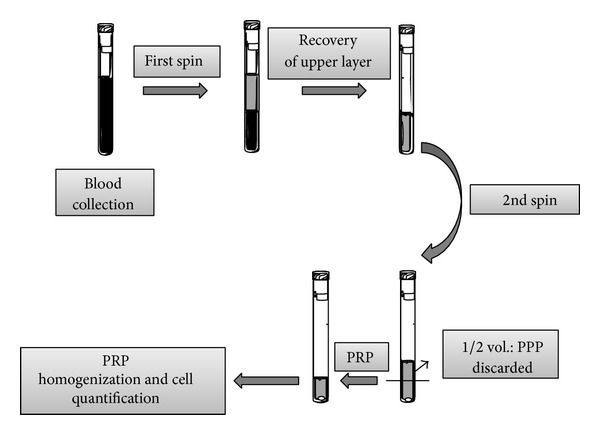
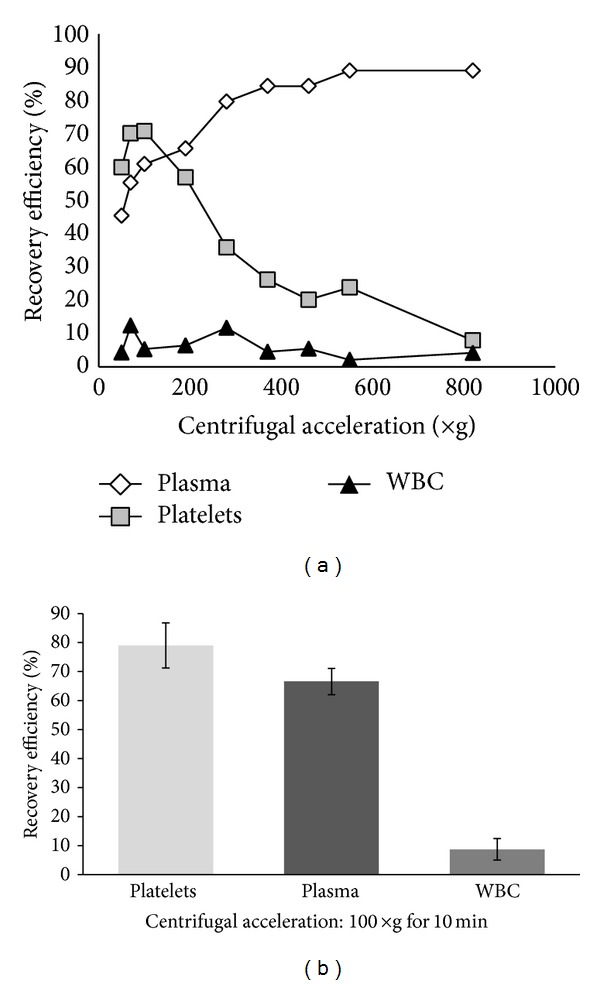
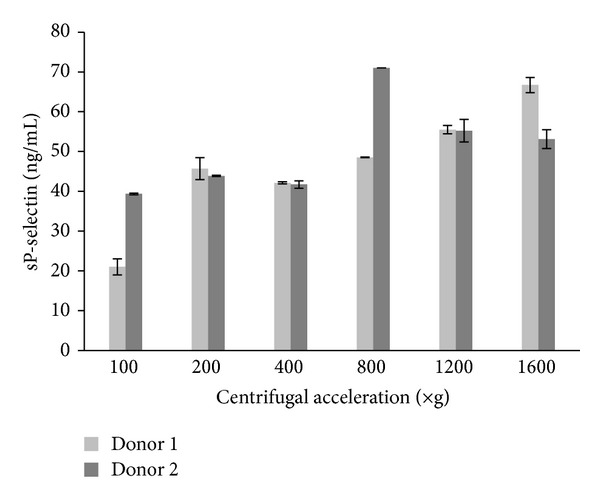
Introduction. Platelet-Rich Plasma (PRP) is rich in growth factors, playing important role in tissue healing. The wide variation of reported protocols for preparation of PRP leads to variable compositions, which induce different biological responses and prevent results comparison. This study aims to highlight relevant aspects of the centrifugation step to obtain reproducible results and overall quality. Material and Methods. Samples of blood were collected from 20 healthy donors that have signed free informed consent. Two centrifugation steps (spins) were analyzed for the influence of centrifugal acceleration, time, processed volume, and platelet gradient. The Pure Platelet-Rich Plasma (P-PRP) was characterized as platelet concentration, integrity, and viability (sP-selectin measurement). Results. Lower centrifugal accelerations favour platelet separation. The processing of 3.5 mL of blood at 100 ×g for 10 min (1st spin), 400 ×g for 10 min (2nd spin), withdrawing 2/3 of remnant plasma, promoted high platelet recovery (70-80%) and concentration (5x) maintaining platelet integrity and viability. The recovery of platelets was reduced for a larger WB volume (8.5 mL) processed. Conclusion. Centrifugal acceleration, time, WB processed volume, and minimization of the platelet gradient before sampling are relevant aspects to ensure reproducible compositions within the autologous nature of PRP.
引言。富血小板血浆(PRP)富含生长因子,在组织愈合中发挥重要作用。报道的PRP制备方案差异很大,导致成分各异,从而引发不同的生物学反应并阻碍结果比较。本研究旨在强调离心步骤的相关方面,以获得可重复的结果和整体质量。材料与方法。从20名签署了自由知情同意书的健康供体采集血样。分析了两个离心步骤(转速)对离心加速度、时间、处理体积和血小板梯度的影响。对纯富血小板血浆(P-PRP)进行血小板浓度、完整性和活力(可溶性P-选择素测量)表征。结果。较低的离心加速度有利于血小板分离。以100×g离心10分钟(第一次转速)处理3.5mL血液,然后以400×g离心10分钟(第二次转速),抽取2/3的残余血浆,可促进高血小板回收率(70-80%)和浓度(5倍),同时保持血小板的完整性和活力。对于处理的较大全血体积(8.5mL),血小板回收率降低。结论。离心加速度、时间、处理的全血体积以及采样前血小板梯度的最小化是确保PRP自体性质内可重复成分的相关方面。