Muthu Sathish, Krishnan Anand, Ramanathan Karthik Raja
Department of Orthopaedics, Government Medical College, Dindigul, Tamil Nadu, India.
Orthopaedic Research Group, Coimbatore, Tamil Nadu, India.
Ann Med Surg (Lond). 2022 Sep 13;82:104593. doi: 10.1016/j.amsu.2022.104593. eCollection 2022 Oct.
Of late, numerous randomised controlled trials report platelet-rich plasma (PRP) to be ineffective with preparation protocols of low platelet yield despite using expensive commercial PRP kits.
This study aims to identify and standardize a preparation protocol for PRP with maximum platelets yield and concentration to obtain favourable results without the use of commercial preparation kits.
MATERIALS & METHODS: Blood samples were collected from 40 healthy volunteers who signed informed consent for participation in the study. The double spin protocol of PRP preparation was analyzed for variables such as centrifugal acceleration, time, and volume of blood processed and final product utilized. The final PRP prepared was investigated for platelet recovery, concentration, integrity, and viability. Each protocol investigated with technical and biological duplicates to avoid reporting and sampling bias.
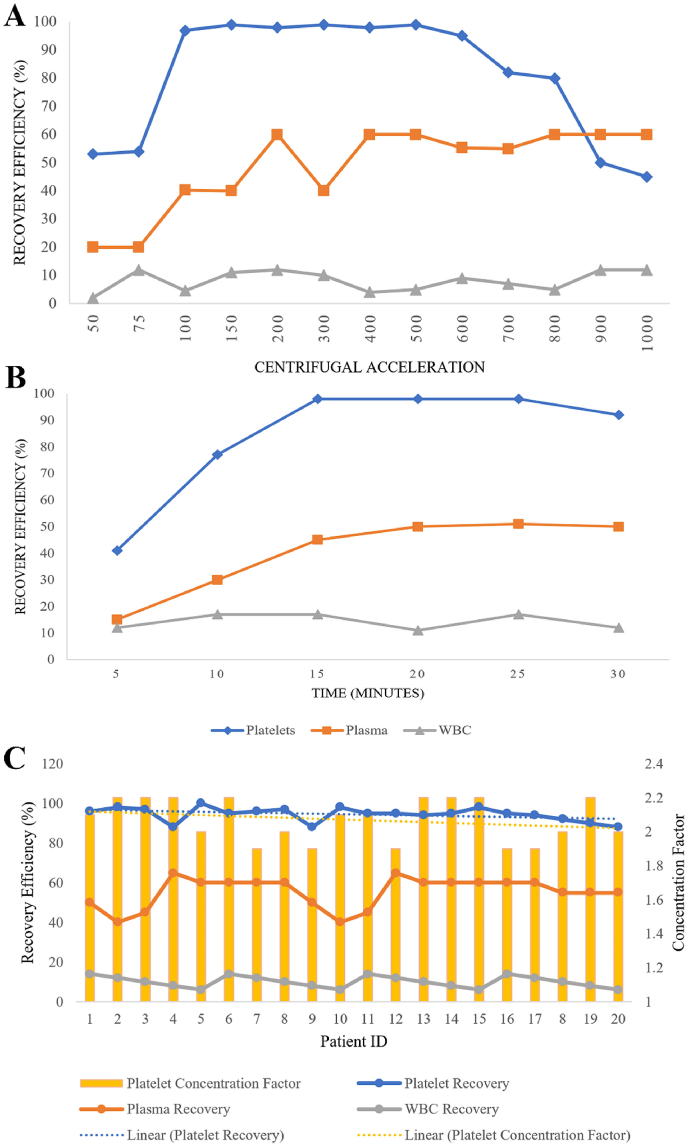
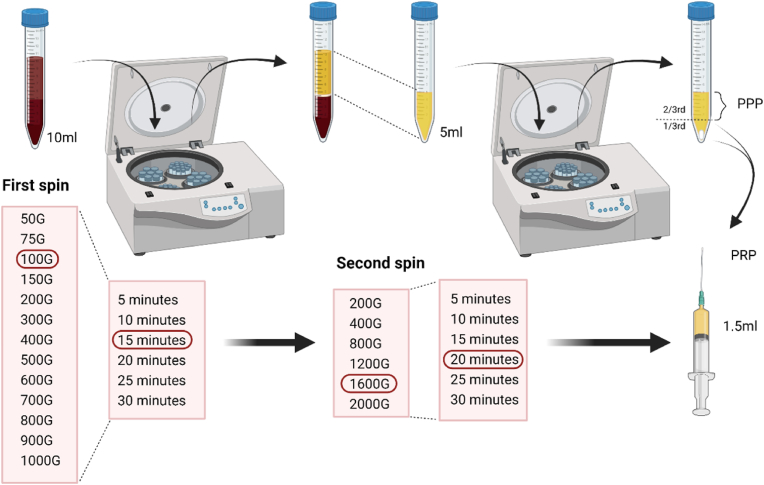
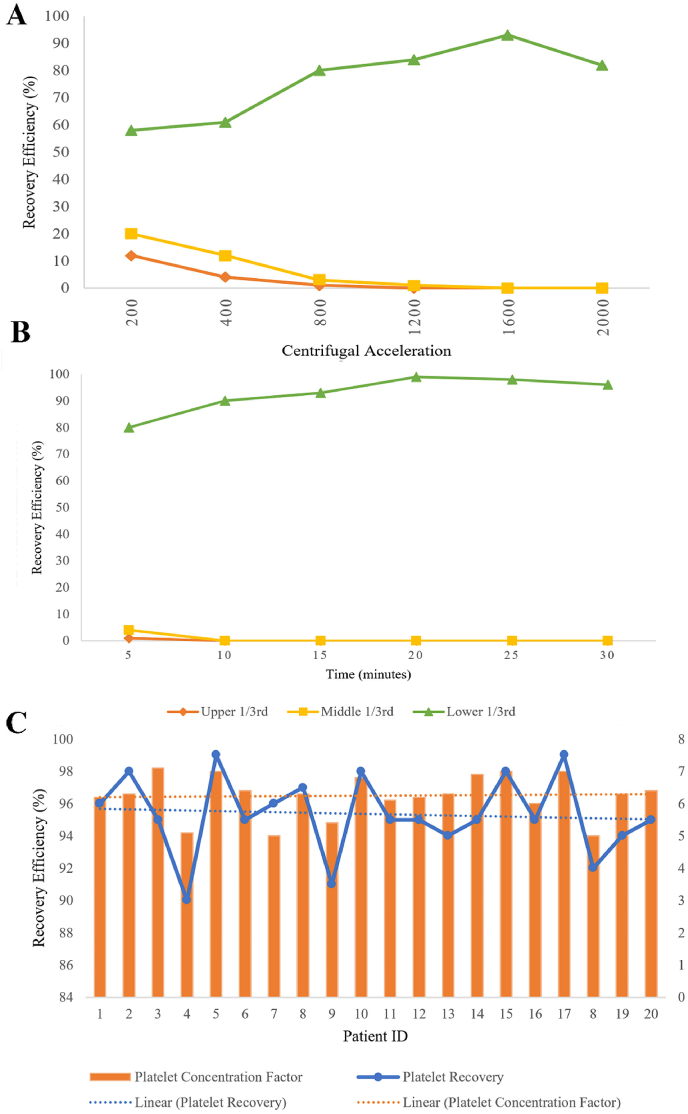
We noted maximum platelet recovery (86-99%) with a consistent 6.4 ± 0.8 times the baseline concentration of platelets with first centrifugation at 100 for 15 min followed by second centrifugation at 1600 for 20 min. We did not note a loss of integrity or viability of the platelets in the final product from the above-said protocol. We also validated the protocol among all the study participants demonstrating consistency.
The preparation of PRP by the double-spin protocol using 10 ml of blood at 100 g followed by 1600 g for 15 and 20 min respectively in a 15 ml tube and using the lower 1/3rd of the final product demonstrated consistent high platelet recovery (86-99%) and concentration (6x) without disturbing the platelet integrity or viability.
最近,许多随机对照试验报告称,尽管使用了昂贵的商业富血小板血浆(PRP)试剂盒,但血小板产量低的制备方案会导致PRP无效。
本研究旨在确定并标准化一种PRP制备方案,以实现最大的血小板产量和浓度,从而在不使用商业制备试剂盒的情况下获得良好效果。
从40名签署知情同意书参与本研究的健康志愿者身上采集血样。分析PRP制备的双离心方案中的变量,如离心加速度、时间、处理的血液体积以及最终使用的产品。对制备的最终PRP进行血小板回收率、浓度、完整性和活力的研究。每个方案都进行了技术和生物学重复实验,以避免报告和抽样偏差。
我们发现,首次以100g离心15分钟,然后以1600g离心20分钟时,血小板回收率最高(86-99%),血小板浓度始终是基线浓度的6.4±0.8倍。我们没有发现上述方案制备的最终产品中的血小板完整性或活力有所损失。我们还在所有研究参与者中验证了该方案,结果具有一致性。
在15ml试管中,采用双离心方案制备PRP,先以100g离心10ml血液15分钟,再以1600g离心20分钟,并使用最终产品的下三分之一,可实现一致的高血小板回收率(86-99%)和浓度(6倍),且不会破坏血小板的完整性或活力。