Noratto Giuliana D, Garcia-Mazcorro Jose F, Markel Melissa, Martino Hercia S, Minamoto Yasushi, Steiner Jörg M, Byrne David, Suchodolski Jan S, Mertens-Talcott Susanne U
Department of Nutrition and Food Science, Texas A&M University, College Station, Texas, United States of America.
Facultad de Medicina Veterinaria y Zootecnia, Universidad Autónoma de Nuevo León, General Escobedo, Nuevo León, México.
PLoS One. 2014 Jul 9;9(7):e101723. doi: 10.1371/journal.pone.0101723. eCollection 2014.
Growing evidence shows the potential of nutritional interventions to treat obesity but most investigations have utilized non-digestible carbohydrates only. Peach and plum contain high amounts of polyphenols, compounds with demonstrated anti-obesity effects. The underlying process of successfully treating obesity using polyphenols may involve an alteration of the intestinal microbiota. However, this phenomenon is not well understood.
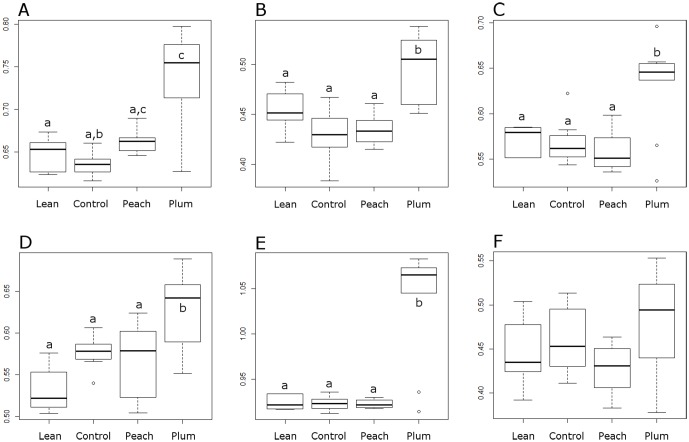
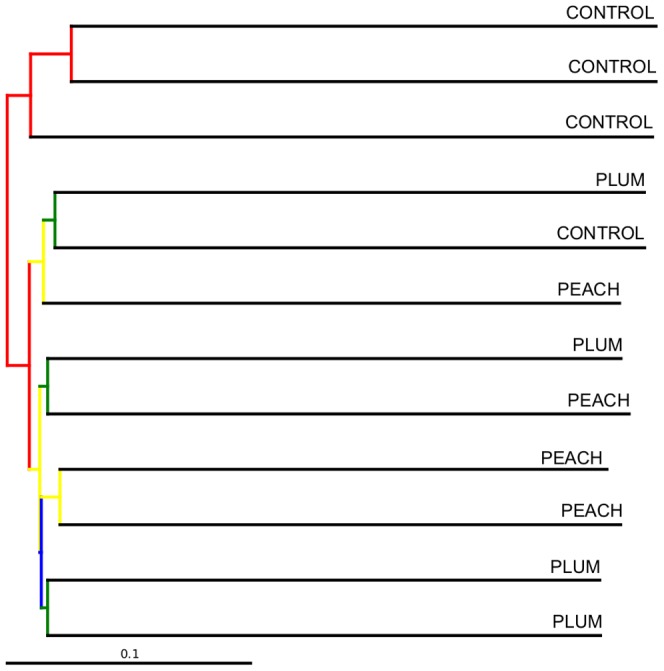
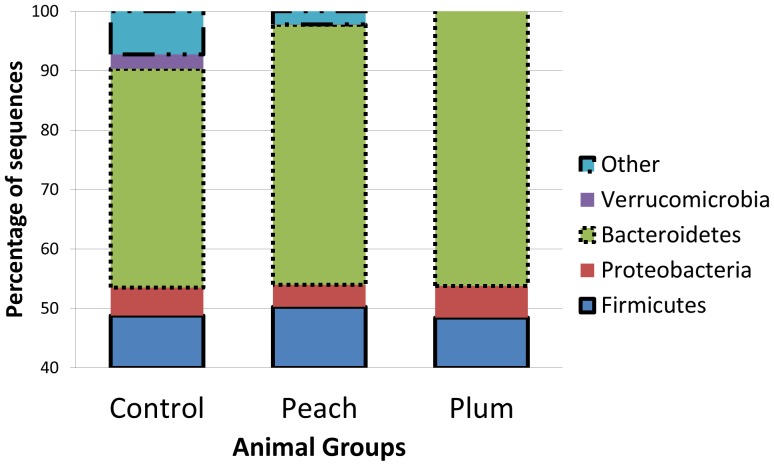
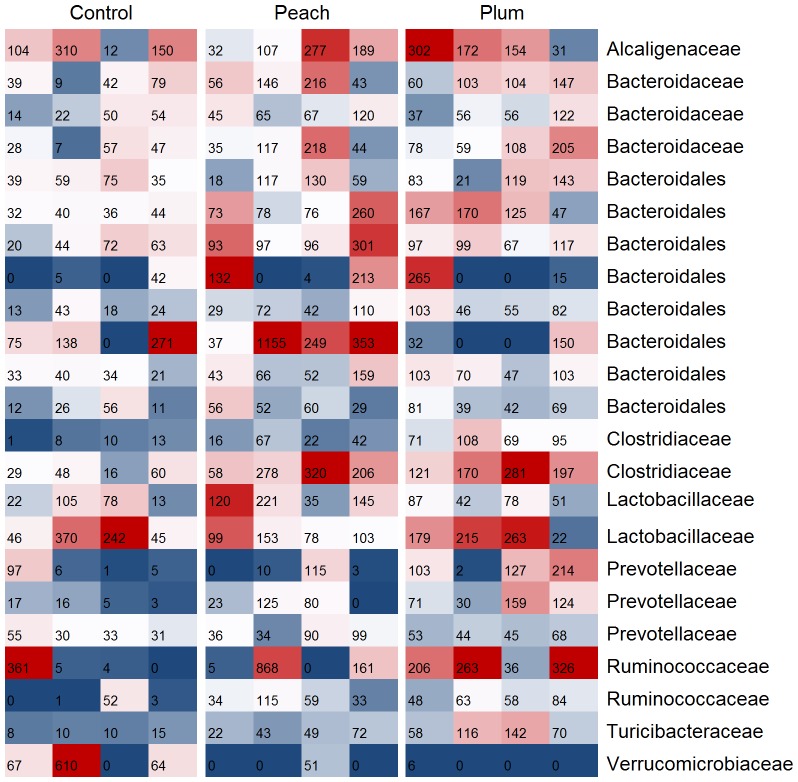
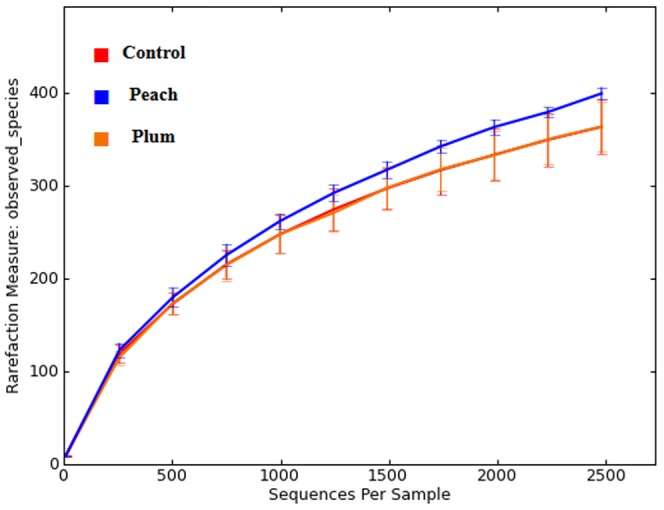
METHODOLOGY/PRINCIPAL FINDINGS: Obese Zucker rats were assigned to three groups (peach, plum, and control, n = 10 each), wild-type group was named lean (n = 10). Carbohydrates in the fruit juices were eliminated using enzymatic hydrolysis. Fecal samples were obtained after 11 weeks of fruit or control juice administration. Real-time PCR and 454-pyrosequencing were used to evaluate changes in fecal microbiota. Over 1,500 different Operational Taxonomic Units at 97% similarity were detected in all rats. Several bacterial groups (e.g. Lactobacillus and members of Ruminococcacea) were found to be more abundant in the peach but especially in the plum group (plum juice contained 3 times more total polyphenolics compared to peach juice). Principal coordinate analysis based on Unifrac-based unweighted distance matrices revealed a distinct separation between the microbiota of control and treatment groups. These changes in fecal microbiota occurred simultaneously with differences in fecal short-chain acids concentrations between the control and treatment groups as well as a significant decrease in body weight in the plum group.
This study suggests that consumption of carbohydrate-free peach and plum juice has the potential to modify fecal microbial ecology in an obese animal model. The separate contribution of polyphenols and non-polyphenols compounds (vitamins and minerals) to the observed changes is unknown.
越来越多的证据表明营养干预在治疗肥胖方面具有潜力,但大多数研究仅使用了不可消化的碳水化合物。桃子和李子含有大量多酚,这些化合物已被证明具有抗肥胖作用。使用多酚成功治疗肥胖的潜在过程可能涉及肠道微生物群的改变。然而,这种现象尚未得到充分理解。
方法/主要发现:将肥胖的 Zucker 大鼠分为三组(桃子组、李子组和对照组,每组 n = 10),野生型组称为瘦组(n = 10)。使用酶水解去除果汁中的碳水化合物。在给予果汁或对照果汁 11 周后采集粪便样本。使用实时 PCR 和 454 焦磷酸测序来评估粪便微生物群的变化。在所有大鼠中检测到超过 1500 个相似度为 97%的不同操作分类单元。发现几个细菌类群(如乳酸杆菌和瘤胃球菌科成员)在桃子组中更为丰富,但在李子组中尤其丰富(李子汁中的总多酚含量是桃子汁的 3 倍)。基于 Unifrac 非加权距离矩阵的主坐标分析显示,对照组和治疗组的微生物群之间存在明显分离。粪便微生物群的这些变化与对照组和治疗组之间粪便短链酸浓度的差异以及李子组体重的显著下降同时发生。
本研究表明,在肥胖动物模型中,饮用无碳水化合物的桃子和李子汁有可能改变粪便微生物生态。多酚和非多酚化合物(维生素和矿物质)对观察到的变化的单独贡献尚不清楚。