Park Su Ji, Weon Byung Mook, Lee Ji San, Lee Junho, Kim Jinkyung, Je Jung Ho
X-ray Imaging Center, Department of Materials Science and Engineering, Pohang University of Science and Technology, San 31, Hyoja-dong, Pohang 790-784, South Korea.
School of Advanced Materials Science and Engineering, SKKU Advanced Institute of Nanotechnology (SAINT), Sungkyunkwan University, Suwon 440-746, South Korea.
Nat Commun. 2014 Jul 10;5:4369. doi: 10.1038/ncomms5369.
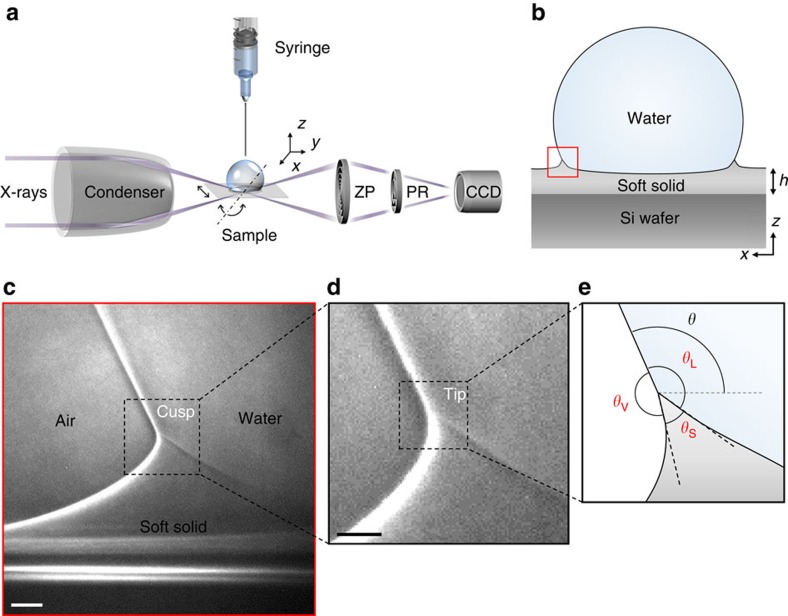
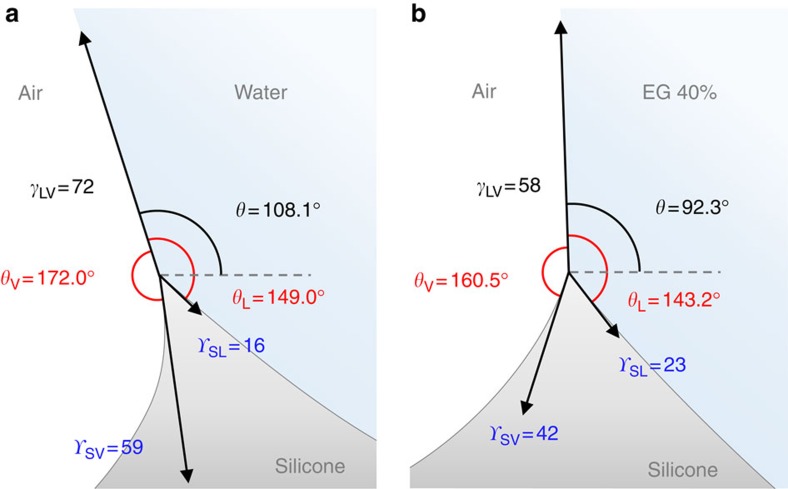
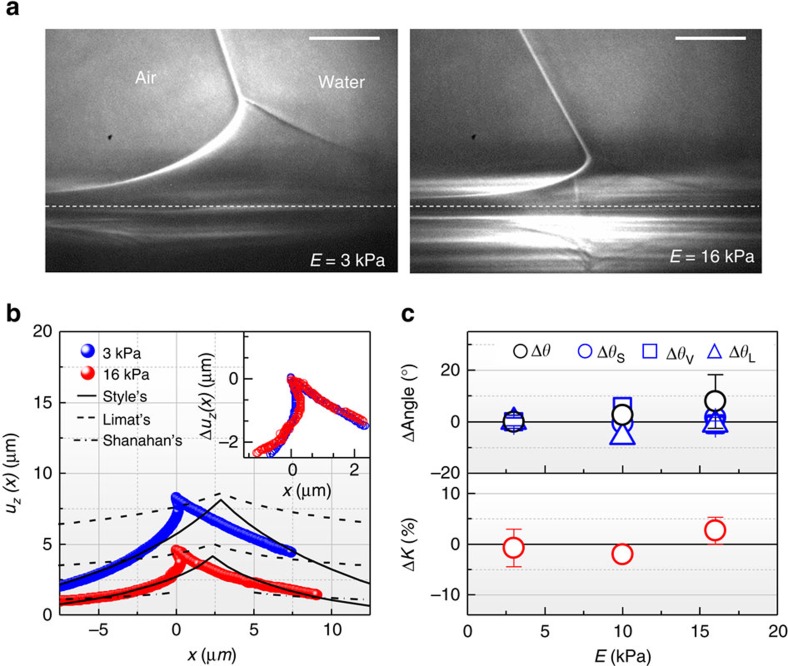
One of the most questionable issues in wetting is the force balance that includes the vertical component of liquid surface tension. On soft solids, the vertical component leads to a microscopic protrusion of the contact line, that is, a 'wetting ridge'. The wetting principle determining the tip geometry of the ridge is at the heart of the issues over the past half century. Here we reveal a universal wetting principle from the ridge tips directly visualized with high spatio-temporal resolution of X-ray microscopy. We find that the cusp of the ridge is bent with an asymmetric tip, whose geometry is invariant during ridge growth or by surface softness. This singular asymmetry is deduced by linking the macroscopic and microscopic contact angles to Young and Neuman laws, respectively. Our finding shows that this dual-scale approach would be contributable to a general framework in elastowetting, and give hints to issues in cell-substrate interaction and elasto-capillary problems.
在润湿过程中最具争议的问题之一是力平衡,其中包括液体表面张力的垂直分量。在软固体上,垂直分量会导致接触线出现微观凸起,即“润湿脊”。决定脊尖几何形状的润湿原理是过去半个世纪以来诸多问题的核心。在此,我们通过具有高时空分辨率的X射线显微镜直接观察到的脊尖揭示了一种通用的润湿原理。我们发现,脊的尖端呈不对称弯曲,其几何形状在脊生长过程中或因表面柔软度而保持不变。这种独特的不对称性是通过分别将宏观和微观接触角与杨氏定律和纽曼定律联系起来推导得出的。我们的研究结果表明,这种双尺度方法将有助于建立弹性润湿的通用框架,并为细胞 - 基质相互作用和弹性毛细管问题提供线索。