Nikolaou Panayiotis, Coffey Aaron M, Barlow Michael J, Rosen Matthew S, Goodson Boyd M, Chekmenev Eduard Y
Department of Radiology, Vanderbilt University Institute of Imaging Science, Vanderbilt University , Nashville, Tennessee 37232, United States.
Anal Chem. 2014 Aug 19;86(16):8206-12. doi: 10.1021/ac501537w. Epub 2014 Jul 10.
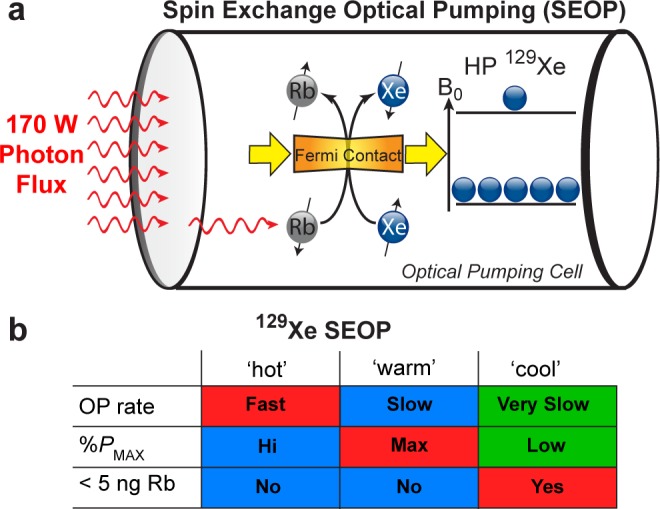
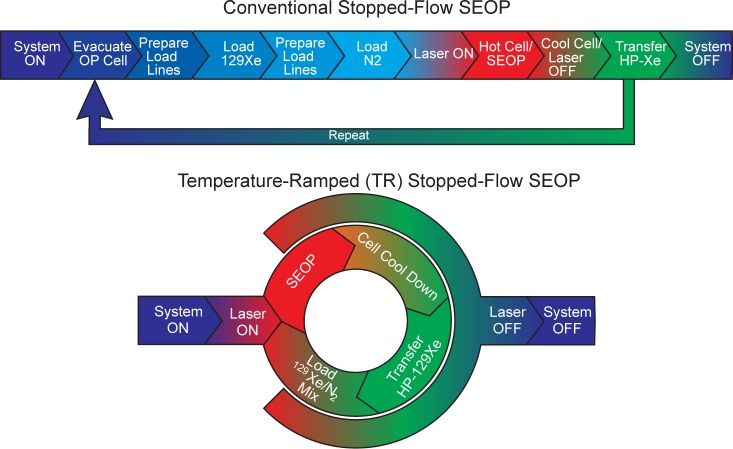
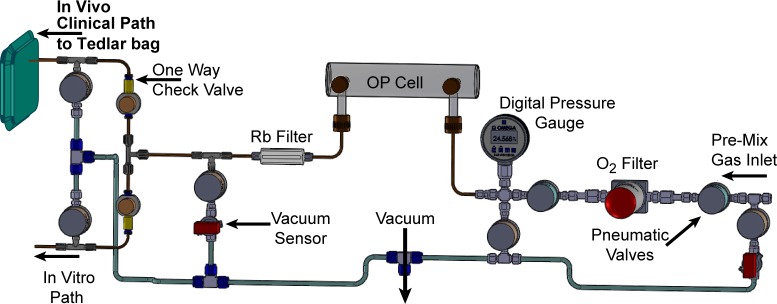
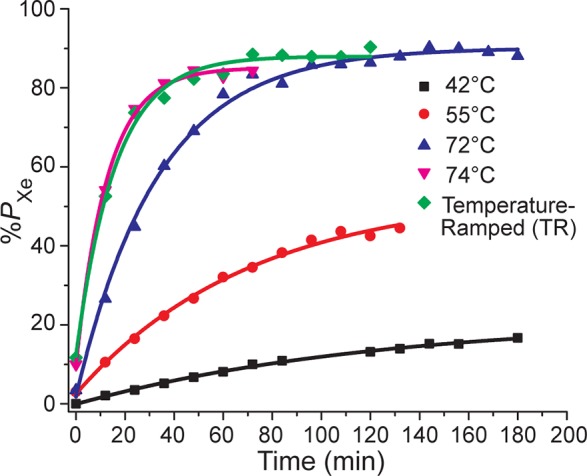
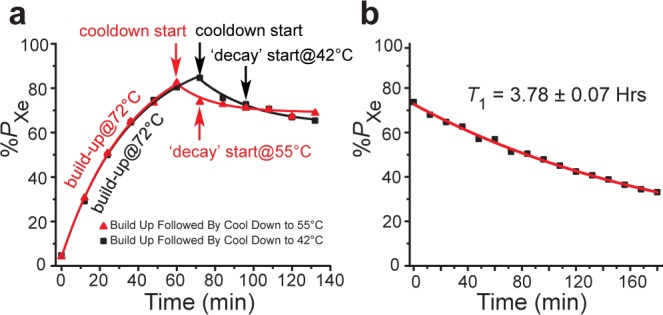
We describe temperature-ramped spin-exchange optical pumping (TR-SEOP) in an automated high-throughput batch-mode (129)Xe hyperpolarizer utilizing three key temperature regimes: (i) "hot"-where the (129)Xe hyperpolarization rate is maximal, (ii) "warm"-where the (129)Xe hyperpolarization approaches unity, and (iii) "cool"-where hyperpolarized (129)Xe gas is transferred into a Tedlar bag with low Rb content (<5 ng per ∼1 L dose) suitable for human imaging applications. Unlike with the conventional approach of batch-mode SEOP, here all three temperature regimes may be operated under continuous high-power (170 W) laser irradiation, and hyperpolarized (129)Xe gas is delivered without the need for a cryocollection step. The variable-temperature approach increased the SEOP rate by more than 2-fold compared to the constant-temperature polarization rate (e.g., giving effective values for the exponential buildup constant γSEOP of 62.5 ± 3.7 × 10(-3) min(-1) vs 29.9 ± 1.2 × 10(-3) min(-1)) while achieving nearly the same maximum %PXe value (88.0 ± 0.8% vs 90.1% ± 0.8%, for a 500 Torr (67 kPa) Xe cell loading-corresponding to nuclear magnetic resonance/magnetic resonance imaging (NMR/MRI) enhancements of ∼3.1 × 10(5) and ∼2.32 × 10(8) at the relevant fields for clinical imaging and HP (129)Xe production of 3 T and 4 mT, respectively); moreover, the intercycle "dead" time was also significantly decreased. The higher-throughput TR-SEOP approach can be implemented without sacrificing the level of (129)Xe hyperpolarization or the experimental stability for automation-making this approach beneficial for improving the overall (129)Xe production rate in clinical settings.
我们描述了一种在自动化高通量批处理模式的(129)Xe超极化器中采用的变温自旋交换光泵浦(TR-SEOP)技术,该技术利用了三个关键温度区间:(i)“热”区间——(129)Xe超极化速率最大;(ii)“温”区间——(129)Xe超极化接近1;(iii)“冷”区间——超极化的(129)Xe气体被转移到一个Rb含量低(每约1 L剂量<5 ng)的泰德拉袋中,适用于人体成像应用。与传统的批处理模式SEOP方法不同,这里所有三个温度区间都可以在连续高功率(170 W)激光照射下运行,并且超极化的(129)Xe气体无需进行低温收集步骤即可输送。与恒温极化速率相比,变温方法使SEOP速率提高了两倍多(例如,指数增长常数γSEOP的有效值分别为62.5±3.7×10⁻³ min⁻¹和29.9±1.2×10⁻³ min⁻¹),同时实现了几乎相同的最大%PXe值(对于500 Torr(67 kPa)的Xe细胞加载,分别为88.0±0.8%和90.1%±0.8%,对应于临床成像相关场强下约3.1×10⁵和3 T及4 mT的HP(129)Xe产生时约2.32×10⁸的核磁共振/磁共振成像(NMR/MRI)增强);此外,循环间的“死”时间也显著减少。更高通量的TR-SEOP方法可以在不牺牲(129)Xe超极化水平或自动化实验稳定性的情况下实施,这使得该方法有利于提高临床环境中整体(129)Xe的产生率。